Sawaya Yohei, Ishizaka Masahiro, Kubo Akira, Shiba Takahiro, Hirose Tamaki, Onoda Ko, Maruyama Hitoshi, Urano Tomohiko
Department of Physical Therapy, School of Health Sciences, International University of Health and Welfare: 2600-1 Kitakanemaru, Ohtawara-city, Tochigi 324-8501, Japan.
Division of Physical Therapy, Doctoral Program in Health Sciences, Graduate School of Health and Welfare Sciences, International University of Health and Welfare, Japan.
J Phys Ther Sci. 2020 Nov;32(11):754-759. doi: 10.1589/jpts.32.754. Epub 2020 Nov 11.
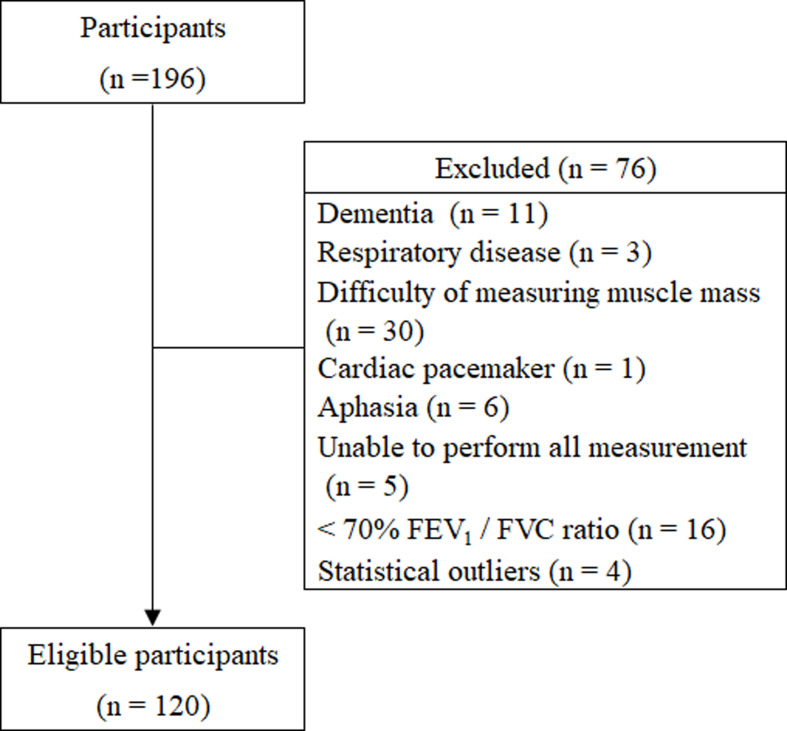
[Purpose] We focused on skeletal muscle mass index, one of the biomarkers of sarcopenia, and investigated the association between skeletal muscle mass index and the parameters of lung function and respiratory muscle strength. [Participants and Methods] After applying the exclusion criteria, we included, in this cross-sectional study, 120 community-dwelling older adults aged ≥65 years who required long-term care/support and underwent ambulatory rehabilitation under the long-term care insurance system in Japan. We measured the skeletal muscle mass index, forced vital capacity, forced expiratory volume in 1 second, peak expiratory flow rate, maximum expiratory pressure, and maximum inspiratory pressure. The data were analyzed using Pearson correlation coefficient and multiple regression analysis. [Results] The skeletal muscle mass index was positively correlated with only maximum expiratory pressure for both male and female participants by Pearson's correlation coefficient. With the skeletal muscle mass index as a dependent variable, only the maximum expiratory pressure was significant for both male and female participants by the multiple regression analysis. [Conclusion] Therefore, the findings of this study suggested that compared with lung function tests, maximum expiratory pressure, which is an indicator of respiratory muscle strength, is related to muscle mass. Maximum expiratory pressure might be the most useful indicator for sarcopenia.
[目的] 我们聚焦于肌肉减少症的生物标志物之一——骨骼肌质量指数,并研究了骨骼肌质量指数与肺功能参数及呼吸肌力量之间的关联。[参与者与方法] 在应用排除标准后,在这项横断面研究中,我们纳入了120名年龄≥65岁、需要长期护理/支持且在日本长期护理保险制度下接受门诊康复治疗的社区居住老年人。我们测量了骨骼肌质量指数、用力肺活量、1秒用力呼气量、呼气峰值流速、最大呼气压力和最大吸气压力。使用Pearson相关系数和多元回归分析对数据进行分析。[结果] 通过Pearson相关系数,骨骼肌质量指数仅与男性和女性参与者的最大呼气压力呈正相关。以骨骼肌质量指数为因变量,通过多元回归分析,仅最大呼气压力对男性和女性参与者均具有显著性。[结论] 因此,本研究结果表明,与肺功能测试相比,作为呼吸肌力量指标的最大呼气压力与肌肉量相关。最大呼气压力可能是肌肉减少症最有用的指标。