Wu Xiangqi, You Wei, Wu Zhiming, Ye Fei, Chen Shaoliang
Division of Cardiology, Nanjing First Hospital, Nanjing Medical University, Nanjing, China.
Pulm Circ. 2020 Nov 25;10(4):2045894020969079. doi: 10.1177/2045894020969079. eCollection 2020 Oct-Dec.
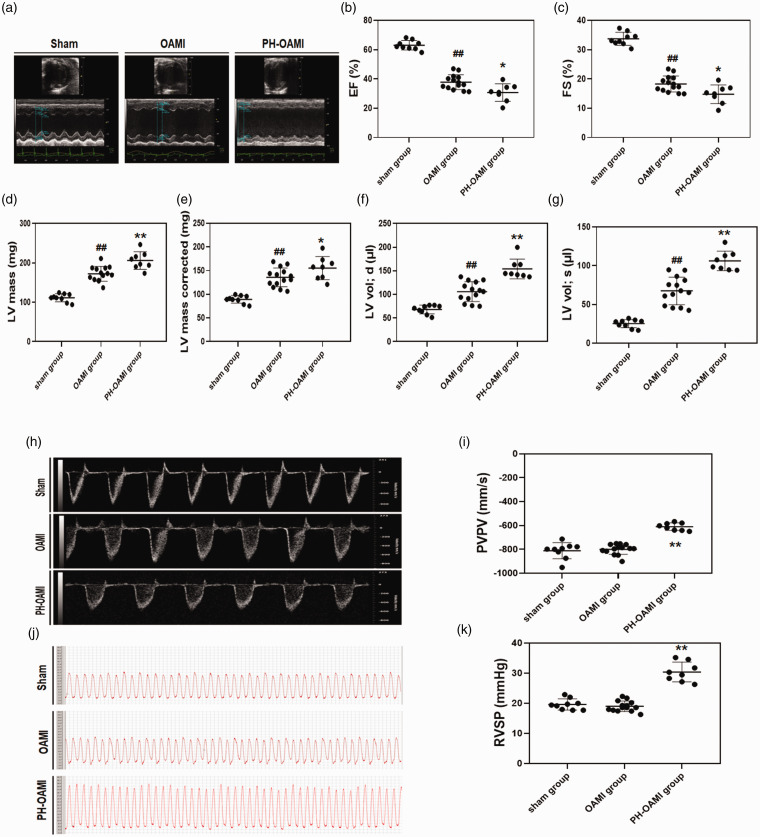
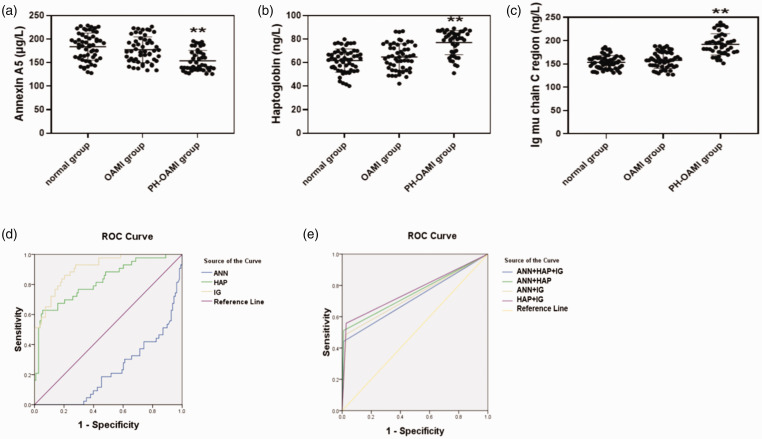
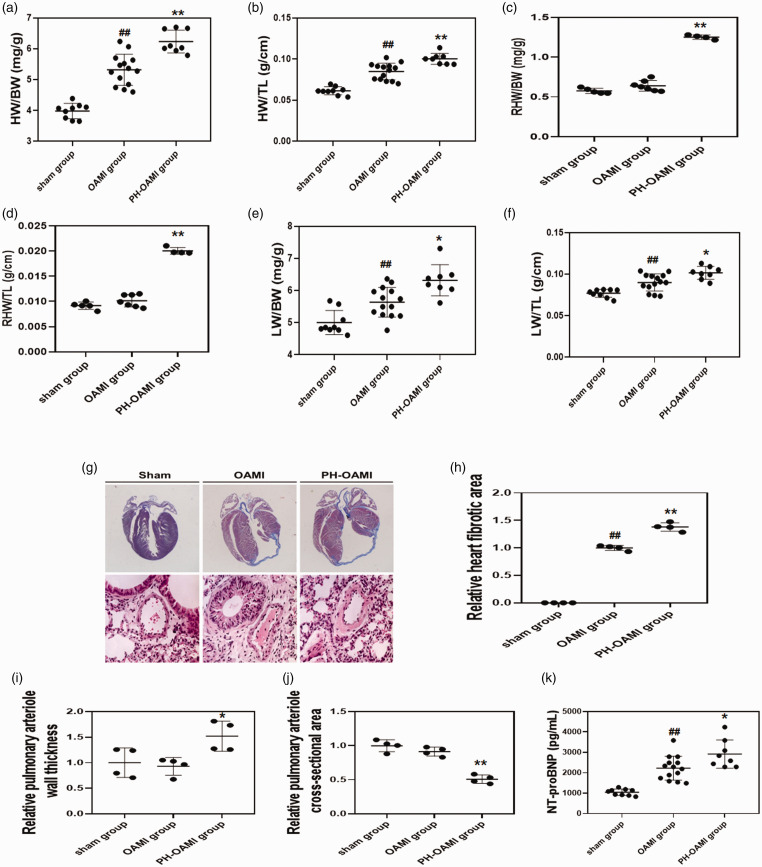
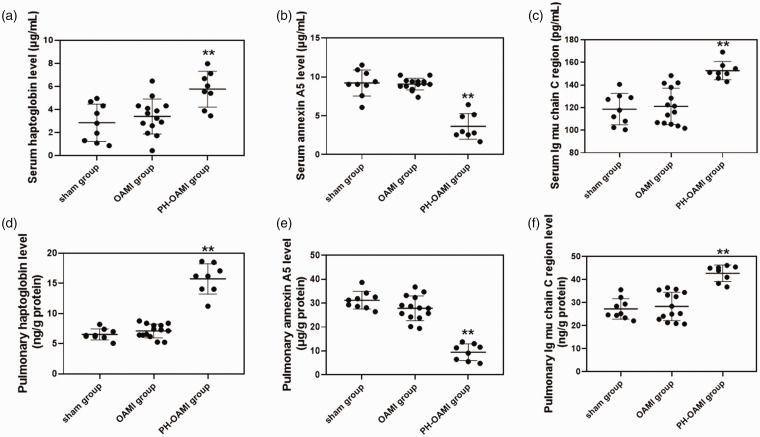
Pulmonary hypertension (PH) related to old anterior myocardial infarction (OAMI) always accompanies a bad prognosis, and thus, we aimed to screen serum biomarkers related to PH in OAMI patients. According to right ventricular systolic pressure, we divided mice into sham, OAMI, and PH-OAMI groups and evaluated body, heart and lung weight, heart function, pulmonary blood flow velocity, cardiac fibrotic area, and pulmonary arteriole condition. Lung and serum were under the proteomic analysis. Levels of three identified proteins were measured. Compared with sham and OAMI mice, PH-OAMI mice showed heart dysfunction, low pulmonary blood flow, high right ventricular systolic pressure, heavy heart and lung weight, large cardiac fibrotic area, and pathological pulmonary arteriole remodeling (<0.05 or <0.01). Haptoglobin, annexin A5, and Ig mu chain C region of lung and serum were changed significantly in PH-OAMI mice (<0.01). Then, we collected serum and clinical data, measured three serum protein levels, and performed multivariate regression and receiver operating characteristic curve in patients (normal, OAMI, and PH-OAMI groups). Compared with normal and OAMI patients, serum levels of three proteins in PH-OAMI patients were also altered notably (<0.01). These three proteins can predict PH in OAMI patients (<0.01). Receiver operating characteristic curve analysis revealed haptoglobin (cut-off value: 78.295, sensitivity: 62.8%, specificity: 94.4%), annexin A5 (cut-off value: 151.925, sensitivity: 41.9%, specificity: 82.4%), and Ig mu chain C region (cut-off value: 168.885, sensitivity: 86.0%, specificity: 79.6%) (<0.01). Three circulating serum proteins can be useful for the categorization of OAMI patients with and without PH.
与陈旧性前壁心肌梗死(OAMI)相关的肺动脉高压(PH)往往预后不良,因此,我们旨在筛选OAMI患者中与PH相关的血清生物标志物。根据右心室收缩压,我们将小鼠分为假手术组、OAMI组和PH - OAMI组,并评估体重、心脏和肺重量、心功能、肺血流速度、心脏纤维化面积和肺小动脉状况。对肺和血清进行蛋白质组学分析。测定三种已鉴定蛋白质的水平。与假手术组和OAMI组小鼠相比,PH - OAMI组小鼠表现出心脏功能障碍、肺血流低、右心室收缩压高、心脏和肺重量增加、心脏纤维化面积大以及病理性肺小动脉重塑(<0.05或<0.01)。PH - OAMI组小鼠肺和血清中的触珠蛋白、膜联蛋白A5和Igμ链C区发生了显著变化(<0.01)。然后,我们收集了患者(正常组、OAMI组和PH - OAMI组)的血清和临床数据,测定了三种血清蛋白水平,并进行了多变量回归分析和受试者工作特征曲线分析。与正常患者和OAMI患者相比,PH - OAMI患者血清中三种蛋白质的水平也有显著改变(<0.01)。这三种蛋白质可以预测OAMI患者是否患有PH(<0.01)。受试者工作特征曲线分析显示,触珠蛋白(临界值:78.295,敏感性:62.8%,特异性:94.4%)、膜联蛋白A5(临界值:151.925,敏感性:41.9%,特异性:82.4%)和Igμ链C区(临界值:168.885,敏感性:86.0%,特异性:79.6%)(<0.01)。三种循环血清蛋白可用于区分有和没有PH的OAMI患者。