Curtin Lee, Whitmire Paula, Rickertsen Cassandra R, Mazza Gina L, Canoll Peter, Johnston Sandra K, Mrugala Maciej M, Swanson Kristin R, Hu Leland S
Mathematical NeuroOncology Lab, Precision Neurotherapeutics Innovation Program, Department of Neurologic Surgery, Mayo Clinic, Arizona, AZ, United States.
Department of Health Sciences Research, Mayo Clinic, Arizona, AZ, United States.
Front Oncol. 2020 Nov 16;10:580750. doi: 10.3389/fonc.2020.580750. eCollection 2020.
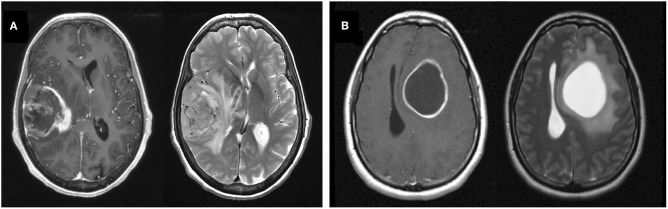
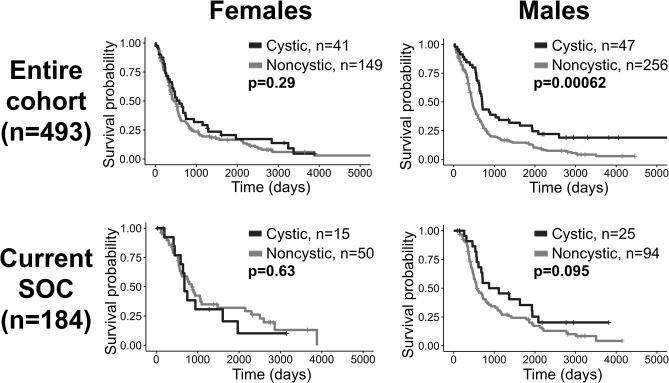
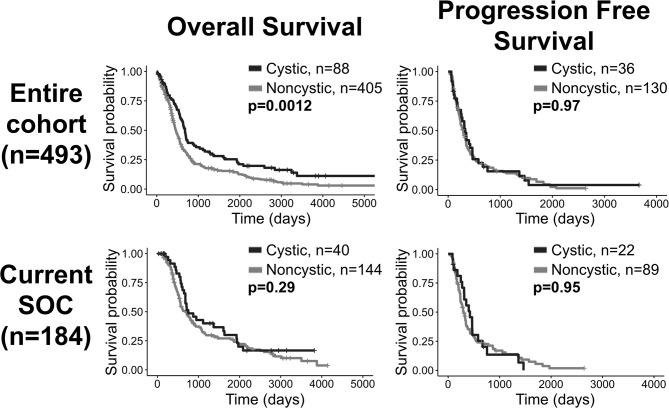
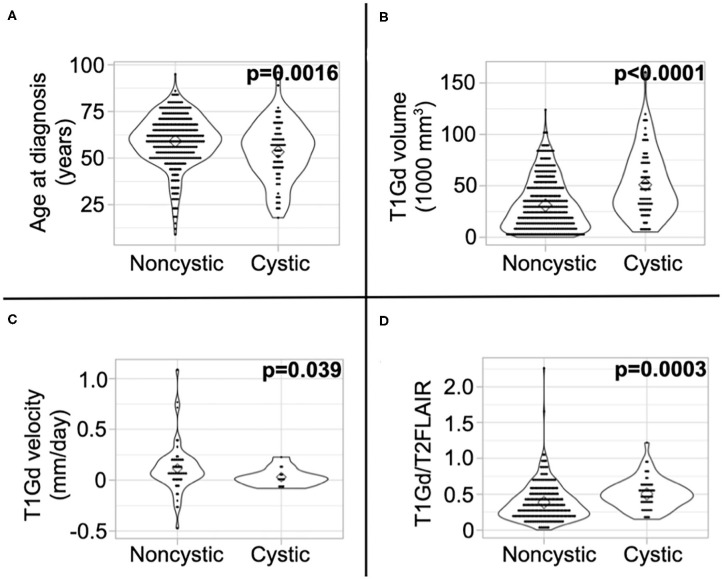
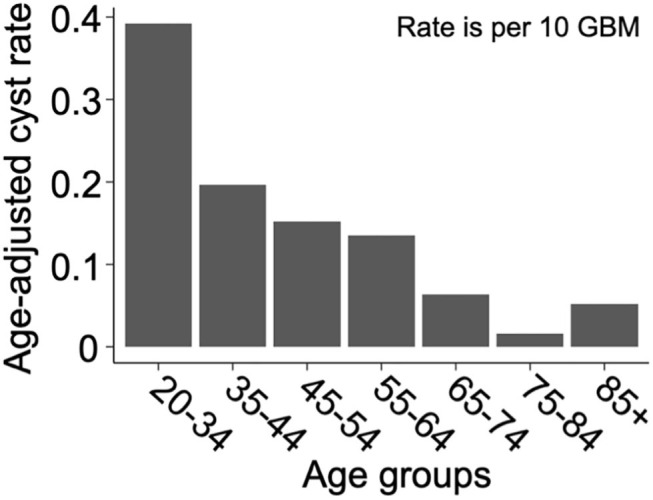
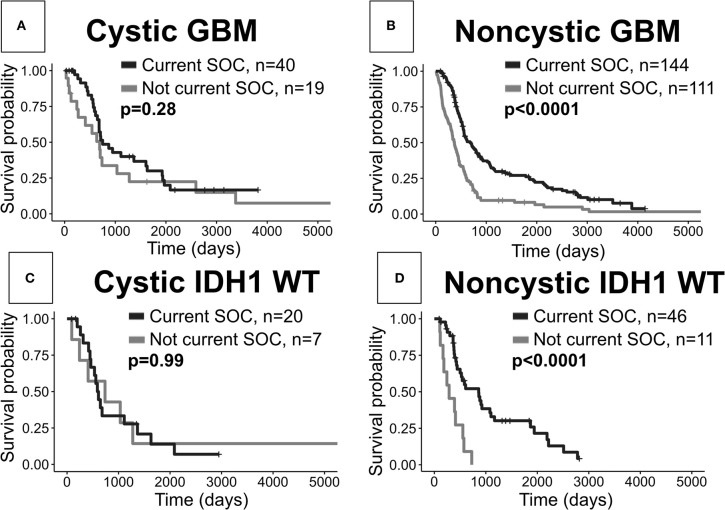
Glioblastoma (GBM) is the most aggressive primary brain tumor and can have cystic components, identifiable through magnetic resonance imaging (MRI). Previous studies suggest that cysts occur in 7-23% of GBMs and report mixed results regarding their prognostic impact. Using our retrospective cohort of 493 patients with first-diagnosis GBM, we carried out an exploratory analysis on this potential link between cystic GBM and survival. Using pretreatment MRIs, we manually identified 88 patients with GBM that had a significant cystic component at presentation and 405 patients that did not. Patients with cystic GBM had significantly longer overall survival and were significantly younger at presentation. Within patients who received the current standard of care (SOC) ( = 184, 40 cystic), we did not observe a survival benefit of cystic GBM. Unexpectedly, we did not observe a significant survival benefit between this SOC cystic cohort and patients with cystic GBM diagnosed before the standard was established ( = 40 with SOC, = 19 without SOC); this significant SOC benefit was clearly observed in patients with noncystic GBM ( = 144 with SOC, = 111 without SOC). When stratified by sex, the survival benefit of cystic GBM was only preserved in male patients ( = 303, 47 cystic). We report differences in the absolute and relative sizes of imaging abnormalities on MRI and the prognostic implication of cysts based on sex. We discuss hypotheses for these differences, including the possibility that the presence of a cyst could indicate a less aggressive tumor.
胶质母细胞瘤(GBM)是最具侵袭性的原发性脑肿瘤,可能含有囊性成分,可通过磁共振成像(MRI)识别。先前的研究表明,7%-23%的GBM存在囊肿,并且关于其预后影响的报告结果不一。我们对493例初诊GBM患者的回顾性队列进行了研究,对囊性GBM与生存之间的这种潜在联系进行了探索性分析。利用治疗前的MRI,我们手动识别出88例初诊时具有显著囊性成分的GBM患者和405例无显著囊性成分的患者。囊性GBM患者的总生存期明显更长,且初诊时明显更年轻。在接受当前标准治疗(SOC)的患者中(n = 184,40例囊性),我们未观察到囊性GBM的生存获益。出乎意料的是,我们未观察到该SOC囊性队列与在该标准确立之前诊断的囊性GBM患者之间有显著的生存获益(40例接受SOC,19例未接受SOC);在非囊性GBM患者中(144例接受SOC,111例未接受SOC)明显观察到了这种显著的SOC获益。按性别分层时,囊性GBM的生存获益仅在男性患者中存在(n = 303,47例囊性)。我们报告了MRI上成像异常的绝对和相对大小差异以及基于性别的囊肿的预后意义。我们讨论了这些差异的假设,包括囊肿的存在可能表明肿瘤侵袭性较小的可能性。