Holland Ian, Davies Jamie A
Deanery of Biomedical Science and Synthsys Centre for Synthetic and Systems Biology, University of Edinburgh, Edinburgh, United Kingdom.
Front Bioeng Biotechnol. 2020 Nov 13;8:571777. doi: 10.3389/fbioe.2020.571777. eCollection 2020.
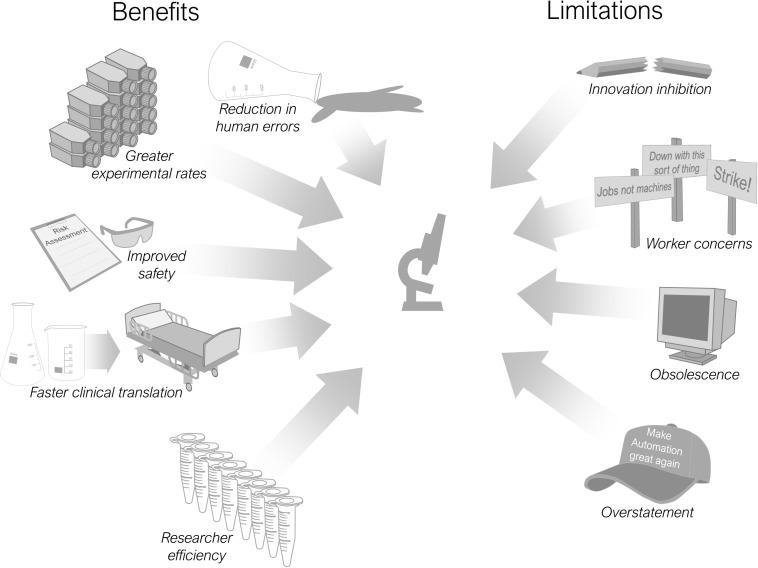
Protocols in the academic life science laboratory are heavily reliant on the manual manipulation of tools, reagents and instruments by a host of research staff and students. In contrast to industrial and clinical laboratory environments, the usage of automation to augment or replace manual tasks is limited. Causes of this 'automation gap' are unique to academic research, with rigid short-term funding structures, high levels of protocol variability and a benevolent culture of investment in people over equipment. Automation, however, can bestow multiple benefits through improvements in reproducibility, researcher efficiency, clinical translation, and safety. Less immediately obvious are the accompanying limitations, including obsolescence and an inhibitory effect on the freedom to innovate. Growing the range of automation options suitable for research laboratories will require more flexible, modular and cheaper designs. Academic and commercial developers of automation will increasingly need to design with an environmental awareness and an understanding that large high-tech robotic solutions may not be appropriate for laboratories with constrained financial and spatial resources. To fully exploit the potential of laboratory automation, future generations of scientists will require both engineering and biology skills. Automation in the research laboratory is likely to be an increasingly critical component of future research programs and will continue the trend of combining engineering and science expertise together to answer novel research questions.
学术生命科学实验室的实验方案严重依赖众多研究人员和学生对工具、试剂及仪器的手工操作。与工业和临床实验室环境不同,利用自动化来增强或取代手工任务的情况较为有限。这种“自动化差距”的成因在学术研究中独具特色,包括僵化的短期资金结构、实验方案的高度变异性以及重视人力投资而非设备投资的氛围。然而,自动化可通过提高可重复性、研究人员效率、临床转化能力及安全性带来诸多益处。不太明显的是随之而来的局限性,包括过时以及对创新自由的抑制作用。扩大适用于研究实验室的自动化选项范围将需要更灵活、模块化且成本更低的设计。自动化的学术和商业开发者将越来越需要在设计时具备环境意识,并认识到大型高科技机器人解决方案可能不适用于资金和空间资源有限的实验室。为了充分挖掘实验室自动化的潜力,未来的科学家将需要具备工程和生物学技能。研究实验室中的自动化可能会成为未来研究项目中越来越关键的组成部分,并将延续将工程和科学专业知识结合起来以解答新研究问题的趋势。