Fang Qing, Zhu Guoying, Huang Jianwei, Pan Shayi, Fang Minyan, Li Qiuting, Yin Qin, Liu Xiaoqing, Tang Qingya, Huang Dongping, Liu Jingmin
Department of Clinical Nutrition, People's Hospital of Shanghai Putuo District, Shanghai, China.
Department of Nursing, People's Hospital of Shanghai Putuo District, Shanghai, China.
Front Med (Lausanne). 2020 Nov 12;7:552415. doi: 10.3389/fmed.2020.552415. eCollection 2020.
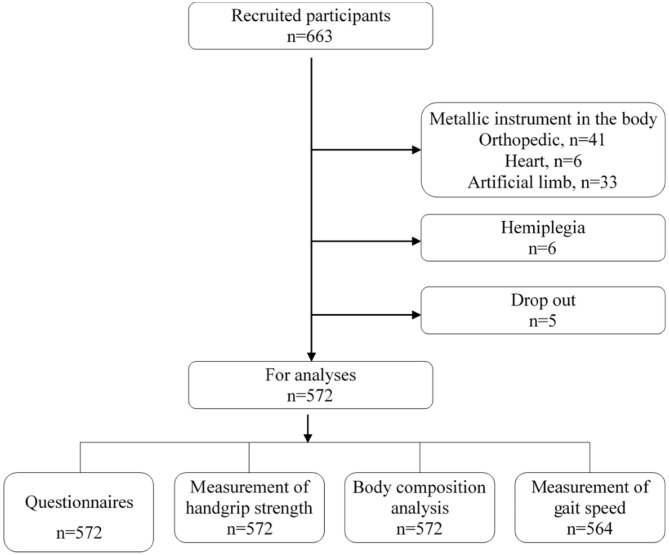
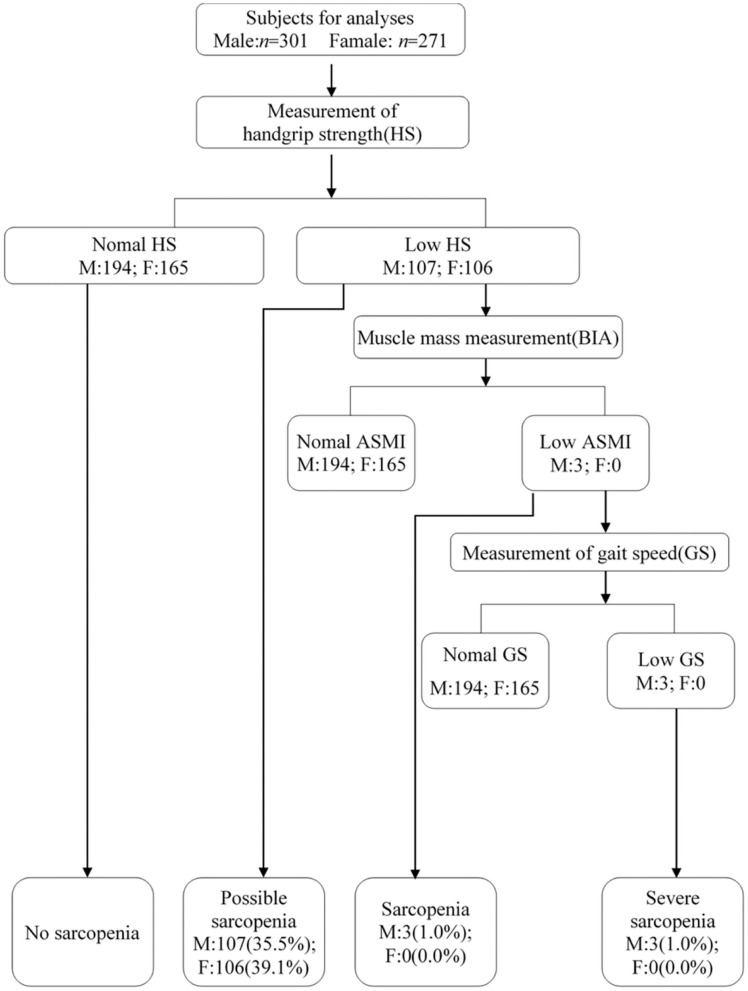
Our study aimed to investigate the prevalence and associated factors of sarcopenia in the disabled elderly in communities in Shanghai, China. A cross-sectional study was conducted in 2018. Five hundred and seventy two participants (≥60 years) were recruited through cluster sampling from Putuo District of Shanghai. Sarcopenia was defined according to the updated consensus of the European Sarcoma Working Group in 2019. The sarcopenia, depression, and nutrition status were assessed by using SARC-F, the Short Version of the Center for Epidemiological Studies Depression Scale (CES-D-10), and the Mini Nutritional Assessment-Short form (MNA-SF), respectively Physical activity was also assessed. Our results showed the prevalence of sarcopenia was 0.5%, but the prevalence of low handgrip strength was 37.2% (male, 5.5%; female, 39.1%). The modified Poisson regression model was used to evaluate the relationship among related variables and low handgrip strength. The risk for low handgrip strength was higher in the physically disabled subjects than in the visually disabled ones (aPR: 1.69, 95% CI: 1.88-2.42). Depressive symptoms (aPR: 1.31, 95% CI: 1.04-1.62) and PASE score (aPR: 0.99, 95% CI: 0.99-1.00) were independently associated with low handgrip strength. In summary, the prevalence of EWGSOP2-defined sarcopenia is low and the prevalence of declined muscle strength is high in the disabled elderly. The elderly participants with a physical disability had a higher prevalence of low hand handgrip strength than those with a visual disability. More studies with a larger sample size and longitudinal follow-up are needed to confirm our findings.
我们的研究旨在调查中国上海社区残疾老年人肌肉减少症的患病率及相关因素。2018年进行了一项横断面研究。通过整群抽样从上海普陀区招募了572名参与者(≥60岁)。根据2019年欧洲肌肉减少症工作组的最新共识定义肌肉减少症。分别使用SARC-F、流行病学研究中心抑郁量表简版(CES-D-10)和微型营养评定简表(MNA-SF)评估肌肉减少症、抑郁和营养状况。还评估了身体活动情况。我们的结果显示,肌肉减少症的患病率为0.5%,但握力低的患病率为37.2%(男性为5.5%;女性为39.1%)。采用修正的泊松回归模型评估相关变量与握力低之间的关系。身体残疾的受试者握力低的风险高于视力残疾的受试者(aPR:1.69,95%CI:1.88-2.42)。抑郁症状(aPR:1.31,95%CI:1.04-1.62)和PASE评分(aPR:0.99,95%CI:0.99-1.00)与握力低独立相关。总之,EWGSOP2定义的肌肉减少症在残疾老年人中的患病率较低,而肌肉力量下降的患病率较高。身体残疾的老年参与者握力低的患病率高于视力残疾的参与者。需要更多样本量更大且进行纵向随访的研究来证实我们的发现。