Håheim Brage, Kondratiev Timofei, Dietrichs Erik Sveberg, Tveita Torkjel
Anesthesia and Critical Care Research Group, Department of Clinical Medicine, UiT, The Arctic University of Norway, Tromsø, Norway.
Experimental and Clinical Pharmacology Research Group, Department of Medical Biology, UiT, The Arctic University of Norway, Tromsø, Norway.
Front Med (Lausanne). 2020 Nov 12;7:566388. doi: 10.3389/fmed.2020.566388. eCollection 2020.
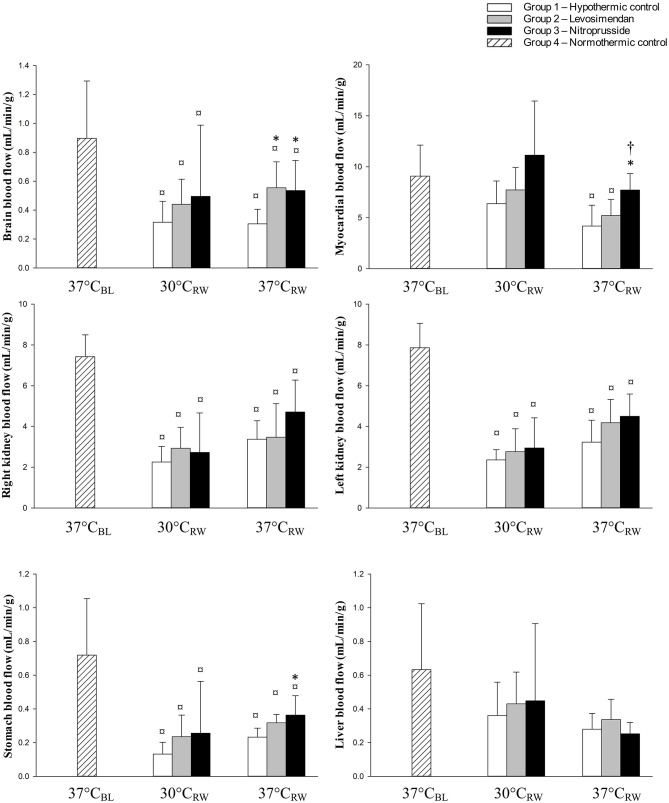
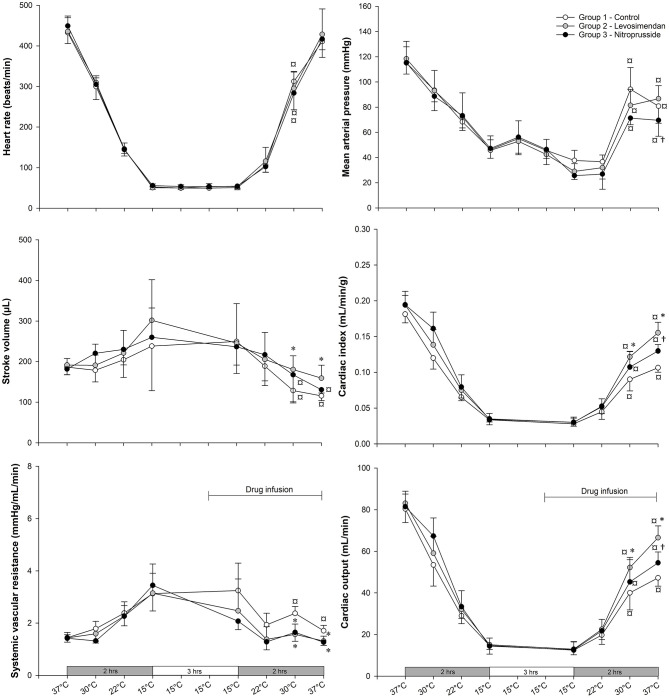
Rewarming from hypothermia is often challenged by coexisting cardiac dysfunction, depressed organ blood flow (OBF), and increased systemic vascular resistance. Previous research shows cardiovascular inotropic support and vasodilation during rewarming to elevate cardiac output (CO). The present study aims to compare the effects of inodilatation by levosimendan (LS) and vasodilation by nitroprusside (SNP) on OBF and global oxygen transport during rewarming from hypothermia. We used an experimental rat model of 4 h 15°C hypothermia and rewarming. A stable isotope-labeled microsphere technique was used to determine OBF. Cardiac and arterial pressures were monitored with fluid-filled pressure catheters, and CO was measured by thermodilution. Two groups were treated with either LS ( = 7) or SNP ( = 7) during the last hour of hypothermia and throughout rewarming. Two groups served as hypothermic ( = 7) and normothermic ( = 6) controls. All hypothermia groups had significantly reduced CO, oxygen delivery, and OBF after rewarming compared to their baseline values. After rewarming, LS had elevated CO significantly more than SNP (66.57 ± 5.6/+30% vs. 54.48 ± 5.2/+14%) compared to the control group (47.22 ± 3.9), but their ability to cause elevation of brain blood flow (BBF) was the same (0.554 ± 0.180/+81 vs. 0.535 ± 0.208/+75%) compared to the control group (0.305 ± 0.101). We interpret the vasodilator properties of LS and SNP to be the primary source to increase organ blood flow, superior to the increase in CO.
低温复温常因并存的心功能不全、器官血流量(OBF)降低和全身血管阻力增加而面临挑战。先前的研究表明,复温期间心血管正性肌力支持和血管舒张可提高心输出量(CO)。本研究旨在比较左西孟旦(LS)进行的血管扩张剂正性肌力作用与硝普钠(SNP)进行的血管舒张对低温复温期间OBF和整体氧输送的影响。我们使用了一个4小时15°C低温及复温的实验大鼠模型。采用稳定同位素标记微球技术测定OBF。用充满液体的压力导管监测心脏和动脉压力,通过热稀释法测量CO。在低温的最后一小时及整个复温过程中,两组分别接受LS(n = 7)或SNP(n = 7)治疗。两组作为低温(n = 7)和正常体温(n = 6)对照组。与基线值相比,所有低温组复温后CO、氧输送和OBF均显著降低。复温后,与对照组(47.22 ± 3.9)相比,LS使CO升高的幅度显著大于SNP(66.57 ± 5.6/+30% 对 54.48 ± 5.2/+14%),但与对照组(0.305 ± 0.101)相比,它们增加脑血流量(BBF)的能力相同(0.554 ± 0.180/+81 对 0.535 ± 0.208/+75%)。我们认为,LS和SNP的血管舒张特性是增加器官血流量的主要来源,优于CO的增加。