
在猪意外深度低温心脏骤停模型中,降温及体外生命支持复温阶段的心肺反应。
Cardiopulmonary responses during the cooling and the extracorporeal life support rewarming phases in a porcine model of accidental deep hypothermic cardiac arrest.
作者信息
Debaty Guillaume, Maignan Maxime, Perrin Bertrand, Brouta Angélique, Guergour Dorra, Trocme Candice, Bach Vincent, Tanguy Stéphane, Briot Raphaël
机构信息
Department of Emergency Medicine, SAMU 38, University Hospital of Grenoble, Grenoble, France.
University Grenoble Alps/CNRS/TIMC-IMAG UMR 5525/Team PRETA, Grenoble, F-38041, France.
出版信息
Scand J Trauma Resusc Emerg Med. 2016 Jul 8;24:91. doi: 10.1186/s13049-016-0283-7.
BACKGROUND
This study aimed to assess cardiac and pulmonary pathophysiological responses during cooling and extracorporeal life support (ECLS) rewarming in a porcine model of deep hypothermic cardiac arrest (DHCA). In addition, we evaluated whether providing a lower flow rate of ECLS during the rewarming phase might attenuate cardiopulmonary injuries.
METHODS
Twenty pigs were cannulated for ECLS, cooled until DHCA occurred and subjected to 30 min of cardiac arrest. In order to assess the physiological impact of ECLS on cardiac output we measured flow in the pulmonary artery using Doppler echocardiography as well as a modified thermodilution technique using the Swan-Ganz catheter (injection site in the right ventricle). The animals were randomized into two groups during rewarming: a group with a low blood flow rate of 1.5 L/min (LF group) and a group with a normal flow rate of 3.0 L/min (NF group). The ECLS temperature was adjusted to 5 °C above the central core. Cardiac output, hemodynamics and pulmonary function parameters were evaluated.
RESULTS
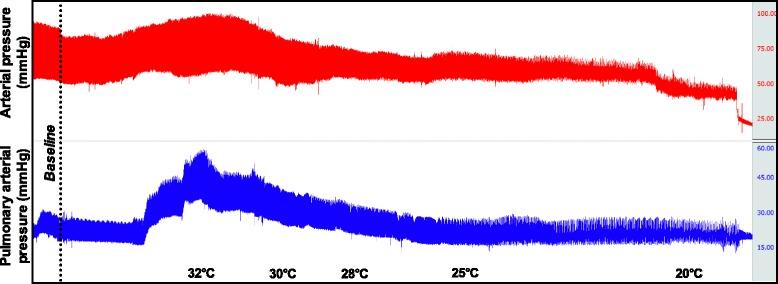
During the cooling phase, cardiac output, heart rhythm and blood pressure decreased continuously. Pulmonary artery pressure tended to increase at 32 °C compared to the initial value (20.2 ± 1.7 mmHg vs. 29.1 ± 5.6 mmHg, p = 0.09). During rewarming, arterial blood pressure was higher in the NF than in the LF group at 20° and 25 °C (p = 0.003 and 0.05, respectively). After rewarming to 35 °C, cardiac output was 3.9 ± 0.5 L/min in the NF group vs. 2.7 ± 0.5 L/min in LF group (p = 0.06). At the end of rewarming under ECLS cardiac output was inversely proportional to the ECLS flow rate. Moreover, the ECLS flow rate did not significantly change pulmonary vascular resistance.
DISCUSSION
Using a newly developed experimental model of DHCA treated by ECLS, we assessed the cardiac and pulmonary pathophysiological response during the cooling phase and the ECLS rewarming phase. Despite lower metabolic need during hypothermia, a low ECLS blood flow rate during rewarming did not improved cardiopulmonary injuries after rewarming.
CONCLUSION
A low ECLS flow rate during the rewarming phase did not attenuate pulmonary lesions, increased blood lactate level and tended to decrease cardiac output after rewarming. A normal ECLS flow rate did not increase pulmonary vascular resistance compared to a low flow rate. This experimental model on pigs contributes a number of pathophysiological findings relevant to the rewarming strategy for patients who have undergone accidental DHCA.
背景
本研究旨在评估在深度低温心脏骤停(DHCA)猪模型中,降温及体外生命支持(ECLS)复温过程中心脏和肺部的病理生理反应。此外,我们还评估了在复温阶段提供较低的ECLS流速是否可能减轻心肺损伤。
方法
20头猪接受ECLS插管,冷却至发生DHCA,并经历30分钟心脏骤停。为了评估ECLS对心输出量的生理影响,我们使用多普勒超声心动图测量肺动脉血流,并使用Swan-Ganz导管(右心室注射部位)采用改良热稀释技术进行测量。在复温过程中,动物被随机分为两组:低血流速率1.5L/分钟的组(LF组)和正常血流速率3.0L/分钟的组(NF组)。将ECLS温度调整至比中心体温高5°C。评估心输出量、血流动力学和肺功能参数。
结果
在降温阶段,心输出量、心律和血压持续下降。与初始值相比,肺动脉压在32°C时趋于升高(20.2±1.7mmHg对29.1±5.6mmHg,p = 0.09)。在复温过程中,在20°C和25°C时,NF组的动脉血压高于LF组(分别为p = 0.003和0.05)。复温至35°C后,NF组的心输出量为3.9±0.5L/分钟,而LF组为2.7±0.5L/分钟(p = 0.06)。在ECLS复温结束时,心输出量与ECLS流速成反比。此外,ECLS流速并未显著改变肺血管阻力。
讨论
使用新开发的经ECLS治疗的DHCA实验模型,我们评估了降温阶段和ECLS复温阶段心脏和肺部的病理生理反应。尽管低温期间代谢需求较低,但复温期间低ECLS血流速率并未改善复温后的心肺损伤。
结论
复温阶段低ECLS流速并未减轻肺部病变,未增加血乳酸水平,且复温后心输出量有下降趋势。与低流速相比,正常ECLS流速并未增加肺血管阻力。该猪实验模型为与意外DHCA患者复温策略相关的一些病理生理研究结果提供了依据。


 Zotero 插件