Papathanasiou Jannis Vasileios
Department of Medical Imaging, Allergology and Physiotherapy, Faculty of Dental Medicine, Medical University of Plovdiv, Bulgaria.
Department Kinesitherapy of Faculty of Public Health, Medical University of Sofia, Bulgaria.
J Frailty Sarcopenia Falls. 2020 Dec 1;5(4):102-108. doi: 10.22540/JFSF-05-102. eCollection 2020 Dec.
Frail subjects with chronic heart failure (CHF) often demonstrate limited tolerance of exertion, shortness of breath, and reduced walking capacity resulting poor quality of life (QoL). The aim of this study was to quantify the improvements in functional exercise capacity (FEC) and QoL among Bulgarian frail subjects with CHF performed group-based high-intensity aerobic interval training (HIAIT)/m-Ullevaal intervention and to compare it with moderate intensity continuous training (MICT) protocol.
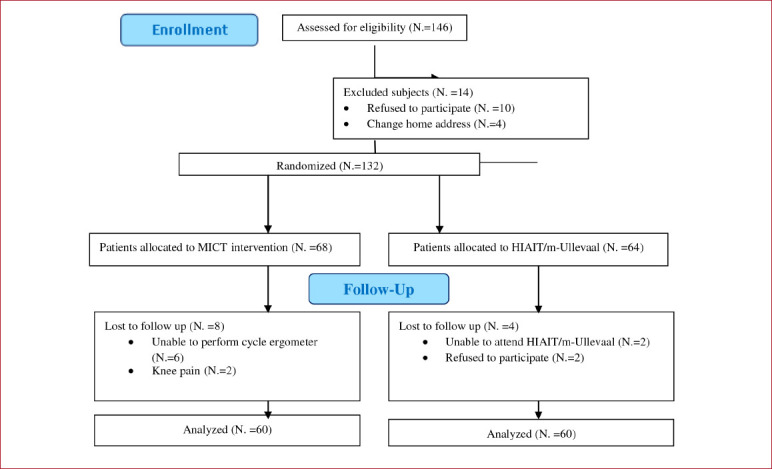
One hundred and twenty (n=120) frail subjects with mean age of 63.73±6.68 years, in CHF and NYHA class II-IIIB, were enrolled in the single-center, prospective, two-arm randomized controlled clinical trial conducted at the Medical Center for Rehabilitation and Sports Medicine-I-Plovdiv. The baseline assessment included 6-minute walk test (6ΜWT), peak oxygen uptake (VO), modified Borg Perceived Exertion Scale (mBPES), and Minnesota living with the Heart Failure Questionnaire (MLHFQ).
The improvement in 6MWT (P<0.001), VO (P<0.001), mBPES (P<0.001), and MLHFQ (P<0.001) observed among frail subjects performed HIAIT/m-Ullevaal intervention was significantly greater compared to the improvement observed in the subjects performed MICT protocol (P<0.001).
The group-based HIAIT/m-Ullevaal intervention is a new perspective and challenge for both, Bulgarian cardiac rehabilitation (CR), and frail patients with CHF.
患有慢性心力衰竭(CHF)的虚弱患者通常表现出运动耐力有限、呼吸急促以及步行能力下降,从而导致生活质量(QoL)较差。本研究的目的是量化保加利亚患有CHF的虚弱患者在进行基于小组的高强度有氧间歇训练(HIAIT)/米-于勒瓦尔干预后功能运动能力(FEC)和QoL的改善情况,并将其与中等强度持续训练(MICT)方案进行比较。
120名平均年龄为63.73±6.68岁、患有CHF且纽约心脏协会(NYHA)心功能分级为II-IIIB级的虚弱患者,被纳入在普罗夫迪夫第一康复与运动医学医疗中心进行的单中心、前瞻性、双臂随机对照临床试验。基线评估包括6分钟步行试验(6MWT)、峰值摄氧量(VO)、改良的博格自觉用力程度量表(mBPES)和明尼苏达心力衰竭生活问卷(MLHFQ)。
与进行MICT方案的患者相比,进行HIAIT/米-于勒瓦尔干预的虚弱患者在6MWT(P<0.001)、VO(P<0.001)、mBPES(P<0.001)和MLHFQ(P<0.001)方面的改善明显更大(P<0.001)。
基于小组的HIAIT/米-于勒瓦尔干预对保加利亚心脏康复(CR)和患有CHF的虚弱患者来说都是一个新的视角和挑战。