Department of Obstetrics, Gynecology & Reproductive Sciences, University of California San Francisco, San Francisco, CA, USA.
Department of Medicine, Center for AIDS Prevention Studies, University of California San Francisco, San Francisco, CA, USA.
J Int AIDS Soc. 2020 Dec;23(12):e25647. doi: 10.1002/jia2.25647.
The rollout of antiretroviral therapy (ART) has been associated with reductions in HIV-related stigma, but pathways through which this reduction occurs are poorly understood. In the newer context of universal test and treat (UTT) interventions, where rapid diffusion of ART uptake takes place, there is an opportunity to understand the processes through which HIV-related stigma can decline, and how UTT strategies may precipitate more rapid and widespread changes in stigma. This qualitative study sought to evaluate how a UTT intervention influenced changes in beliefs, attitudes and behaviours related to HIV.
Longitudinal qualitative in-depth semi-structured interview data were collected within a community-cluster randomized UTT trial, the Sustainable East Africa Research in Community Health (SEARCH) study, annually over three rounds (2014 to 2016) from two cohorts of adults (n = 32 community leaders, and n = 112 community members) in eight rural communities in Uganda and Kenya. Data were inductively analysed to develop new theory for understanding the pathways of stigma decline.
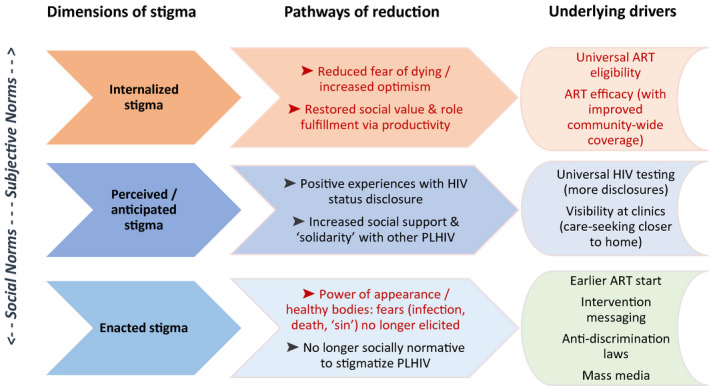
We present an emergent theoretical model of pathways through which HIV-related stigma may decline: internalized stigma may be reduced by two processes accelerated through the uptake and successful usage of ART: first, a reduced fear of dying and increased optimism for prolonged and healthy years of life; second, a restoration of perceived social value and fulfilment of subjective role expectations via restored physical strength and productivity. Anticipated stigma may be reduced in response to widespread engagement in HIV testing, leading to an increasing number of HIV status disclosures in a community, "normalizing" disclosure and reducing fears. Improvements in the perceived quality of HIV care lead to people living with HIV (PLHIV) seeking care in nearby facilities, seeing other known community members living with HIV, reducing isolation and facilitating opportunities for social support and "solidarity." Finally, enacted stigma may be reduced in response to the community viewing the healthy bodies of PLHIV successfully engaged in treatment, which lessens the fears that trigger enacted stigma; it becomes no longer socially normative to stigmatize PLHIV. This process may be reinforced through public health messaging and anti-discrimination laws.
Declines in HIV-related stigma appear to underway and explained by social processes accelerated by UTT efforts. Widespread implementation of UTT shows promise for reducing multiple dimensions of stigma, which is critical for improving health outcomes among PLHIV.
抗逆转录病毒疗法(ART)的推出与艾滋病毒相关耻辱感的降低有关,但人们对这种降低的途径知之甚少。在普遍检测和治疗(UTT)干预的新背景下,ART 的快速普及为了解艾滋病毒相关耻辱感下降的过程以及 UTT 策略如何促成耻辱感更快、更广泛的变化提供了机会。这项定性研究旨在评估 UTT 干预如何影响与 HIV 相关的信念、态度和行为的变化。
在社区集群随机 UTT 试验(可持续东非社区健康研究[SEACH])中,每年在乌干达和肯尼亚的 8 个农村社区的两个队列中收集两轮(2014 年至 2016 年)的纵向定性深入半结构化访谈数据:社区领导(n=32)和社区成员(n=112)。对数据进行归纳分析,以建立理解耻辱感下降途径的新理论。
我们提出了一个关于艾滋病毒相关耻辱感可能下降的途径的新理论模型:通过两种通过接受和成功使用 ART 加速的过程,内化的耻辱感可能会降低:首先,对死亡的恐惧减少,对延长和健康的生活年限的乐观情绪增加;其次,通过恢复体力和生产力,恢复感知到的社会价值和满足主观角色期望。预期的耻辱感可能会因广泛参与 HIV 检测而减少,从而导致社区中越来越多的 HIV 状况披露,使披露“正常化”并减少恐惧。对艾滋病毒护理质量的改善导致艾滋病毒感染者(PLHIV)在附近的设施中寻求护理,看到其他已知的社区成员也在接受 HIV 治疗,减少了孤立感,并为社会支持和“团结”创造了机会。最后,由于社区看到 PLHIV 成功接受治疗而拥有健康的身体,实施的耻辱感可能会减少,这减轻了引发实施耻辱感的恐惧;对 PLHIV 进行污名化不再是社会规范。这一过程可能通过公共卫生宣传和反歧视法得到加强。
艾滋病毒相关耻辱感的下降似乎正在进行,并可以通过 UTT 努力加速的社会过程来解释。广泛实施 UTT 有望减少多种耻辱感维度,这对于改善 PLHIV 的健康结果至关重要。