Department of Physical Therapy and Rehabilitation Science, and Division of Geriatrics, University of California, San Francisco, 1500 Owens Street, Box 0736, San Francisco, CA 94158, USA.
Department of Physical Therapy and Rehabilitation Science, University of California, San Francisco, San Francisco, California, USA.
Phys Ther. 2021 Jan 4;101(1). doi: 10.1093/ptj/pzaa193.
The objective was to evaluate implementation of telehealth physical therapy in response to COVID-19 and identify implementation strategies to maintain and scale up telehealth physical therapy within a large urban academic medical center.
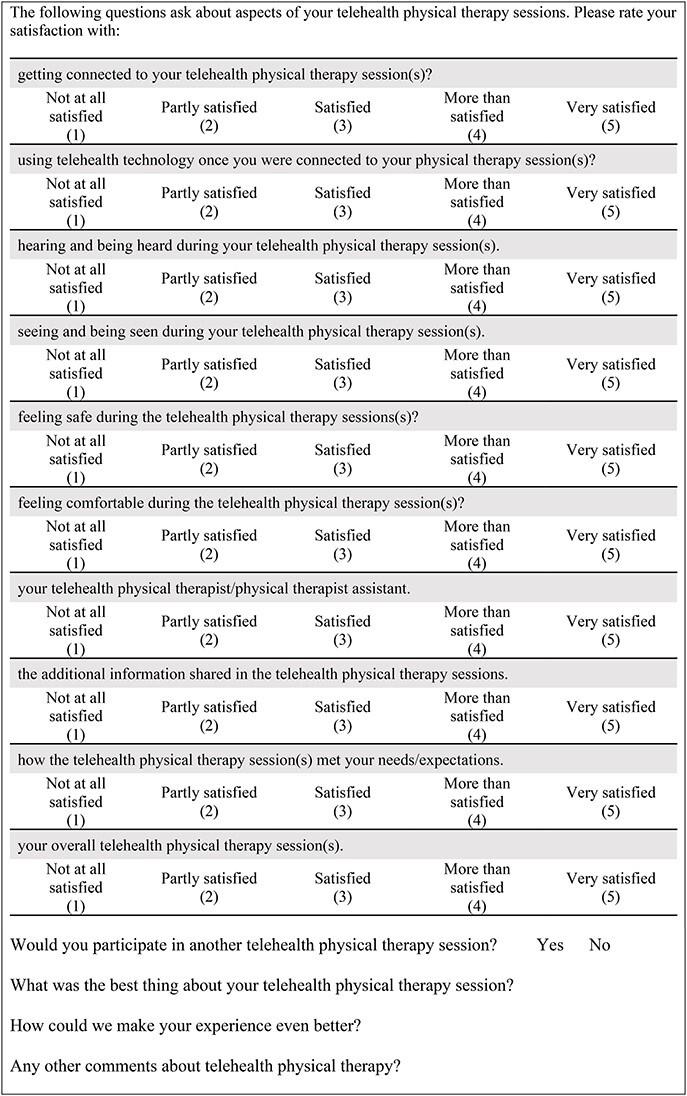
The Reach Effectiveness Adoption Implementation Maintenance (RE-AIM) framework was used to evaluate telehealth physical therapy implementation. Patient-level data were extracted from electronic medical records between March 16, 2020, and May 16, 2020 (implementation phase). Reach was defined as the proportion of physical therapy sessions completed via telehealth. Effectiveness was assessed using a patient-reported satisfaction survey with a 5-point Likert scale. Adoption was defined as the proportion of physical therapists who used telehealth. Implementation was assessed through qualitative analysis of patient and clinician perspectives to identify emergent themes, retrospectively classify strategies used during the implementation phase, and prospectively identify evidence-based strategies to increase telehealth maintenance and scale-up. Maintenance of telehealth was defined as the proportion of patients who indicated they would attend another telehealth session.
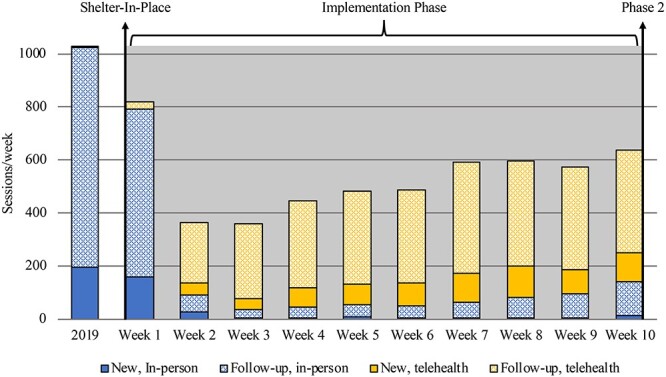
There were 4548 physical therapy sessions provided by 40 therapists from March 22, 2020, to May 16, 2020, of which 3883 (85%) were telehealth. Ninety-four percent of patients were satisfied. All physical therapists (100%) used telehealth technology at least once. Retrospectively classified and prospectively identified evidence-based strategies were organized into 5 qualitative themes that supported implementation: organizational factors (policies, preexisting partnerships), engaging external stakeholders (satisfaction survey), champions (clinician leaders), clinician education (dynamic, ongoing training), and process (promote adaptability, small tests of change). Ninety-two percent of patients reported they would attend another telehealth session.
Findings from this study suggest that implementation of telehealth physical therapy during the COVID-19 pandemic was feasible and acceptable in this setting.
These results can be used to guide future health policy, quality improvement, and implementation science initiatives to expand the use and study of telehealth for physical therapy.
评估针对 COVID-19 实施远程医疗物理治疗的情况,并确定在大型城市学术医疗中心内维持和扩大远程医疗物理治疗的实施策略。
采用实施效果传播采纳实施维持(RE-AIM)框架评估远程医疗物理治疗的实施情况。从 2020 年 3 月 16 日至 5 月 16 日(实施阶段)的电子病历中提取患者层面的数据。远程医疗完成的物理治疗疗程比例定义为可达性。采用 5 分李克特量表的患者满意度调查评估效果。采用远程医疗使用者的比例定义采纳程度。通过对患者和临床医生观点的定性分析评估实施情况,以确定新出现的主题,回顾性分类实施阶段使用的策略,并前瞻性确定增加远程医疗维持和扩大规模的循证策略。远程医疗的维持程度定义为表示愿意参加另一次远程医疗治疗的患者比例。
2020 年 3 月 22 日至 5 月 16 日期间,40 名治疗师提供了 4548 次物理治疗疗程,其中 3883 次(85%)为远程医疗。94%的患者表示满意。所有治疗师(100%)都至少使用过一次远程医疗技术。回顾性分类和前瞻性确定的循证策略被组织成 5 个支持实施的定性主题:组织因素(政策、现有合作伙伴关系)、吸引外部利益相关者(满意度调查)、拥护者(临床领导者)、临床医生教育(动态、持续培训)和流程(促进适应性、小范围变革测试)。92%的患者表示他们会参加另一次远程医疗治疗。
本研究结果表明,在 COVID-19 大流行期间,在这种环境下实施远程医疗物理治疗是可行且可接受的。
这些结果可用于指导未来的卫生政策、质量改进和实施科学计划,以扩大远程医疗在物理治疗中的使用和研究。