Mental Health Research and Treatment Center, Department of Clinical Psychology and Psychotherapy, Ruhr-Universität Bochum, Bochum, Germany.
Mental Health Research and Treatment Center, Department of Clinical Child and Adolescent Psychology, Ruhr-Universität Bochum, Bochum, Germany.
PLoS One. 2020 Dec 7;15(12):e0243523. doi: 10.1371/journal.pone.0243523. eCollection 2020.
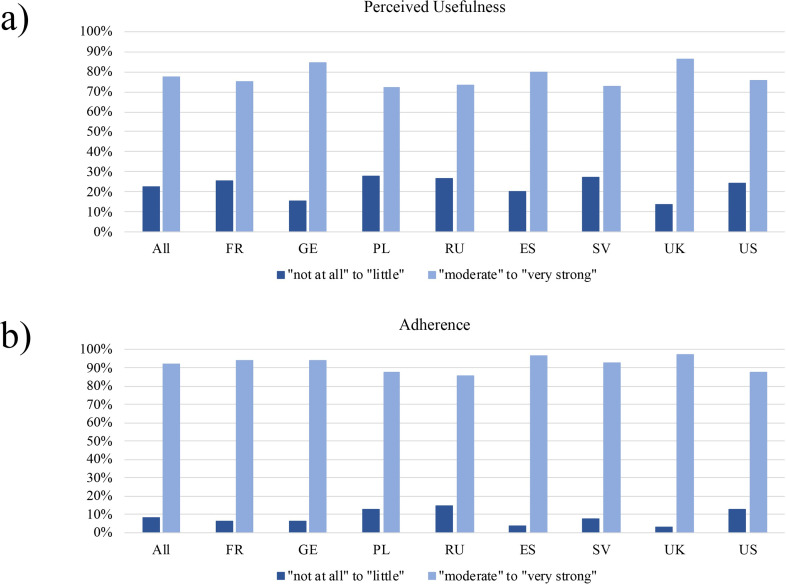
Behavioral measures, such as the wearing of facemasks and maintaining of distance to other people, have been central in fighting the COVID-19 pandemic and will continue to be important in curbing its spread. We therefore investigated their perceived usefulness, adherence and their predictors in representative online samples in eight countries (France, Germany, Poland, Russia, Spain, Sweden, U.K., U.S.). Of the 7,658 participants, 77.4% rated governmental measures (highest: Germany, lowest: France) as useful and 91.7% reported adherence to them. Adherence was lowest in Russia and Poland, where people felt particularly left alone and not well supported, and in the U.S. and Sweden, where governments showed ambivalent attitudes towards the measures. The highest adherence was reported in countries with very high mortality (U.K., Spain, France) or very positively perceived government communication (Germany). Female gender, higher age, belonging to a risk group, being affected physically and mentally, perception of governmental communication as guided by the interests of people, feeling of being well informed and the level of positive mental health positively predicted both outcomes, while being affected economically negatively predicted both outcomes. Country-specific results are considered in the light of the protection motivation theory and the theory of planned behavior together with potential ways to improve active participation of the population. Overall, we recommend the governments and authorities to stress that each individual can contribute to the control of the COVID-19 situation by adherence to the measures in the public communication. Moreover, they should emphasize the risk of unconscious infection of older individuals by younger people, as well as the importance of physical activity for the protection of mental and physical health especially during the pandemic.
行为措施,如佩戴口罩和与他人保持距离,一直是抗击 COVID-19 大流行的核心措施,在遏制其传播方面仍将非常重要。因此,我们在八个国家(法国、德国、波兰、俄罗斯、西班牙、瑞典、英国和美国)的代表性在线样本中调查了这些措施的感知有用性、遵守情况及其预测因素。在 7658 名参与者中,77.4%(最高:德国,最低:法国)认为政府措施有用,91.7%报告遵守了这些措施。在俄罗斯和波兰,人们感到特别孤立和没有得到很好的支持,而在美国和瑞典,政府对这些措施持矛盾态度,因此遵守率最低。在死亡率非常高(英国、西班牙和法国)或政府沟通被认为非常积极的国家(德国),遵守率最高。女性、年龄较大、属于风险群体、身体和精神受到影响、认为政府沟通是为了人民的利益、感觉信息灵通以及积极的心理健康水平,这两者都呈正相关,而经济受到影响则与这两者都呈负相关。考虑到保护动机理论和计划行为理论,以及提高民众积极参与的潜在途径,我们结合各国具体情况进行了讨论。总体而言,我们建议政府和当局在公共传播中强调,每个人通过遵守这些措施都可以为控制 COVID-19 做出贡献。此外,他们还应该强调年轻人无意识感染老年人的风险,以及体育活动对于保护身心健康的重要性,特别是在大流行期间。