Department of Experimental Psychology & Wellcome Trust Centre for Integrative Neuroimaging, University of Oxford, Anna Watts Building, Radcliffe Observatory Quarter, Woodstock Road, Oxford, OX2 6GG, UK; Department of Psychology, Royal Holloway, University of London, Egham Hill, Surrey TW20 0EX, UK.
Department of Experimental Psychology & Wellcome Trust Centre for Integrative Neuroimaging, University of Oxford, Anna Watts Building, Radcliffe Observatory Quarter, Woodstock Road, Oxford, OX2 6GG, UK.
Neuroimage. 2021 Feb 1;226:117599. doi: 10.1016/j.neuroimage.2020.117599. Epub 2020 Dec 4.
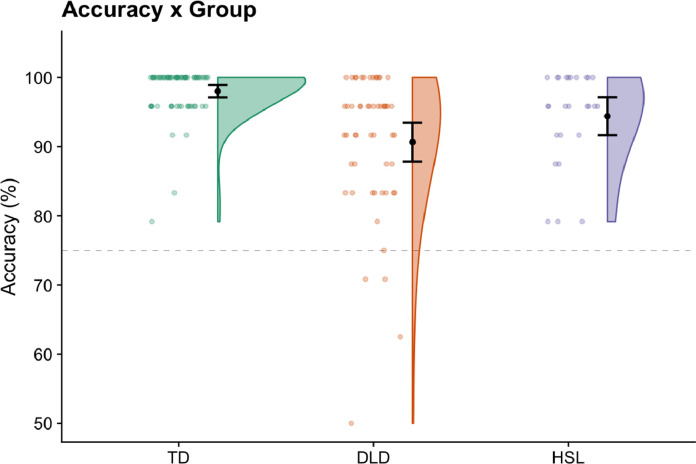
Developmental language disorder (DLD) is characterised by difficulties in learning one's native language for no apparent reason. These language difficulties occur in 7% of children and are known to limit future academic and social achievement. Our understanding of the brain abnormalities associated with DLD is limited. Here, we used a simple four-minute verb generation task (children saw a picture of an object and were instructed to say an action that goes with that object) to test children between the ages of 10-15 years (DLD N = 50, typically developing N = 67). We also tested 26 children with poor language ability who did not meet our criteria for DLD. Contrary to our registered predictions, we found that children with DLD did not have (i) reduced activity in language relevant regions such as the left inferior frontal cortex; (ii) dysfunctional striatal activity during overt production; or (iii) a reduction in left-lateralised activity in frontal cortex. Indeed, performance of this simple language task evoked activity in children with DLD in the same regions and to a similar level as in typically developing children. Consistent with previous reports, we found sub-threshold group differences in the left inferior frontal gyrus and caudate nuclei, but only when analysis was limited to a subsample of the DLD group (N = 14) who had the poorest performance on the task. Additionally, we used a two-factor model to capture variation in all children studied (N = 143) on a range of neuropsychological tests and found that these language and verbal memory factors correlated with activity in different brain regions. Our findings indicate a lack of support for some neurological models of atypical language learning, such as the procedural deficit hypothesis or the atypical lateralization hypothesis, at least when using simple language tasks that children can perform. These results also emphasise the importance of controlling for and monitoring task performance.
发育性语言障碍(DLD)的特征是儿童在没有明显原因的情况下学习母语出现困难。这些语言障碍在 7%的儿童中出现,并已知会限制其未来的学业和社交成就。我们对与 DLD 相关的大脑异常的理解有限。在这里,我们使用了一个简单的四分钟动词生成任务(儿童看到一个物体的图片,并被指示说出与该物体相关的动作)来测试 10-15 岁的儿童(DLD N=50,典型发育 N=67)。我们还测试了 26 名语言能力较差但不符合 DLD 标准的儿童。与我们预先注册的预测相反,我们发现 DLD 儿童没有:(i)语言相关区域(如左额下回)活动减少;(ii)在明显产生过程中纹状体活动功能障碍;或(iii)额皮质左侧活动减少。实际上,这个简单的语言任务的表现激发了 DLD 儿童与典型发育儿童相同区域和相似水平的活动。与之前的报告一致,我们发现左额下回和尾状核存在亚阈值的组间差异,但仅当分析仅限于任务表现最差的 DLD 组(N=14)的亚样本时才会出现这种情况。此外,我们使用了一个双因素模型来捕捉所有研究儿童(N=143)在一系列神经心理学测试中的变化,并发现这些语言和言语记忆因素与不同大脑区域的活动相关。我们的发现表明,至少在使用儿童能够完成的简单语言任务时,一些非典型语言学习的神经学模型,如程序缺陷假说或非典型侧化假说,缺乏支持。这些结果还强调了控制和监测任务表现的重要性。