Department of Radiology, Brigham and Women's Hospital, Harvard Medical School, Boston, MA, USA.
Department of Psychiatry, Brigham and Women's Hospital, Harvard Medical School, Boston, MA, USA.
Neuroimage. 2021 Feb 1;226:117564. doi: 10.1016/j.neuroimage.2020.117564. Epub 2020 Dec 4.
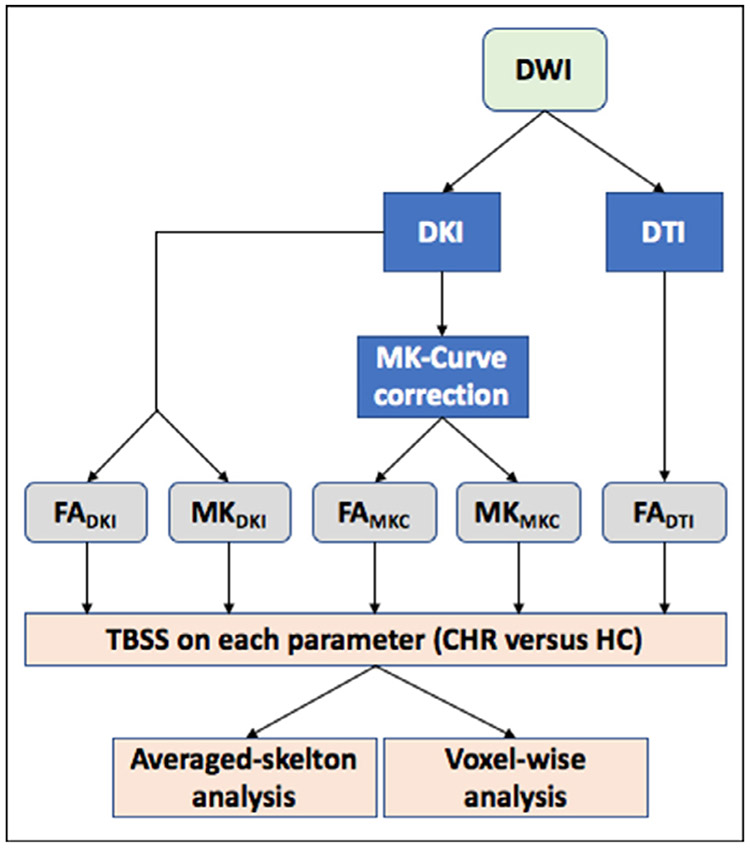
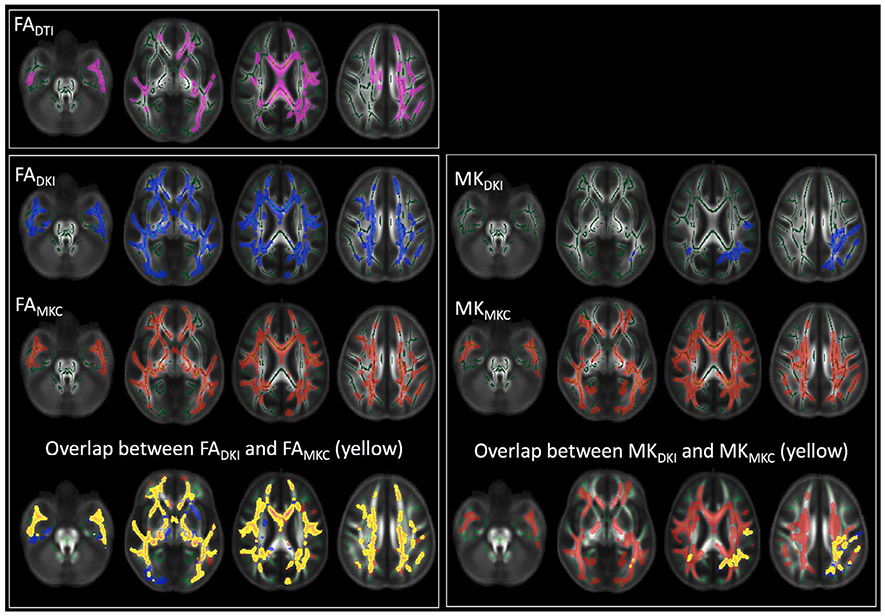
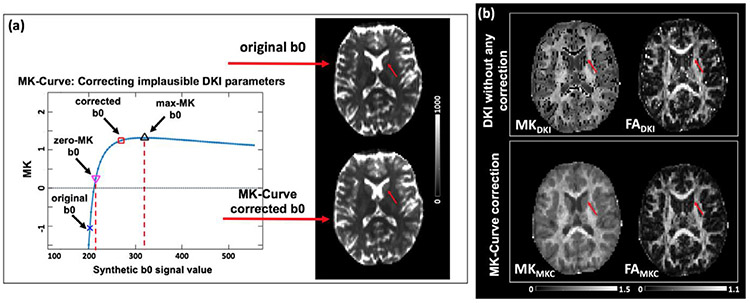
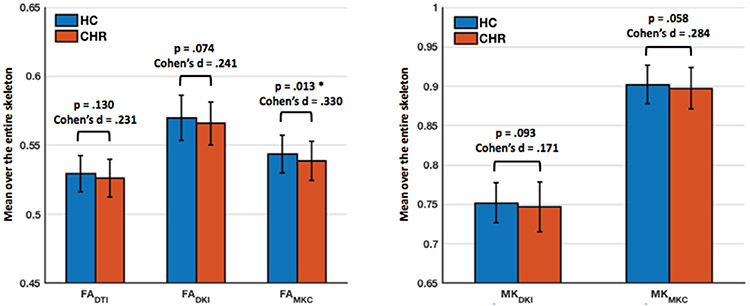
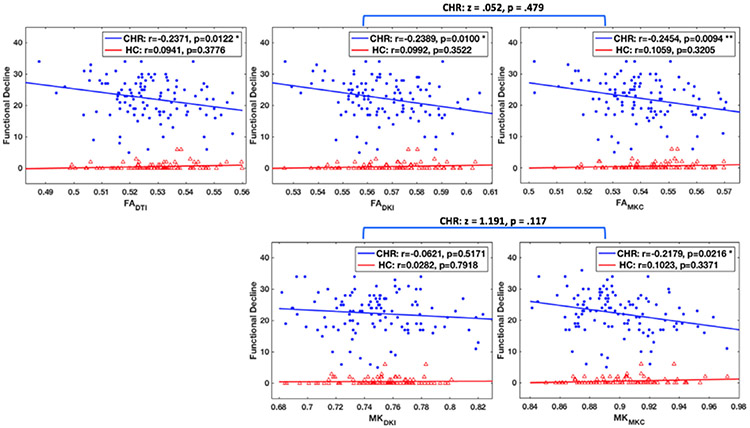
Diffusion kurtosis imaging (DKI) is a diffusion MRI approach that enables the measurement of brain microstructural properties, reflecting molecular restrictions and tissue heterogeneity. DKI parameters such as mean kurtosis (MK) provide additional subtle information to that provided by popular diffusion tensor imaging (DTI) parameters, and thus have been considered useful to detect white matter abnormalities, especially in populations that are not expected to show severe brain pathologies. However, DKI parameters often yield artifactual output values that are outside of the biologically plausible range, which diminish sensitivity to identify true microstructural changes. Recently we have proposed the mean-kurtosis-curve (MK-Curve) method to correct voxels with implausible DKI parameters, and demonstrated its improved performance against other approaches that correct artifacts in DKI. In this work, we aimed to evaluate the utility of the MK-Curve method to improve the identification of white matter abnormalities in group comparisons. To do so, we compared group differences, with and without the MK-Curve correction, between 115 individuals at clinical high risk for psychosis (CHR) and 93 healthy controls (HCs). We also compared the correlation of the corrected and uncorrected DKI parameters with clinical characteristics. Following the MK-curve correction, the group differences had larger effect sizes and higher statistical significance (i.e., lower p-values), demonstrating increased sensitivity to detect group differences, in particular in MK. Furthermore, the MK-curve-corrected DKI parameters displayed stronger correlations with clinical variables in CHR individuals, demonstrating the clinical relevance of the corrected parameters. Overall, following the MK-curve correction our analyses found widespread lower MK in CHR that overlapped with lower fractional anisotropy (FA), and both measures were significantly correlated with a decline in functioning and with more severe symptoms. These observations further characterize white matter alterations in the CHR stage, demonstrating that MK and FA abnormalities are widespread, and mostly overlap. The improvement in group differences and stronger correlation with clinical variables suggest that applying MK-curve would be beneficial for the detection and characterization of subtle group differences in other experiments as well.
扩散峰度成像(DKI)是一种扩散 MRI 方法,可用于测量脑微观结构特性,反映分子限制和组织异质性。DKI 参数(如平均峰度(MK))提供了比流行的扩散张量成像(DTI)参数更多的细微信息,因此被认为有助于检测白质异常,尤其是在那些预计不会出现严重脑病变的人群中。然而,DKI 参数通常会产生超出生物学合理范围的人为输出值,从而降低了识别真正微观结构变化的敏感性。最近,我们提出了平均峰度曲线(MK-Curve)方法来校正不合理的 DKI 参数的体素,并证明了它在纠正 DKI 伪影方面优于其他方法的性能。在这项工作中,我们旨在评估 MK-Curve 方法在组间比较中改善白质异常识别的效用。为此,我们比较了 115 名临床高风险精神分裂症(CHR)个体和 93 名健康对照(HC)个体的组间差异,分别有无 MK-Curve 校正。我们还比较了校正和未校正的 DKI 参数与临床特征的相关性。在进行 MK-Curve 校正后,组间差异的效应大小更大,统计学意义更高(即 p 值更低),表明校正后对组间差异的检测敏感性更高,尤其是在 MK 上。此外,在 CHR 个体中,MK-curve 校正后的 DKI 参数与临床变量的相关性更强,表明校正后的参数具有临床相关性。总体而言,在进行 MK-Curve 校正后,我们的分析发现 CHR 患者的 MK 普遍较低,与 FA 降低重叠,并且这两个指标都与功能下降和更严重的症状显著相关。这些观察结果进一步描述了 CHR 阶段的白质改变,表明 MK 和 FA 异常是广泛存在的,并且大部分重叠。组间差异的改善和与临床变量的更强相关性表明,在其他实验中应用 MK-Curve 将有助于检测和描述细微的组间差异。