Galam Serge, Cheon Taksu
CEVIPOF-Centre for Political Research, Sciences Po and CNRS, 98 rue de l'Université, 75007 Paris, France.
Laboratory of Physics, Kochi University of Technology, Tosa Yamada, Kochi 782-8502, Japan.
Entropy (Basel). 2019 Dec 24;22(1):25. doi: 10.3390/e22010025.
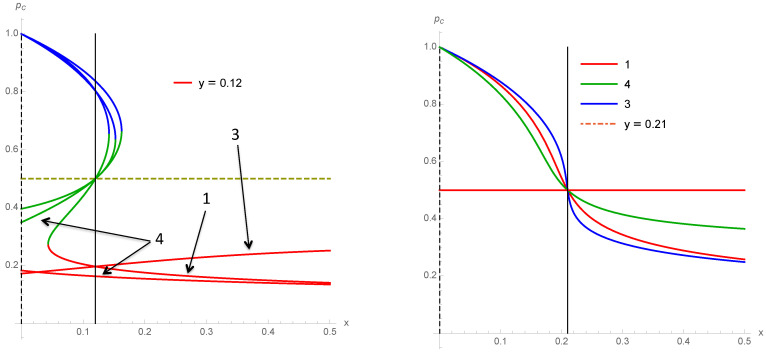
Asymmetry in contrarian behavior is investigated within the Galam model of opinion dynamics using update groups of size 3 with two competing opinions A and B. Denoting and the respective proportions of A and B contrarians, four schemes of implementations are studied. The first scheme activates contrarians after each series of updates with probabilities and for agents holding respectively opinion A and B. Second scheme activates contrarians within the update groups only against global majority with probability when A is the majority and when B is the majority. The third scheme considers in-group contrarians acting prior to the local majority update against both local majority and minority opinions. The last scheme activates in-group contrarians prior to the local majority update but only against the local majority. The main result is the loss of the fifty-fifty attractor produced by symmetric contrarians. Producing a bit less contrarians on its own side than the other side becomes the key to win a public debate, which in turn can guarantee an election victory. The associated phase diagram of opinion dynamics is found to exhibit a rich variety of counterintuitive results.
在意见动态的加拉姆模型中,使用大小为3的更新组,其中有两种相互竞争的意见A和B,研究了反向行为中的不对称性。用(p_A)和(p_B)分别表示持有意见A和B的反向者的各自比例,研究了四种实施方案。第一种方案在每次更新系列后,以概率(p_A)和(p_B)分别激活持有意见A和B的反向者。第二种方案仅在更新组内,当A是多数时,以概率(p_A)针对全局多数激活反向者;当B是多数时,以概率(p_B)激活反向者。第三种方案考虑组内反向者在局部多数更新之前,针对局部多数和少数意见采取行动。最后一种方案在局部多数更新之前激活组内反向者,但仅针对局部多数。主要结果是对称反向者产生的五五吸引子的丧失。在自己一方产生比另一方略少的反向者成为赢得公开辩论的关键,这反过来又可以保证选举胜利。发现相关的意见动态相图呈现出丰富多样的反直觉结果。