The Centre for Molecular Imaging and Translational Research Laboratory, The Peter MacCallum Cancer Centre, 305 Grattan Street, Melbourne, VIC 3000, Australia.
Department of Pharmaceutical Chemistry, Faculty of Pharmacy, University of Alexandria, El Sultan Hussein St. Azarita, Alexandria 21521, Egypt.
Molecules. 2020 Dec 3;25(23):5700. doi: 10.3390/molecules25235700.
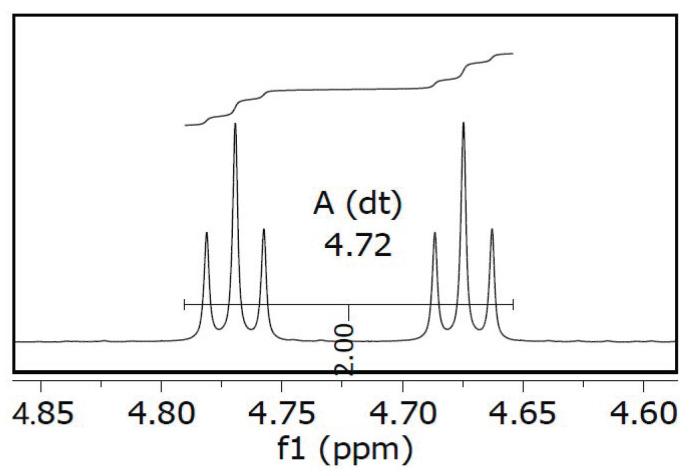
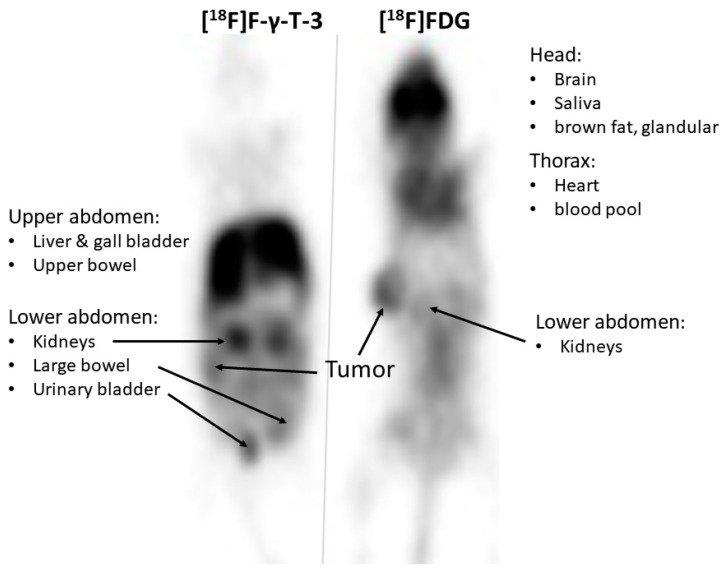
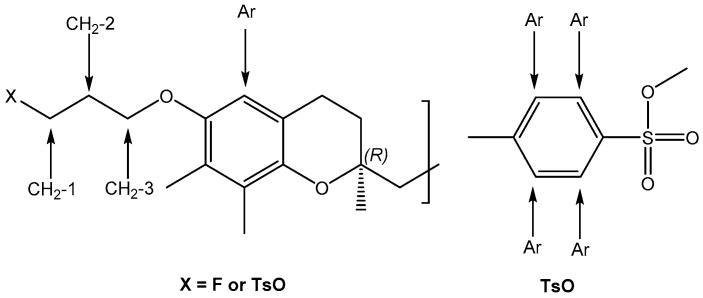
Vitamin E, a natural antioxidant, is of interest to scientists, health care pundits and faddists; its nutritional and biomedical attributes may be validated, anecdotal or fantasy. Vitamin E is a mixture of tocopherols (TPs) and tocotrienols (T-3s), each class having four substitutional isomers (α-, β-, γ-, δ-). Vitamin E analogues attain only low concentrations in most tissues, necessitating exacting invasive techniques for analytical research. Quantitative positron emission tomography (PET) with an F-18-labeled molecular probe would expedite access to Vitamin E's biodistributions and pharmacokinetics via non-invasive temporal imaging. ()-6-(3-[F]Fluoropropoxy)-2,7,8-trimethyl-2-(4,8,12-trimethyltrideca-3,7,11-trien-1-yl)-chromane ([F]F-γ-T-3) was prepared for this purpose. [F]F-γ-T-3 was synthesized from γ-T-3 in two steps: (i) 1,3-di--tosylpropane was introduced at C6-O to form TsO-γ-T-3, and (ii) reaction of this tosylate with [F]fluoride in DMF/K. Non-radioactive F-γ-T-3 was synthesized by reaction of γ-T-3 with 3-fluoropropyl methanesulfonate. [F]F-γ-T-3 biodistribution in a murine tumor model was imaged using a small-animal PET scanner. F-γ-T-3 was prepared in 61% chemical yield. [F]F-γ-T-3 was synthesized in acceptable radiochemical yield (RCY 12%) with high radiochemical purity (>99% RCP) in 45 min. Preliminary F-18 PET images in mice showed upper abdominal accumulation with evidence of renal clearance, only low concentrations in the thorax (lung/heart) and head, and rapid clearance from blood. [F]F-γ-T-3 shows promise as an F-18 PET tracer for detailed in vivo studies of Vitamin E. The labeling procedure provides acceptable RCY, high RCP and pertinence to all eight Vitamin E analogues.
维生素 E 是一种天然抗氧化剂,引起了科学家、医疗保健专家和时尚人士的关注;其营养和生物医学特性可能已得到验证、传闻或幻想。维生素 E 是生育酚 (TPs) 和生育三烯酚 (T-3s) 的混合物,每类有四个取代异构体 (α-、β-、γ-、δ-)。维生素 E 类似物在大多数组织中的浓度仅达到低水平,因此需要精确的侵入性技术进行分析研究。带有 F-18 标记的分子探针的定量正电子发射断层扫描 (PET) 将通过非侵入性的时间成像,加速获取维生素 E 的生物分布和药代动力学。为此,制备了用于此目的的[F]F-γ-T-3。[F]F-γ-T-3 由γ-T-3 两步合成:(i)在 C6-O 上引入 1,3-二-O-对甲苯磺酰基丙烷以形成 TsO-γ-T-3,和 (ii) 该甲苯磺酸盐与 DMF/K 中的[F]氟反应。非放射性 F-γ-T-3 通过γ-T-3 与 3-氟丙基甲磺酸酯的反应合成。使用小动物 PET 扫描仪对 F-γ-T-3 在小鼠肿瘤模型中的生物分布进行成像。在 61%的化学产率下制备了 F-γ-T-3。[F]F-γ-T-3 在 45 分钟内以可接受的放射性化学产率 (RCY 12%) 和高放射性化学纯度 (>99%RCP) 合成,具有较高的放射性化学纯度 (>99%RCP)。初步的 F-18 PET 图像显示,腹部上半部分积聚,有肾脏清除的证据,胸部 (肺/心) 和头部的浓度较低,并且从血液中迅速清除。[F]F-γ-T-3 有望成为 F-18 PET 示踪剂,用于详细的维生素 E 体内研究。标记程序提供了可接受的 RCY、高 RCP 和与所有八种维生素 E 类似物的相关性。