Wang Yu-Shin, Li Miao, Tell Lisa A, Baynes Ronald E, Davis Jennifer L, Vickroy Thomas W, Riviere Jim E, Lin Zhoumeng
Institute of Computational Comparative Medicine (ICCM), Department of Anatomy and Physiology, College of Veterinary Medicine, Kansas State University, Manhattan, KS, USA.
Department of Medicine and Epidemiology, School of Veterinary Medicine, University of California-Davis, Davis, CA, USA.
J Vet Pharmacol Ther. 2020 Dec 2;44(4):423-55. doi: 10.1111/jvp.12931.
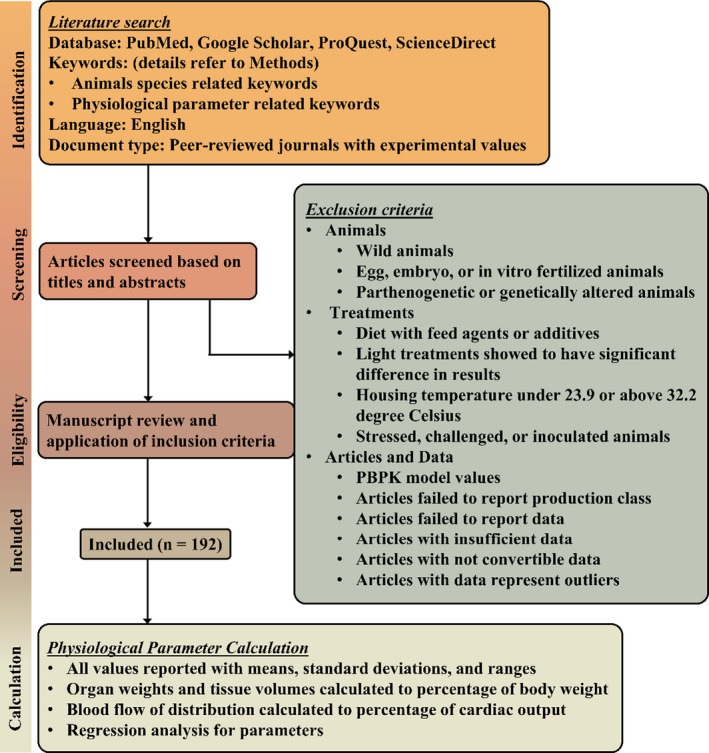
Physiologically based pharmacokinetic (PBPK) models are growing in popularity due to human food safety concerns and for estimating drug residue distribution and estimating withdrawal intervals for veterinary products originating from livestock species. This paper focuses on the physiological and anatomical data, including cardiac output, organ weight, and blood flow values, needed for PBPK modeling applications for avian species commonly consumed in the poultry market. Experimental and field studies from 1940 to 2019 for broiler chickens (1-70 days old, 40 g - 3.2 kg), laying hens (4-15 months old, 1.1-2.0 kg), and turkeys (1 day-14 months old, 60 g -12.7 kg) were searched systematically using PubMed, Google Scholar, ProQuest, and ScienceDirect for data collection in 2019 and 2020. Relevant data were extracted from the literature with mean and standard deviation (SD) being calculated and compiled in tables of relative organ weights (% of body weight) and relative blood flows (% of cardiac output). Trends of organ or tissue weight growth during different life stages were calculated when sufficient data were available. These compiled data sets facilitate future PBPK model development and applications, especially in estimating chemical residue concentrations in edible tissues to calculate food safety withdrawal intervals for poultry.
基于生理学的药代动力学(PBPK)模型因人们对人类食品安全的关注以及用于估计兽药残留分布和估算源自家畜物种的兽药产品的休药期而越来越受欢迎。本文重点关注家禽市场常见禽类物种的PBPK建模应用所需的生理和解剖学数据,包括心输出量、器官重量和血流量值。2019年和2020年,利用PubMed、谷歌学术、ProQuest和科学Direct系统检索了1940年至2019年关于肉鸡(1至70日龄,40克至3.2千克)、蛋鸡(4至15月龄,1.1至2.0千克)和火鸡(1日龄至14月龄,60克至12.7千克)的实验和田间研究,以收集数据。从文献中提取相关数据,计算平均值和标准差(SD),并编制成相对器官重量(体重百分比)和相对血流量(心输出量百分比)表格。当有足够数据时,计算不同生命阶段器官或组织重量的增长趋势。这些汇编的数据集有助于未来PBPK模型的开发和应用,特别是在估计可食用组织中的化学残留浓度以计算家禽食品安全休药期方面。