Copenhagen Prospective Studies on Asthma in Childhood, Herlev and Gentofte Hospital, University of Copenhagen, Copenhagen, Denmark.
Department of Pediatrics, Slagelse Hospital, Slagelse, Denmark.
JAMA Netw Open. 2020 Dec 1;3(12):e2026018. doi: 10.1001/jamanetworkopen.2020.26018.
Observational studies have reported an association between high maternal vitamin D levels and improved neurodevelopment in offspring, but no randomized clinical trial (RCT) has investigated these observations.
To determine whether high-dose vitamin D supplementation during pregnancy improves offspring neurodevelopment from birth to age 6 years.
DESIGN, SETTING, AND PARTICIPANTS: This prespecified secondary analysis of a double-blinded, placebo-controlled RCT of high-dose vitamin D3 supplementation vs standard dose during the third trimester of pregnancy was conducted in the unselected prospective mother-child birth cohort at a single-center research unit in Denmark as part of the Copenhagen Prospective Studies on Asthma in Childhood 2010 (COPSAC-2010). Participants included pregnant women; women with vitamin D intake greater than 600 IU/d or an endocrine, heart, or kidney disorder, and those who did not speak Danish fluently were excluded. Neurodevelopmental assessments for offspring of these women were performed at ages 0 to 6 years. Children born prematurely (gestational week <37), with low birth weight (<2500 g), or with a neurological disease affecting neurodevelopment were excluded. Data were analyzed from August 2019 to February 2020.
High-dose (ie, 2800 IU/d) vs standard dose (ie, 400 IU/d) vitamin D3 supplementation from pregnancy week 24 until 1 week after birth.
The primary outcome of interest was cognitive development assessed at 2.5 years using the Bayley Scales of Infant and Toddler Development. Other neurodevelopmental outcomes included age of motor milestone achievement (Denver Developmental Index and World Health Organization milestone registration), language development (MacArthur-Bates Communicative Development Inventories), general neurodevelopment at age 3 years (Ages and Stages Questionnaire), and emotional and behavioral problems at age 6 years (Strengths and Difficulties Questionnaire).
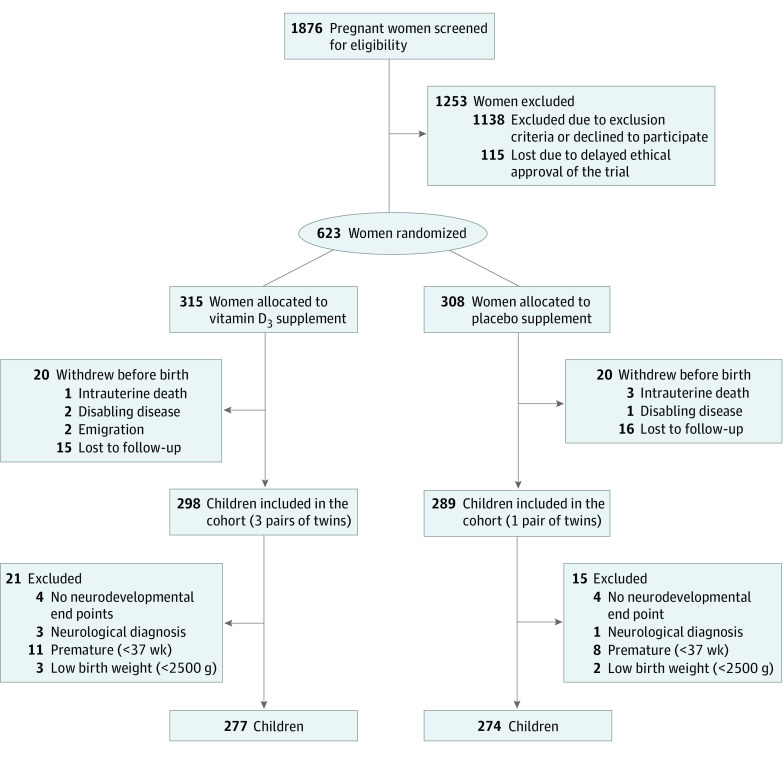
Among 623 women randomized, 315 were randomized to high-dose vitamin D3 and 308 were randomized to standard dose placebo. A total of 551 children were evaluated from birth to age 6 years, (282 [51.2%] boys; 528 [95.8%] White), with 277 children in the high-dose vitamin D3 group and 274 children in the standard dose group. There was no effect of the high-dose compared with standard dose of vitamin D3 supplementation during pregnancy on offspring achievement of motor milestones (β = 0.08 [95% CI, -0.26 to 0.43]; P = .64), cognitive development (score difference: 0.34 [95% CI, -1.32 to 1.99]; P = .70), general neurodevelopment (median [IQR] communication score: 50 [50-55] vs 50 [50-55]; P = .62), or emotional and behavioral problems (odds ratio, 0.76 [95% CI, 0.53 to 1.09]; P = .14). There was no effect on language development expressed by the word production at 1 year (median [IQR], 2 [0-6] words vs 3 [1-6] words; P = .16), although a decreased word production was apparent at 2 years in children in the high-dose vitamin D3 group (median [IQR], 232 [113-346] words vs 253 [149-382.5] words; P = .02).
In this prespecified secondary analysis of an RCT, maternal high-dose vitamin D3 supplementation during the third trimester of pregnancy did not improve neurodevelopmental outcomes in the offspring during the first 6 years of life. These findings contribute essential information clarifying the effects of prenatal exposure to vitamin D on neurodevelopment in childhood.
ClinicalTrials.gov Identifier: NCT00856947.
观察性研究报告称,母体维生素 D 水平高与后代神经发育改善有关,但尚无随机临床试验 (RCT) 对此进行研究。
确定妊娠晚期高剂量维生素 D 补充是否能改善出生至 6 岁儿童的后代神经发育。
设计、地点和参与者:这是一项对丹麦一个单中心研究单位未选择的前瞻性母婴出生队列进行的双盲、安慰剂对照 RCT 的预设二次分析,该研究纳入了孕妇;维生素 D 摄入量大于 600IU/d 或患有内分泌、心脏或肾脏疾病,以及不能流利讲丹麦语的孕妇被排除在外。这些女性的后代在 0 至 6 岁时进行神经发育评估。排除早产(妊娠周数<37)、低出生体重(<2500g)或影响神经发育的神经疾病的儿童。数据于 2019 年 8 月至 2020 年 2 月进行分析。
妊娠 24 周至出生后 1 周时,高剂量(即 2800IU/d)与标准剂量(即 400IU/d)维生素 D3 补充。主要观察指标是使用贝利婴幼儿发育量表评估的 2.5 岁时的认知发育。其他神经发育结局包括运动里程碑达成年龄(丹佛发展指数和世界卫生组织里程碑登记)、语言发育(麦克阿瑟-贝茨沟通发展量表)、3 岁时的一般神经发育(年龄和阶段问卷)和 6 岁时的情绪和行为问题(优势与困难问卷)。
在 623 名随机分组的女性中,315 名随机分为高剂量维生素 D3 组,308 名随机分为标准剂量安慰剂组。共有 551 名儿童从出生到 6 岁进行了评估,(282 名[51.2%]男孩;528 名[95.8%]白人),其中高剂量维生素 D3 组 277 名,标准剂量组 274 名。与妊娠期间标准剂量的维生素 D3 补充相比,高剂量补充对后代运动里程碑的达成(β=0.08[95%CI,-0.26 至 0.43];P=0.64)、认知发育(评分差值:0.34[95%CI,-1.32 至 1.99];P=0.70)、一般神经发育(沟通评分中位数[IQR]:50[50-55] vs 50[50-55];P=0.62)或情绪和行为问题(比值比,0.76[95%CI,0.53 至 1.09];P=0.14)均无影响。1 岁时的词汇生成(中位数[IQR],2[0-6]个词 vs 3[1-6]个词;P=0.16)也没有影响,尽管高剂量维生素 D3 组的词汇生成在 2 岁时明显减少(中位数[IQR],232[113-346]个词 vs 253[149-382.5]个词;P=0.02)。
在这项 RCT 的预设二次分析中,妊娠晚期高剂量维生素 D 补充并不能改善儿童生命最初 6 年的后代神经发育结局。这些发现提供了重要信息,阐明了产前暴露于维生素 D 对儿童神经发育的影响。
ClinicalTrials.gov 标识符:NCT00856947。