Kaffashpoor Azar, Sadeghian Samaneh
Management Department, Faculty of Economics and Administrative Sciences, Ferdowsi University of Mashhad, Mashhad, Iran.
Department of Management, Tabaran Institute of Higher Education, Mashhad, Iran.
BMC Nurs. 2020 Nov 30;19(1):111. doi: 10.1186/s12912-020-00496-w.
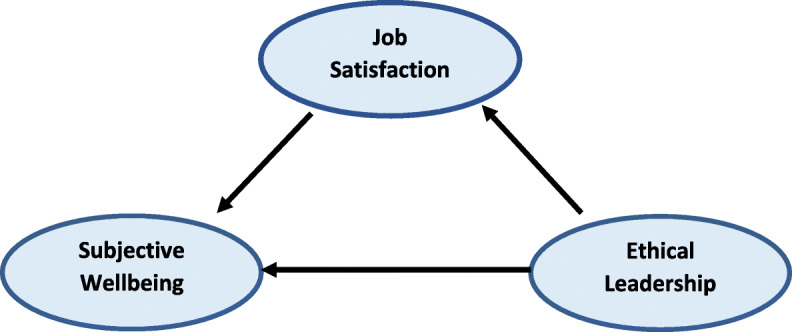
The emerging ethical leadership, a unique approach in leadership viewpoint, has provided the ground for constructing and advancing individual and managerial efficiency by highlighting ethics in organizations. The present study aims to investigate the influence of Ethical Leadership on Subjective Wellbeing, Given the Moderator Job Satisfaction in Private Hospitals in Mashhad.
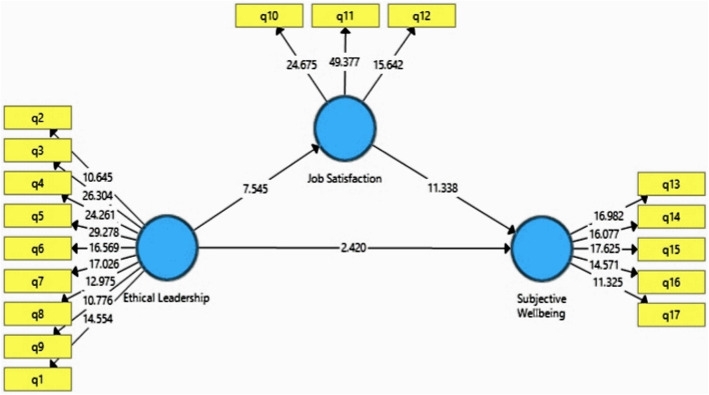
This descriptive-correlational research design stud was conducted in 2015-2016 to inspect the possible effect of ethical leadership on subjective wellbeing and job satisfaction, as dependent and mediator variables, among the Iranian private hospitals' nurses in Mashhad. Simple random sampling method was used to select the sample of 166 nurses out of the population of 730 nurses, in total. The valid and reliable adapted version of the questionnaire designed by Yang (2014) was used to collect the data, and structural equation modeling (SEM) was used to analyze the data set.
The results showed that there is a positive significant correlation between ethical leadership and job satisfaction. More specifically, the findings indicated that Ethical leadership affected the subjective wellbeing of nurses through job satisfaction both directly and indirectly.
The findings illustrated that focus on ethics and ethically-oriented leaders in hospitals, enriched by job satisfaction can lead to the nurses' subjective wellbeing by providing them a positive climate.
新兴的道德领导力作为一种独特的领导观点,通过强调组织中的道德规范,为构建和提高个人及管理效率奠定了基础。本研究旨在探讨道德领导力对主观幸福感的影响,鉴于马什哈德私立医院的调节变量工作满意度。
本描述性相关研究设计于2015 - 2016年进行,以考察道德领导力对主观幸福感和工作满意度的可能影响,主观幸福感和工作满意度分别作为因变量和中介变量,研究对象为马什哈德伊朗私立医院的护士。采用简单随机抽样方法,从730名护士的总体中抽取166名护士作为样本。使用杨(2014年)设计的经过验证且可靠的问卷改编版收集数据,并采用结构方程模型(SEM)分析数据集。
结果表明,道德领导力与工作满意度之间存在显著正相关。更具体地说,研究结果表明,道德领导力通过工作满意度直接和间接地影响护士的主观幸福感。
研究结果表明,在医院中关注道德规范和以道德为导向的领导者,并辅以工作满意度,可以为护士营造积极的氛围,从而提高他们的主观幸福感。