Department of Psychosis Studies, Institute of Psychiatry, Psychology and Neuroscience, King's College London, London, UK.
Department of Behavioural Science and Health, Institute of Epidemiology and Health Care, University College London, London, UK.
Transl Psychiatry. 2020 Dec 8;10(1):422. doi: 10.1038/s41398-020-01114-8.
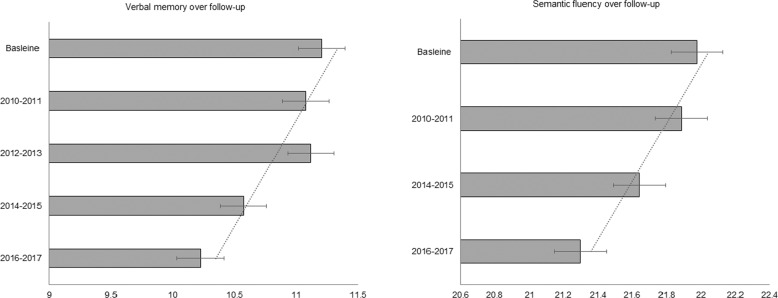
There has been a long argument over whether schizophrenia is a neurodegenerative disorder associated with progressive cognitive impairment. Given high heritability of schizophrenia, ascertaning if genetic susceptibility to schizophrenia is also associated with cognitive decline in healthy people would support the view that schizophrenia leads to an accelerated cognitive decline. Using the population representative sample of 6817 adults aged >50 years from the English Longitudinal Study of Ageing, we investigated associations between the biennial rate of decline in cognitive ability and the schizophrenia polygenic score (SZ-PGS) during the 10-year follow-up period. SZ-PGS was calculated based on summary statistics from the Schizophrenia Working Group of the Psychiatric Genomics Consortium. Cognition was measured sequentially across four time points using verbal memory and semantic fluency tests. The average baseline verbal memory was 10.4 (SD = 3.4) and semantic fluency was 20.7 (SD = 6.3). One standard deviation (1-SD) increase in SZ-PGS was associated with lower baseline semantic fluency (β = -0.25, 95%CI = -0.40 to -0.10, p = 0.002); this association was significant in men (β = -0.36, 95%CI = -0.59 to -0.12, p = 0.003) and in those who were aged 60-69 years old (β = -0.32, 95%CI = -0.58 to -0.05, p = 0.019). Similarly, 1-SD increase in SZ-PGS was associated with lower verbal memory score at baseline in men only (β = -0.12, 95%CI = -0.23 to -0.01, p = 0.040). However, SZ-PGS was not associated with a greater rate of decline in these cognitive domains during the 10-year follow-up. Our findings highlight that while genetic susceptibility to schizophrenia conveys developmental cognitive deficit, it is not associated with an ongoing cognitive decline, at least in later life. These results do not support the neo-Kraepelinian notion of schizophrenia as a genetically determined progressively deteriorating brain disease.
长期以来,人们一直在争论精神分裂症是否是一种与进行性认知障碍相关的神经退行性疾病。鉴于精神分裂症的遗传率很高,确定精神分裂症的遗传易感性是否也与健康人群的认知能力下降有关,将支持精神分裂症导致认知能力加速下降的观点。我们使用来自英国老龄化纵向研究的 6817 名年龄在 50 岁以上的成年人的代表性人群样本,在 10 年的随访期间,调查了认知能力每两年下降的速度与精神分裂症多基因评分(SZ-PGS)之间的关联。SZ-PGS 是根据精神分裂症基因组学联盟的精神分裂症工作组的汇总统计数据计算得出的。认知能力使用口头记忆和语义流畅性测试在四个时间点上进行连续测量。平均基线口头记忆为 10.4(SD=3.4),语义流畅性为 20.7(SD=6.3)。SZ-PGS 增加一个标准差与较低的基线语义流畅性相关(β=-0.25,95%CI=-0.40 至-0.10,p=0.002);这种关联在男性中是显著的(β=-0.36,95%CI=-0.59 至-0.12,p=0.003),在年龄在 60-69 岁的人群中也是显著的(β=-0.32,95%CI=-0.58 至-0.05,p=0.019)。同样,SZ-PGS 增加一个标准差也与男性的基线口头记忆评分较低相关(β=-0.12,95%CI=-0.23 至-0.01,p=0.040)。然而,在 10 年的随访期间,SZ-PGS 与这些认知领域的下降速度没有更大的相关性。我们的研究结果表明,尽管精神分裂症的遗传易感性会导致认知发育缺陷,但至少在晚年,它与持续的认知能力下降无关。这些结果不支持精神分裂症作为一种由遗传决定的进行性恶化的脑疾病的新克氏概念。