
内镜下射频关节突关节治疗腰痛患者:技术与长期结果。一项前瞻性队列研究。
Endoscopic radiofrequency facet joint treatment in patients with low back pain: technique and long-term results. A prospective cohort study.
作者信息
Meloncelli Stefano, Germani Giorgio, Urti Ignazio, Divizia Marco, Rosciano Maria, Puntillo Filomena, Paladini Antonella, Varrassi Giustino
机构信息
Valle Giulia Hospital, Roma, Lazio, Italy.
S.A.M.O. Pain Management Center, Roma, Italy.
出版信息
Ther Adv Musculoskelet Dis. 2020 Dec 1;12:1759720X20958979. doi: 10.1177/1759720X20958979. eCollection 2020.
AIMS
The aim of the study was to evaluate the efficacy of endoscopic rhizotomy (ER) for denervation of lumbar facet joints in patients with chronic low back pain (LBP) due to facet joint syndrome (FJS).
METHODS
A total of 50 consecutive patients suffering from chronic LBP due to facet joints were screened to be treated with ER. The patients participating in the study had a 2-year follow up. Numeric Rating Scale (NRS) and Oswestry Disability Index (ODI) were assessed in the preoperative and postoperative period. To evaluate secondary endpoints, patients were divided into groups. One group included the patients previously treated with percutaneous radiofrequency (RF). The other group comprised patients at their first interventional treatment. We also compared patients dividing them by age and by number of joints treated, trying to elucidate if these parameters could be predictive of effectiveness of the procedure.
RESULTS
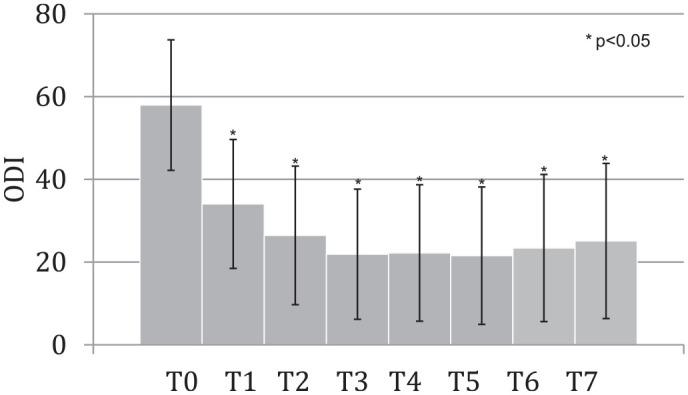
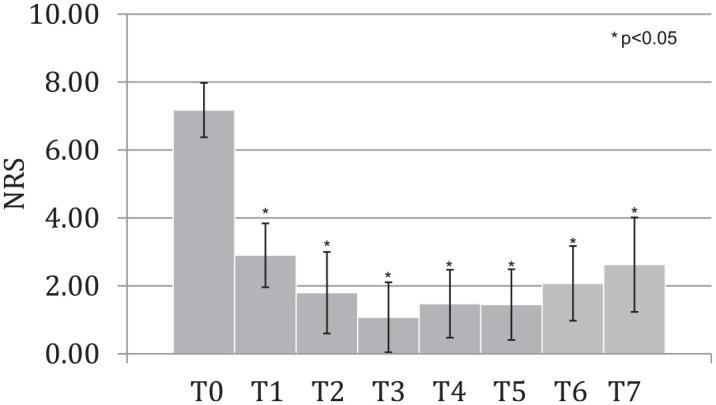
All patients had a reduction in NRS and an improvement in ODI. NRS was reduced significantly after 1 month and remained the same until the end of the study. ODI was significantly improved from T1 (1 month after surgery) up to T7 (end of the study). The improvements did not differ whether already treated with percutaneous rhizotomy or not. Patients less than 60 years or with 1-2 joints treated had better improvement compared with the others.
CONCLUSION
The results obtained demonstrate that ER for denervation of the facet joint is an effective treatment in patients with chronic LBP, with consistent and stable results at 2-year follow up. The technique has a rapid learning curve and no major complications occurred. Moreover, the previous percutaneous RF treatment had no influence on the results obtained with endoscopic technique. There is evidence that best results are obtained in younger patients and/or in patients with 1-2 joints treated.
LAY SUMMARY
Low-back pain has facet joints inflammation or degeneration as pain generator in 20-40% of cases. Nervous lesion of the dorsal ramus innervating the facet joints has been shown as an efficacious treatment to obtain good analgesia. Percutaneous techniques have provided short term results for several reasons. This research aimed to see whether endoscopic denervation, which guarantees a more precise approach to anatomical structure, would result in more durable results. The study conducted on 40 patients has made it clear that this approach gives significant analgesia for at least 2 years, which was the time of patient follow up.
目的
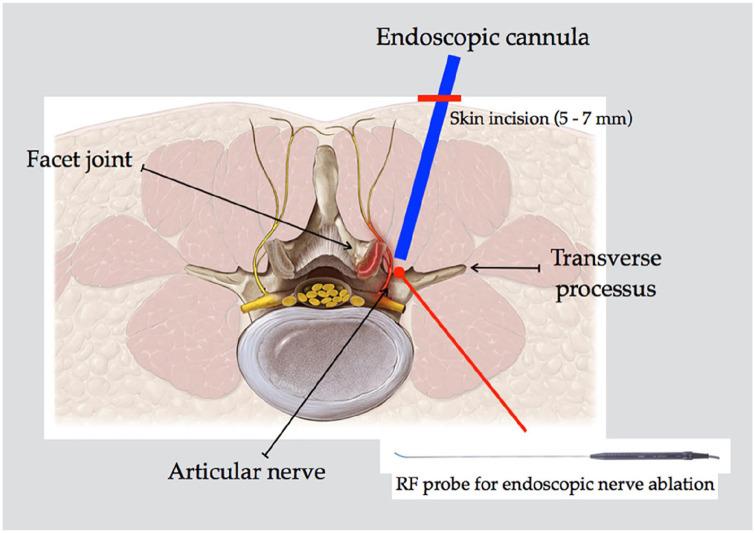
本研究旨在评估内镜下神经根切断术(ER)对因小关节综合征(FJS)导致慢性下腰痛(LBP)患者的腰椎小关节去神经支配的疗效。
方法
共筛选出50例因小关节导致慢性LBP的连续患者接受ER治疗。参与研究的患者进行了为期2年的随访。在术前和术后评估数字评分量表(NRS)和奥斯威斯利功能障碍指数(ODI)。为评估次要终点,将患者分组。一组包括先前接受过经皮射频(RF)治疗的患者。另一组包括首次接受介入治疗的患者。我们还按年龄和治疗关节数量对患者进行分组比较,试图阐明这些参数是否可预测该手术的有效性。
结果
所有患者的NRS均降低,ODI均改善。NRS在1个月后显著降低,直至研究结束保持不变。ODI从T1(术后1个月)到T7(研究结束)显著改善。无论是否已接受经皮神经根切断术,改善情况均无差异。年龄小于60岁或治疗1 - 2个关节的患者比其他患者改善更好。
结论
获得的结果表明,ER用于小关节去神经支配对慢性LBP患者是一种有效的治疗方法,在2年随访中结果一致且稳定。该技术学习曲线快速,未发生重大并发症。此外,先前的经皮RF治疗对内镜技术获得的结果无影响。有证据表明,年轻患者和/或治疗1 - 2个关节的患者效果最佳。
简要概述
在20% - 40%的病例中,下腰痛由小关节炎症或退变作为疼痛源引起。支配小关节的背支神经损伤已被证明是获得良好镇痛效果的有效治疗方法。由于多种原因,经皮技术只能提供短期效果。本研究旨在探讨内镜下神经去支配术(其保证对解剖结构采用更精确的方法)是否会产生更持久的效果。对40例患者进行的研究表明,这种方法至少在2年(患者随访时间)内可提供显著的镇痛效果。
 Zotero 插件