Salter Sandra M, Marriott Ross J, Murray Kevin, Stiles Samantha L, Bailey Paul, Mullins Raymond J, Sanfilippo Frank M
School of Allied Health, Faculty of Health and Medical Sciences, The University of Western Australia, M315, 35 Stirling Highway, Perth, WA, 6009, Australia.
School of Population and Global Health, Faculty of Health and Medical Sciences, The University of Western Australia, Perth, WA, 6009, Australia.
World Allergy Organ J. 2020 Nov 13;13(11):100480. doi: 10.1016/j.waojou.2020.100480. eCollection 2020 Nov.
Anaphylaxis events are increasing worldwide, based on studies of single administrative datasets including hospital admissions, emergency room presentations, and prescription and medical claims data. Linking multiple administrative datasets may provide better epidemiological estimates, by capturing a greater number of anaphylaxis events occurring at the individual level. In this linked data study in Western Australia, we combined 4 population-based datasets to identify anaphylaxis events, factors influencing occurrence, and change in event rates from 2002 to 2013.
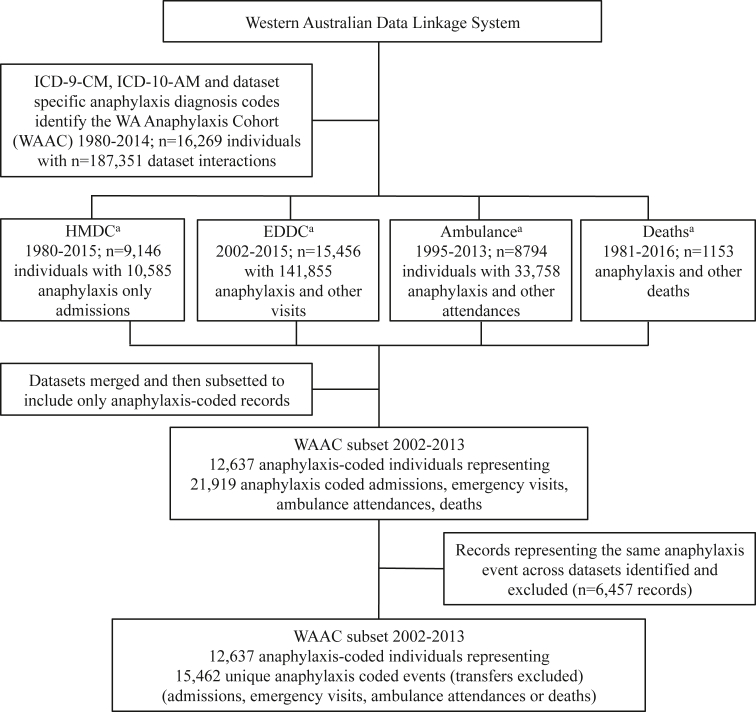
Four linked administrative datasets from the Western Australian Data Linkage System were used, representing ambulance attendances, emergency department presentations, hospital inpatient admissions and death registrations. An anaphylaxis cohort was identified using ICD-9-CM, ICD-10-AM and additional anaphylaxis diagnosis codes, with event rates calculated. We explored the impact of age, gender, cause, Indigenous status and socioeconomic index on event rates. Standard Poisson regression models were used to examine the significance of the change in anaphylaxis event rates over time.
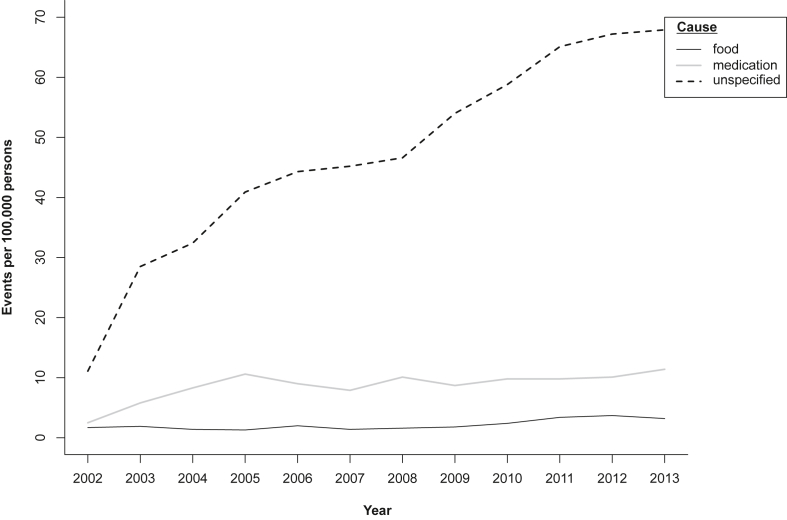
A total 12,637 individuals (mean age 31.8 years, 49.6% female) experienced 15,462 anaphylaxis events between 2002 and 2013 (97.5% in non-Indigenous patients and 59.5% residing in the area of greatest socioeconomic advantage). Anaphylaxis event rates increased from 15.4 to 82.5/10 population between 2002 and 2013. The greatest increase in anaphylaxis events was seen in those coded as unspecified anaphylaxis (all ages, males and females combined, p < 0.001), with the highest rates of unspecified anaphylaxis in males 0-4 years (171.9/10 population in 2013), and females 15-19 years (104.0/10 in 2013). The average annual percent increase (95% CI) for food-related anaphylaxis was 9.2% (6.6-12.0); for medication-related anaphylaxis was 5.8% (4.5-7.1); and for unspecified anaphylaxis was 10.4% (9.8-11.0); all p < 0.001. There was a significant increase in ambulance attendance, emergency presentations and inpatient admissions for anaphylaxis between 2002 and 2013, with emergency presentations (56.0/10 population), inpatient admissions (43.2/10), and ambulance attendance (21.6/10) highest in 2013. Only 25 anaphylaxis-related deaths were recorded in the mortality register with no significant change in rates over time.
Using multiple linked administrative datasets, we identified significantly higher rates of total anaphylaxis than previously reported, with more than 5-fold increases in anaphylaxis events between 2002 and 2013. While the combination of 4 population-level datasets provides a more comprehensive capture of cases, even at the individual dataset level, admission rates for anaphylaxis in Western Australia are substantially higher than those previously reported for similar time periods, both in Australia and worldwide.
基于对包括医院入院、急诊就诊、处方和医疗理赔数据在内的单一管理数据集的研究,全球过敏反应事件呈上升趋势。通过收集个体层面发生的更多过敏反应事件,将多个管理数据集关联起来可能会提供更好的流行病学估计。在西澳大利亚州的这项关联数据研究中,我们合并了4个基于人群的数据集,以识别过敏反应事件、影响其发生的因素以及2002年至2013年期间事件发生率的变化。
使用了西澳大利亚州数据关联系统中的4个关联管理数据集,分别代表救护车出勤、急诊科就诊、医院住院入院和死亡登记。使用国际疾病分类第九版临床修订本(ICD-9-CM)、国际疾病分类第十版澳大利亚修订本(ICD-10-AM)以及其他过敏反应诊断编码识别过敏反应队列,并计算事件发生率。我们探讨了年龄、性别、病因、原住民身份和社会经济指数对事件发生率的影响。使用标准泊松回归模型检验过敏反应事件发生率随时间变化的显著性。
2002年至2013年期间,共有12637人(平均年龄31.8岁,49.6%为女性)经历了15462次过敏反应事件(97.5%为非原住民患者,59.5%居住在社会经济优势最大的地区)。2002年至2013年期间,过敏反应事件发生率从每10万人15.4例增至82.5例。未明确分类的过敏反应事件增加幅度最大(所有年龄段、男女合计,p<0.001),未明确分类的过敏反应发生率在0至4岁男性中最高(2013年为每10万人171.9例),在15至19岁女性中最高(2013年为每10万人104.0例)。与食物相关的过敏反应的年均增长率(95%CI)为9.2%(6.6-12.0);与药物相关的过敏反应为5.8%(4.5-7.1);未明确分类者为10.4%(9.8-11.0);均p<0.001。2002年至2013年期间,过敏反应的救护车出勤、急诊就诊和住院入院人数显著增加,2013年急诊就诊率(每10万人56.0例)、住院入院率(每10万人43.2例)和救护车出勤率(每10万人21.6例)最高。死亡登记中仅记录了25例与过敏反应相关的死亡,发生率随时间无显著变化。
通过使用多个关联管理数据集,我们发现过敏反应总发生率显著高于先前报告,2002年至2013年期间过敏反应事件增加了5倍多。虽然4个基于人群的数据集的组合能更全面地捕获病例,但即使在单个数据集层面,西澳大利亚州的过敏反应入院率也远高于澳大利亚和全球此前报告的同期类似水平。