Tanno Luciana Kase, Bierrenbach Ana Luiza, Simons F Estelle R, Cardona Victoria, Thong Bernard Yu-Hor, Molinari Nicolas, Calderon Moises A, Worm Margitta, Chang Yoon-Seok, Papadopoulos Nikolaos G, Casale Thomas, Demoly Pascal
1Hospital Sírio Libanês, São Paulo, Brazil.
2University Hospital of Montpellier, Montpellier, France.
Allergy Asthma Clin Immunol. 2018 Apr 4;14:12. doi: 10.1186/s13223-018-0234-0. eCollection 2018.
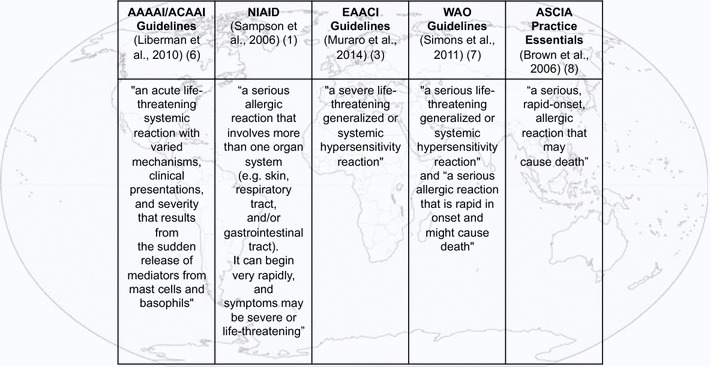
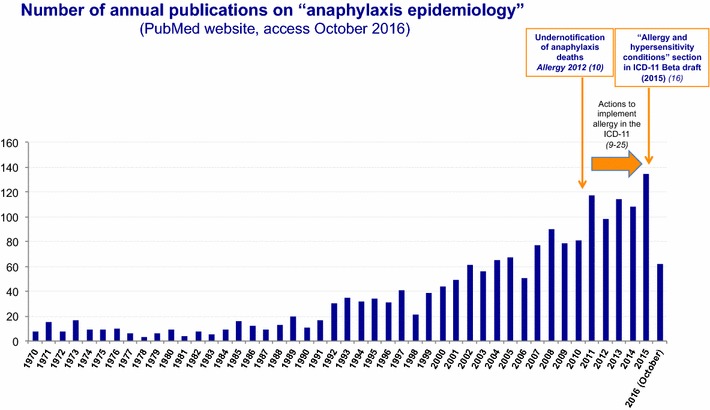
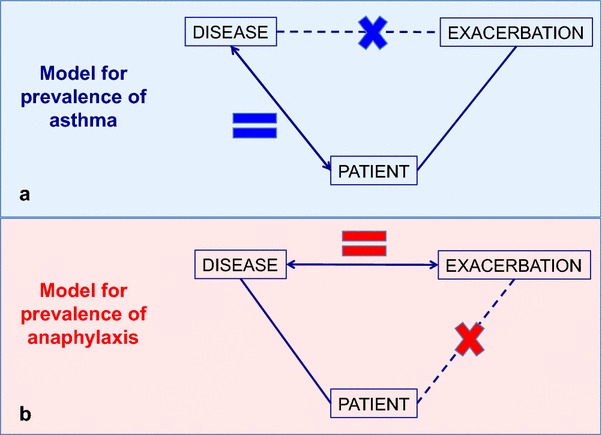
In contrast to the majority of allergic or hypersensitivity conditions, worldwide anaphylaxis epidemiological data remain sparse with low accuracy, which hampers comparable morbidity statistics. Data can differ widely depending on a number of variables. In the current document we reviewed the forms on which anaphylaxis has been defined and classified; and how it can affect epidemiological data. With regards to the methods used to capture morbidity statistics, we observed the impact of the anaphylaxis coding utilizing the World Health Organization's International Classification of Diseases. As an outcome and depending on the anaphylaxis definition, we extracted the cumulative incidence, which may not reflect the real number of new cases. The new ICD-11 anaphylaxis subsection developments and critical view of morbidity statistics data are discussed in order to reach new perspectives on anaphylaxis epidemiology.
与大多数过敏或超敏反应情况不同,全球范围内过敏反应的流行病学数据仍然稀少且准确性低,这妨碍了可比的发病率统计。数据可能因许多变量而有很大差异。在本文件中,我们回顾了过敏反应的定义和分类形式;以及它如何影响流行病学数据。关于用于获取发病率统计数据的方法,我们观察了使用世界卫生组织《国际疾病分类》进行过敏反应编码的影响。作为一个结果,并根据过敏反应的定义,我们提取了累积发病率,这可能无法反映新病例的实际数量。讨论了新的《国际疾病分类第11版》过敏反应子部分的发展以及对发病率统计数据的批判性观点,以便获得关于过敏反应流行病学的新观点。