Salale University, Department of Public Health, Fiche, Ethiopia.
Ambo University, Department of Midwifery, Ambo, Ethiopia.
Biomed Res Int. 2020 Nov 19;2020:8824291. doi: 10.1155/2020/8824291. eCollection 2020.
Anemia is a major public health problem in both developed and developing countries especially among pregnant women. Nearly half of pregnant women in Ethiopia have anemia which has both health and economic impacts. Therefore, this study is aimed at identifying nutritional-related predictors of anemia among pregnant women attending antenatal care in Central Ethiopia, 2019.
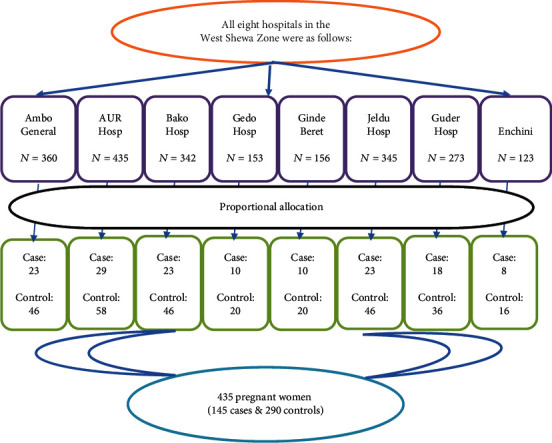
An unmatched case-control study was conducted at public hospitals in Central Ethiopia from February to April 2019. The consecutive sampling technique was used to select study participants. Data were collected by a structured questionnaire, and the collected data were entered into Epi Info version 7 and SPSS version 23 for analysis. Binary and multiple logistic regression analyses were computed to identify predictors of anemia. Adjusted odds ratio (AOR) with 95% confidence interval (CI) and value < 0.05 was used to determine the presence of an association.
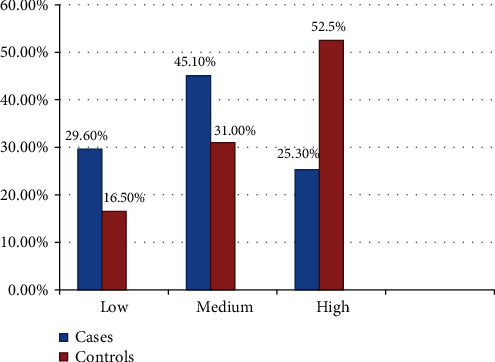
A total of 426 pregnant women (142 cases and 284 controls) had participated in this study. Taking tea/coffee immediately after food (AOR = 2.35, 95% CI: 1.39-3.99), mid-upper arm circumference (MUAC) of mothers of <23 centimeters (AOR = 3.83, 95% CI: 2.26-6.49), the presence of forbidden food during pregnancy (AOR = 2.21, 95% CI: 1.24-3.88), not taking additional food (AOR = 1.99, 95% CI: 1.17-3.40), unable to take fruit (AOR = 4.05, 95% CI: 1.3-15.47), loss of appetite (AOR = 2.28, 95% CI: 1.28-4.09), low dietary diversity score (DDS) (AOR = 3.29, 95% CI: 1.83-5.90), and medium DDS (AOR = 2.88, 95% CI: 1.46-5.70) were found to be determinants of anemia.
Taking tea or coffee immediately after food, MUAC of mothers, the presence of forbidden food, not taking additional food, frequency of taking fruit, and dietary diversity were predictors of anemia among pregnant women. Therefore, interventions targeted at prevention of anemia among pregnant mothers should emphatically consider those identified determinants. This finding also highlights the need for strong nutritional counseling to prevent anemia among pregnant mothers during antenatal care follow-ups along with other interventions.
贫血是发达国家和发展中国家都存在的一个重大公共卫生问题,尤其是在孕妇中。在埃塞俄比亚,几乎有一半的孕妇患有贫血,这对孕妇的健康和经济都有影响。因此,本研究旨在确定 2019 年在埃塞俄比亚中部接受产前护理的孕妇中与营养相关的贫血预测因素。
这是一项在埃塞俄比亚中部的公立医院进行的不匹配病例对照研究,时间为 2019 年 2 月至 4 月。采用连续抽样技术选择研究参与者。数据通过结构化问卷收集,收集的数据输入 Epi Info 版本 7 和 SPSS 版本 23 进行分析。采用二元和多变量逻辑回归分析来确定贫血的预测因素。采用调整后的优势比(AOR)和 95%置信区间(CI)和 值<0.05 来确定关联的存在。
共有 426 名孕妇(142 例病例和 284 例对照)参加了这项研究。食用后立即喝茶/咖啡(AOR=2.35,95%CI:1.39-3.99)、母亲的上臂中部周长(MUAC)<23 厘米(AOR=3.83,95%CI:2.26-6.49)、怀孕期间禁食(AOR=2.21,95%CI:1.24-3.88)、不额外进食(AOR=1.99,95%CI:1.17-3.40)、无法进食水果(AOR=4.05,95%CI:1.3-15.47)、食欲不振(AOR=2.28,95%CI:1.28-4.09)、低膳食多样性得分(DDS)(AOR=3.29,95%CI:1.83-5.90)和中等 DDS(AOR=2.88,95%CI:1.46-5.70)被发现是贫血的决定因素。
食用后立即喝茶/咖啡、母亲 MUAC、禁食、不额外进食、进食水果频率和膳食多样性是孕妇贫血的预测因素。因此,预防孕妇贫血的干预措施应特别考虑到这些确定的决定因素。这一发现还强调了在产前保健随访中,需要通过营养咨询来预防孕妇贫血,同时还需要采取其他干预措施。