Soldi Monica, Sergi Sergi Lucia, Unali Giulia, Kerzel Thomas, Cuccovillo Ivan, Capasso Paola, Annoni Andrea, Biffi Mauro, Rancoita Paola Maria Vittoria, Cantore Alessio, Lombardo Angelo, Naldini Luigi, Squadrito Mario Leonardo, Kajaste-Rudnitski Anna
San Raffaele Telethon Institute for Gene Therapy (SR-TIGET), IRCSS Ospedale San Raffaele, 20132 Milan, Italy.
Vita-Salute San Raffaele University, School of Medicine, 20132 Milan, Italy.
Mol Ther Methods Clin Dev. 2020 Oct 20;19:411-425. doi: 10.1016/j.omtm.2020.10.009. eCollection 2020 Dec 11.
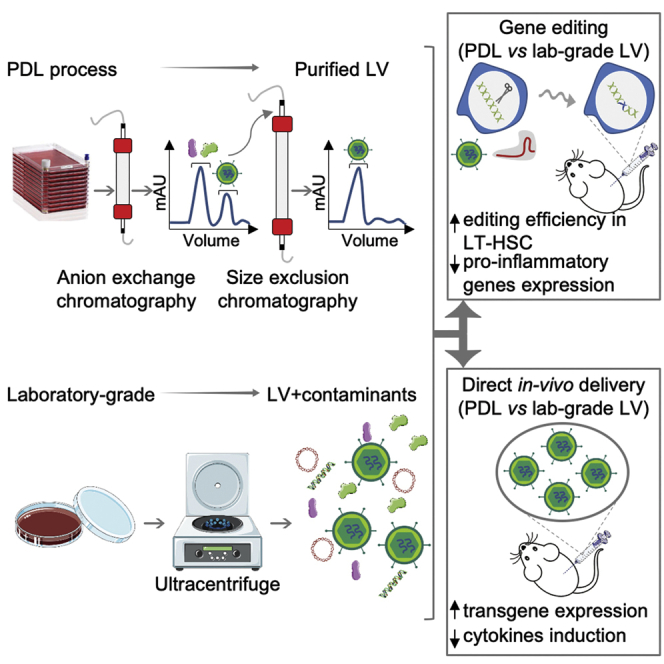
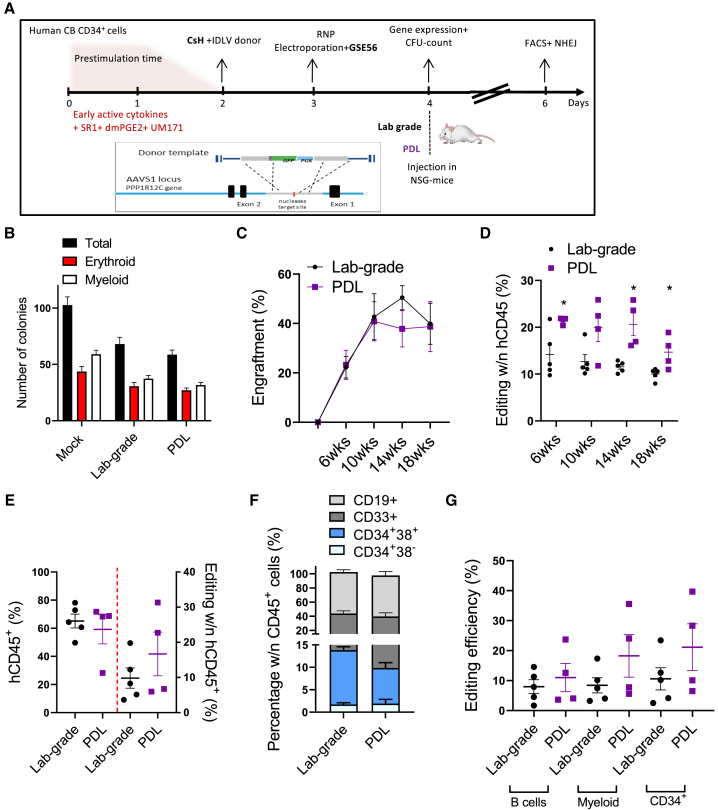
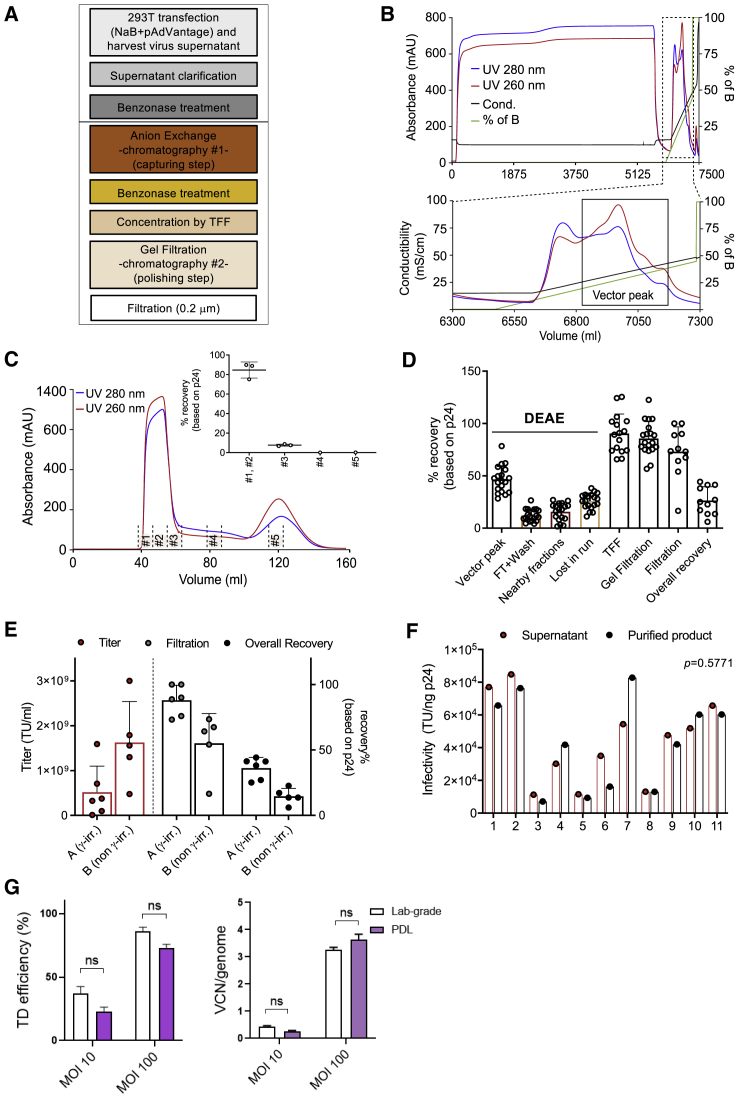
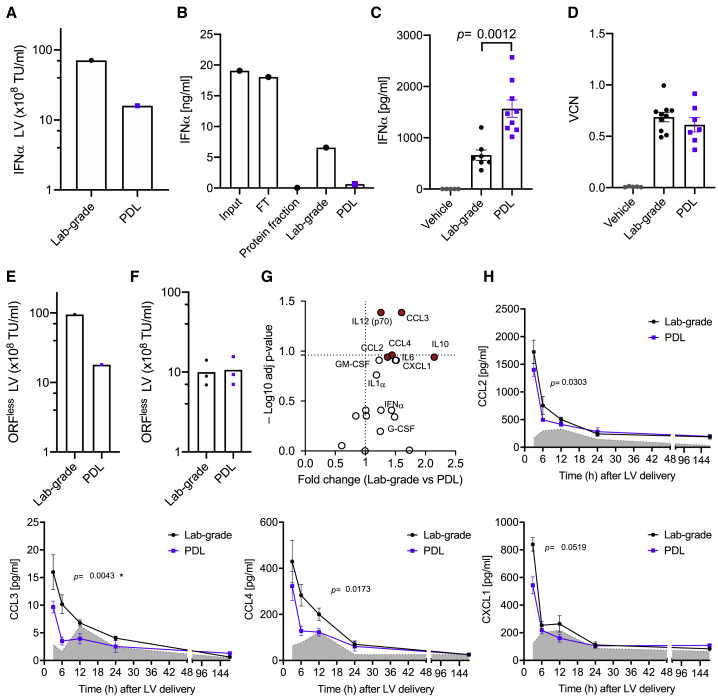
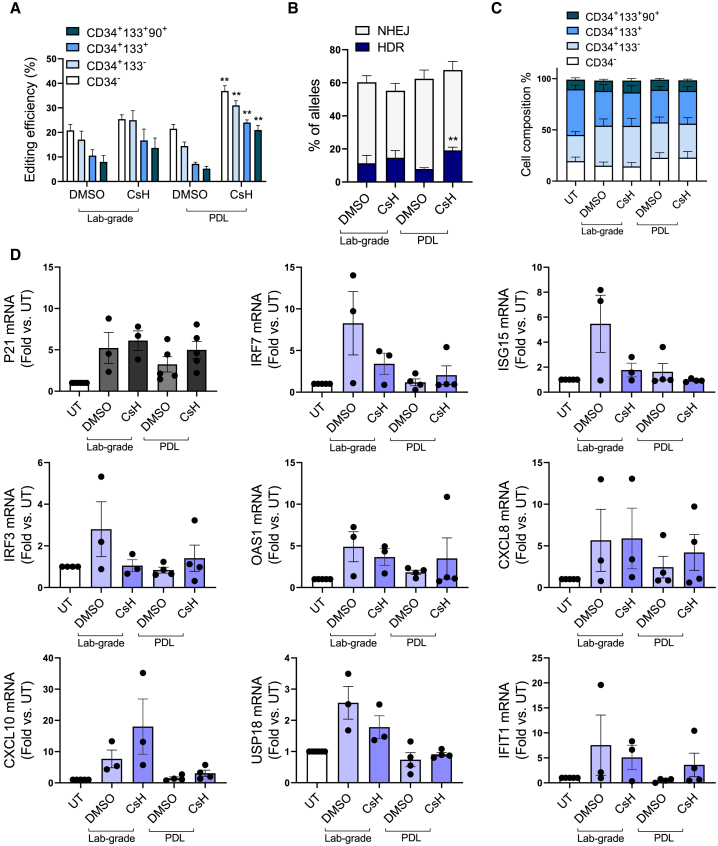
Lentiviral vectors (LVs) are increasingly employed in gene and cell therapy. Standard laboratory production of LVs is not easily scalable, and research-grade LVs often contain contaminants that can interfere with downstream applications. Moreover, purified LV production pipelines have been developed mainly for costly, large-scale, clinical-grade settings. Therefore, a standardized and cost-effective process is still needed to obtain efficient, reproducible, and properly executed experimental studies and preclinical development of and gene therapies, as high infectivity and limited adverse reactions are important factors potentially influencing experimental outcomes also in preclinical settings. We describe here an optimized laboratory-scale workflow whereby an LV-containing supernatant is purified and concentrated by sequential chromatographic steps, obtaining biologically active LVs with an infectious titer and specific activity in the order of 10 transducing unit (TU)/mL and 5 × 10 TU/ng of HIV Gag p24, respectively. The purification workflow removes >99% of the starting plasmid, DNA, and protein impurities, resulting in higher gene transfer and editing efficiency in severe combined immunodeficiency (SCID)-repopulating hematopoietic stem and progenitor cells (HSPCs) , as well as reduced activation of inflammatory responses and as compared to TU-matched, laboratory-grade vectors. Our results highlight the value of accessible purified LV production for experimental studies and preclinical testing.
慢病毒载体(LVs)越来越多地应用于基因和细胞治疗。实验室中LVs的标准生产方法不易扩大规模,且研究级别的LVs通常含有会干扰下游应用的污染物。此外,纯化LVs的生产流程主要是为成本高昂的大规模临床级环境而开发的。因此,仍需要一种标准化且经济高效的流程,以获得高效、可重复且执行得当的实验研究以及基因治疗的临床前开发成果,因为高感染性和有限的不良反应也是在临床前环境中可能影响实验结果的重要因素。我们在此描述了一种优化的实验室规模工作流程,通过连续的色谱步骤对含LVs的上清液进行纯化和浓缩,从而获得具有生物活性的LVs,其感染滴度和比活性分别约为10转导单位(TU)/毫升和5×10 TU/纳克HIV Gag p24。该纯化工作流程去除了超过99%的起始质粒、DNA和蛋白质杂质,与TU匹配的实验室级载体相比,在严重联合免疫缺陷(SCID)重建造血干细胞和祖细胞(HSPCs)中实现了更高的基因转移和编辑效率,同时减少了炎症反应的激活。我们的结果突出了可获取的纯化LVs生产对于实验研究和临床前测试的价值。