Xu Yingde, Liu Xiangmei, Zheng Yufeng, Li Changyi, Kwok Yeung Kelvin Wai, Cui Zhenduo, Liang Yanqin, Li Zhaoyang, Zhu Shengli, Wu Shuilin
School of Materials Science & Engineering, The Key Laboratory of Advanced Ceramics and Machining Technology By the Ministry of Education of China, Tianjin University, Tianjin, 300072, China.
Hubei Key Laboratory of Polymer Materials, Ministry-of-Education Key Laboratory for the Green Preparation and Application of Functional Materials, School of Materials Science & Engineering, Hubei University, Wuhan, 430062, China.
Bioact Mater. 2020 Nov 20;6(6):1575-1587. doi: 10.1016/j.bioactmat.2020.11.013. eCollection 2021 Jun.
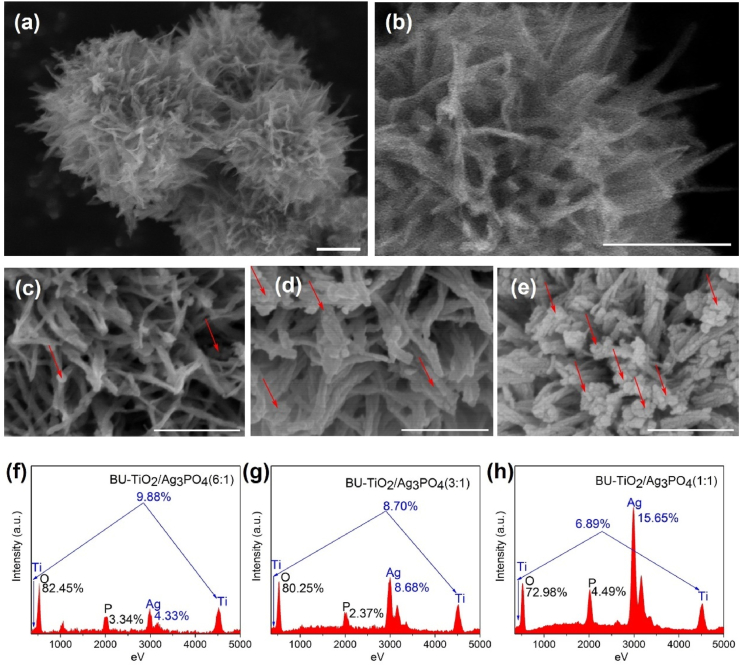
Both phototherapy via photocatalysts and physical puncture by artificial nanostructures are promising substitutes for antibiotics when treating drug-resistant bacterial infectious diseases. However, the photodynamic therapeutic efficacy of photocatalysts is seriously restricted by the rapid recombination of photogenerated electron-hole pairs. Meanwhile, the nanostructures of physical puncture are limited to two-dimensional (2D) platforms, and they cannot be fully used yet. Thus, this research developed a synergistic system of AgPO nanoparticles (NPs), decorated with black urchin-like defective TiO (BU-TiO/AgPO). These NPs had a decreased bandgap compared to BU-TiO, and BU-TiO/AgPO (3:1) exhibited the lowest bandgap and the highest separation efficiency for photogenerated electron-hole pairs. After combination with BU-TiO, the photostability of AgPO improved because the oxygen vacancy of BU-TiO retards the reduction of Ag in AgPO into Ag, thus reducing its toxicity. In addition, the nanospikes on the surface of BU-TiO can, from all directions, physically puncture bacterial cells, thus assisting the hybrid's photodynamic therapeutic effects, alongside the small amount of Ag released from AgPO. This achieves synergy, endowing the hybrid with high antibacterial efficacy of 99.76 ± 0.15% and 99.85 ± 0.09% against and , respectively, after light irradiation for 20 min followed by darkness for 12 h. It is anticipated that these findings may bring new insight for developing synergistic treatment strategies against bacterial infectious diseases or pathogenic bacterial polluted environments.
在治疗耐药细菌感染性疾病时,通过光催化剂进行光疗和利用人工纳米结构进行物理穿刺都是有望替代抗生素的方法。然而,光催化剂的光动力治疗效果受到光生电子 - 空穴对快速复合的严重限制。同时,物理穿刺的纳米结构仅限于二维(2D)平台,尚未得到充分利用。因此,本研究开发了一种由黑色海胆状缺陷TiO修饰的AgPO纳米颗粒(NPs)的协同系统(BU-TiO/AgPO)。与BU-TiO相比,这些NPs的带隙减小,并且BU-TiO/AgPO(3:1)表现出最低的带隙和最高的光生电子 - 空穴对分离效率。与BU-TiO结合后,AgPO的光稳定性提高,因为BU-TiO的氧空位阻碍了AgPO中Ag还原为Ag,从而降低了其毒性。此外,BU-TiO表面的纳米尖刺可以从各个方向物理穿刺细菌细胞,从而辅助该混合物的光动力治疗效果,同时还有少量从AgPO释放的Ag。这实现了协同作用,在光照20分钟后黑暗放置12小时后,该混合物对大肠杆菌和金黄色葡萄球菌的抗菌效率分别达到99.76±0.15%和99.85±0.09%。预计这些发现可能为开发针对细菌感染性疾病或致病性细菌污染环境的协同治疗策略带来新的见解。