Abohamr Samah I, Aldossari Mubarak A, Alaklobi Faisal A, Amer Hala A, Alzarzour Shaimaa H, Abdelhamid Sara W, Aljunaidi Obaid, Badhawi Omar S, Siddiqui Shireen, Jumaa Hanem, Badwi Muhammad, Elsheikh Eman
Heart Health Center, King Saud Medical City. Riyadh, Kingdom of Saudi Arabia. E-mail.
Saudi Med J. 2020 Dec;41(12):1336-1343. doi: 10.15537/smj.2020.12.25514.
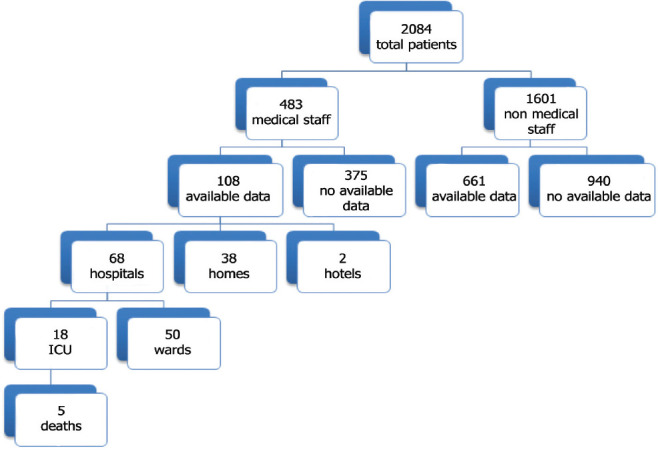
To analyze the clinical characteristics and in-hospital outcomes among coronavirus disease 2019 (COVID-19) positive medical staff compared with those of public. Methods: A total of 108 COVID-19-positive medical staff patients were included in the study from March 23, 2020 to June 15, 2020. Patients were analyzed for demographic data, clinical presentations, and in-hospital outcomes and compared against 661 COVID-19-infected patients of non-medical personel. Results: Mean age of medical staff patients was 44.05±13.9 years, most of whom were women (63.9%). The infected medical staff members consisted of 63 nurses (58.3%), 37 physicians (34.3%), 5 technicians (4.6%), and 3 pharmacists (2.8%). Smoking (60.2%) was the most frequent, followed by diabetes mellitus (37%). Of 108 COVID-19 infected medical staff, 18 (16.6%) were isolated in the intensive care unit (ICU), of which 14 (77.8%) were male, 16 (88.9%) were smokers, and 16 (88.9%) presented with pneumonia. Fatality ratio among medical staff patients was 4.6%. Male gender with odds ratios (OR) of 7.771 and 95% confidence intervals (CI) of 0.837-72.195 and a history of chronic kidney disease of (OR=10.778, 95% CI: 1.503-77.287) were predictors of death among the medical staff group. Conclusion: The incidence of COVID-19 infection among medical staff is quite high, but the occurrence of extreme illness and death is significantly low compared with the general community. Training should be implemented for all hospital staff on infection prevention techniques. Reliable and quick access for testing medical personnel is essential to maintain health, safety, and availability of health care workers during this pandemic.
分析2019冠状病毒病(COVID-19)呈阳性的医务人员与普通人群相比的临床特征及住院结局。方法:2020年3月23日至2020年6月15日,共有108例COVID-19呈阳性的医务人员患者纳入本研究。分析患者的人口统计学数据、临床表现及住院结局,并与661例COVID-19感染的非医务人员患者进行比较。结果:医务人员患者的平均年龄为44.05±13.9岁,其中大多数为女性(63.9%)。受感染的医务人员包括63名护士(58.3%)、37名医生(34.3%)、5名技术人员(4.6%)和3名药剂师(2.8%)。吸烟(60.2%)最为常见,其次是糖尿病(37%)。108例COVID-19感染的医务人员中,18例(16.6%)在重症监护病房(ICU)隔离,其中14例(77.8%)为男性,16例(88.9%)吸烟,16例(88.9%)患有肺炎。医务人员患者的病死率为4.6%。男性(比值比[OR]=7.771,95%置信区间[CI]=0.837-72.195)和慢性肾脏病病史(OR=10.778,95%CI:1.503-77.287)是医务人员组死亡的预测因素。结论:医务人员中COVID-19感染发生率相当高,但与普通人群相比,重症和死亡发生率显著较低。应对所有医院工作人员进行感染预防技术培训。在本次大流行期间,为医务人员提供可靠、快速的检测途径对于维持医护人员的健康、安全及可利用性至关重要。