Department of Medical and Surgical Sciences, University of Foggia, Foggia, Italy.
Brain Behav. 2021 Feb;11(2):e01960. doi: 10.1002/brb3.1960. Epub 2020 Dec 8.
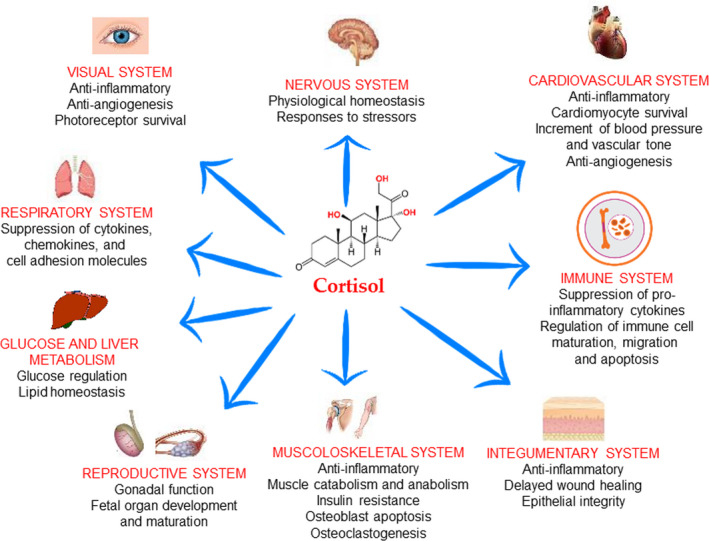
The stress response is different in various individuals, however, the mechanisms that could explain these distinct effects are not well known and the molecular correlates have been considered one at the time. Particular harmful conditions occur if the subject, instead to cope the stressful events, succumb to them, in this case, a cascade reaction happens that through different signaling causes a specific reaction named "sickness behaviour." The aim of this article is to review the complex relations among important molecules belonging to Central nervous system (CNS), immune system (IS), and endocrine system (ES) during the chronic stress response.
After having verified the state of art concerning the function of cortisol, norepinephrine (NE), interleukin (IL)-1β and melatonin, we describe as they work together.
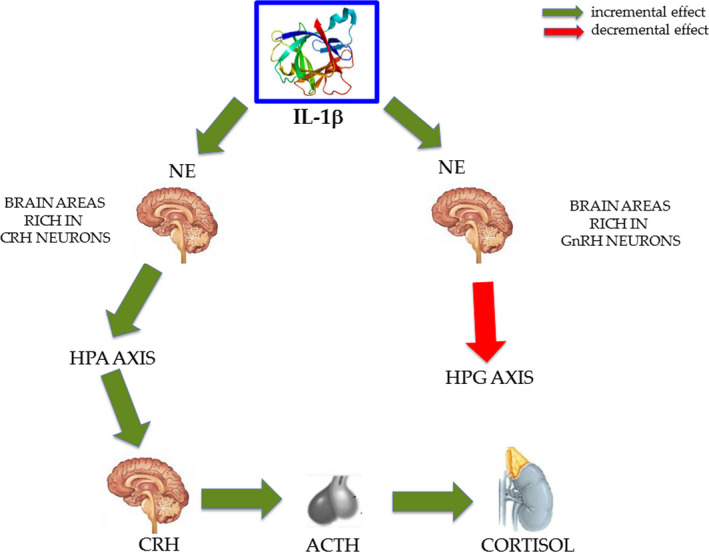
We propose a speculative hypothesis concerning the complex interplay of these signaling molecules during chronic stress, highlighting the role of IL-1β as main biomarker of this effects, indeed, during chronic stress its increment transforms this inflammatory signal into a nervous signal (NE), in turn, this uses the ES (melatonin and cortisol) to counterbalance again IL-1β. During cortisol resistance, a vicious loop occurs that increments all mediators, unbalancing IS, ES, and CNS networks. This IL-1β increase would occur above all when the individual succumbs to stressful events, showing the Sickness Behaviour Symptoms. IL-1β might, through melatonin and vice versa, determine sleep disorders too.
The molecular links here outlined could explain how stress plays a role in etiopathogenesis of several diseases through this complex interplay.
不同个体的应激反应不同,然而,能够解释这些不同影响的机制尚不清楚,而且分子相关性一直被认为是一次性的。如果主体不能应对压力事件,而是屈服于它们,就会出现特殊的有害情况,在这种情况下,级联反应会发生,通过不同的信号转导导致一种特定的反应,称为“疾病行为”。本文的目的是综述中枢神经系统(CNS)、免疫系统(IS)和内分泌系统(ES)中重要分子在慢性应激反应中的复杂关系。
在验证了皮质醇、去甲肾上腺素(NE)、白细胞介素(IL)-1β和褪黑素的功能现状后,我们描述了它们是如何协同工作的。
我们提出了一个关于这些信号分子在慢性应激中复杂相互作用的推测性假设,强调了 IL-1β作为这种效应的主要生物标志物的作用,事实上,在慢性应激中,其增加将这种炎症信号转化为神经信号(NE),反过来,这利用 ES(褪黑素和皮质醇)再次平衡 IL-1β。在皮质醇抵抗时,会发生一个恶性循环,所有介质都会增加,使 IS、ES 和 CNS 网络失衡。这种 IL-1β的增加主要发生在个体屈服于压力事件,表现出疾病行为症状时。IL-1β可能通过褪黑素和反之亦然,导致睡眠障碍。
这里概述的分子联系可以解释应激如何通过这种复杂的相互作用在多种疾病的发病机制中发挥作用。