Universidade Federal de Juiz de Fora - Faculdade de Medicina, Juiz de Fora, MG - Brasil.
Fundação Oswaldo Cruz Programa de Computação Científica - PROCC, Rio de Janeiro, RJ - Brasil.
Arq Bras Cardiol. 2020 Nov;115(5):849-859. doi: 10.36660/abc.20190438.
Acute myocardial infarction (AMI), the leading cause of death in Brazil, has presented regional disparities in mortality rate time trends in recent years. Previous time trend studies did not correct for cause-of-death garbage codes, which may have skewed the estimates.
To analyze regional and gender-based inequalities in the AMI mortality trend in Brazil from 1996-2016.
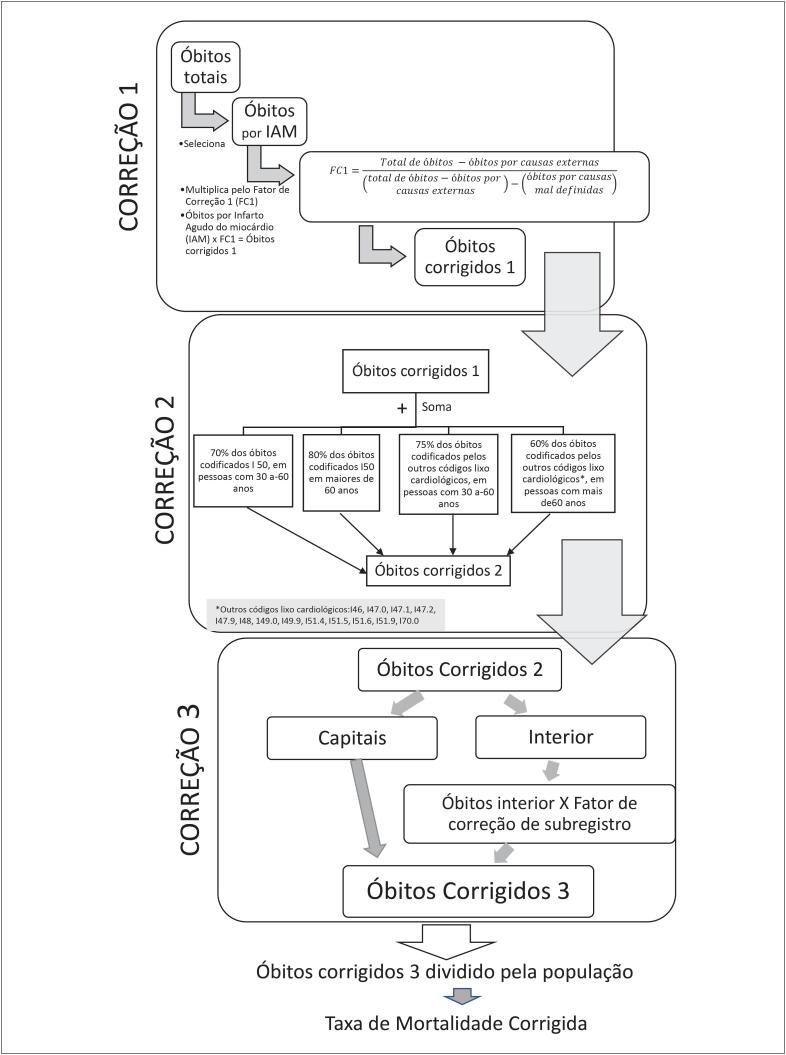
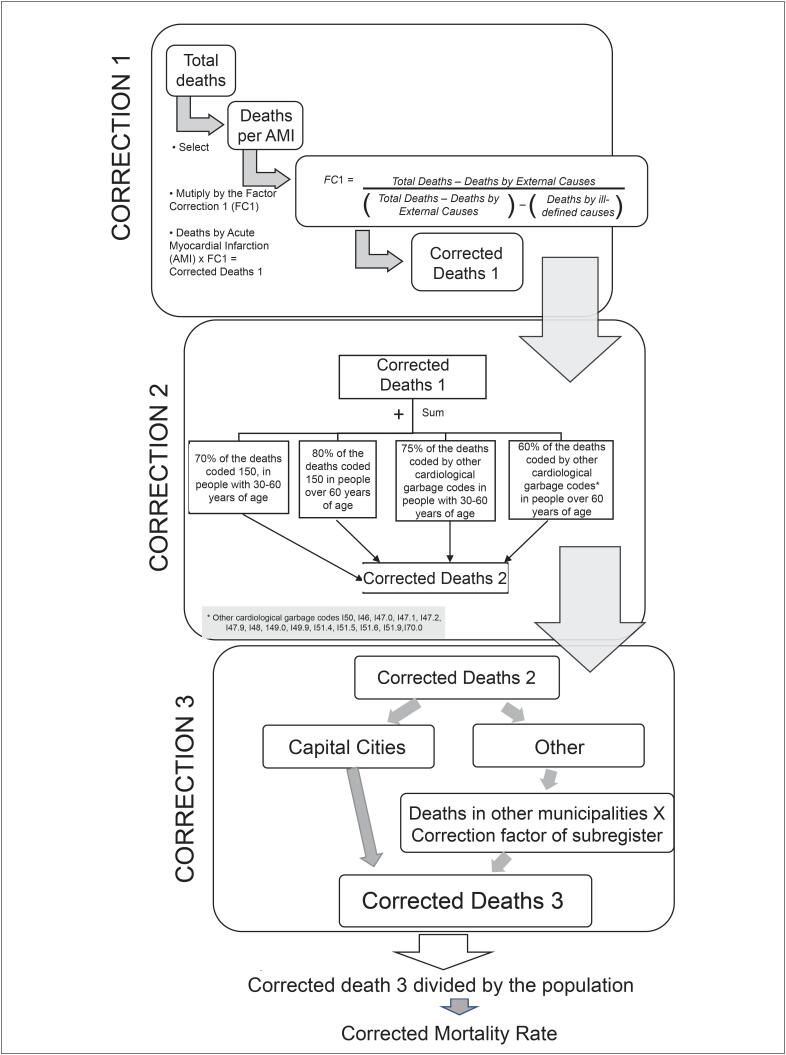
A 21-year time series study (1996-2016). Data are from the Mortality Information System and population estimates from the Brazilian Institute of Geography and Statistics. Corrections of deaths due to ill-defined causes of death, garbage codes, and underreporting were made. The time series broken down by major geographic regions, gender, capital cities, and other municipalities was analyzed using the linear regression technique segmented by Jointpoint. Statistical significance level was set at 5%.
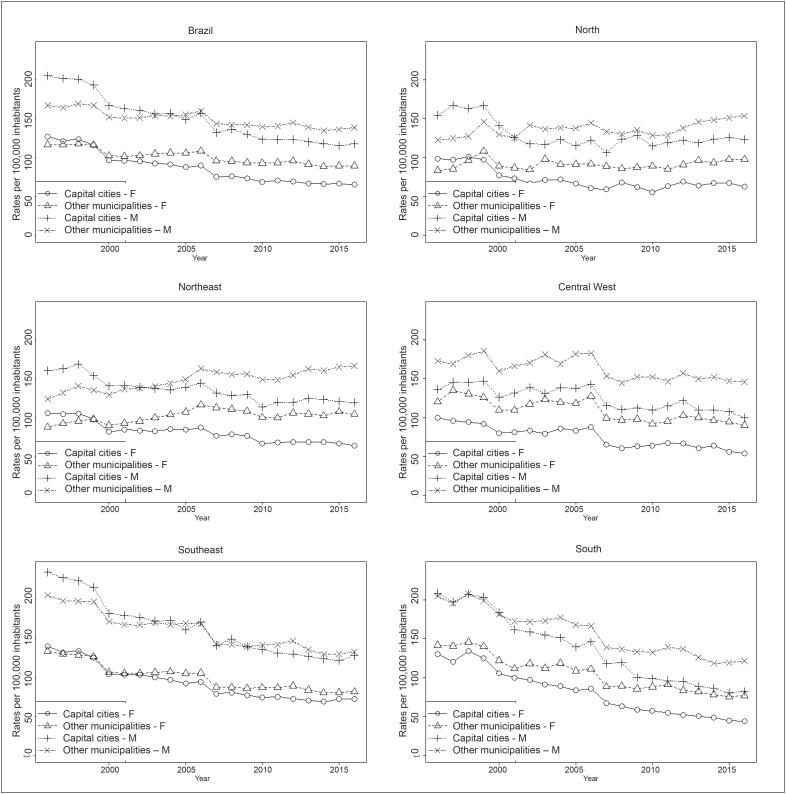
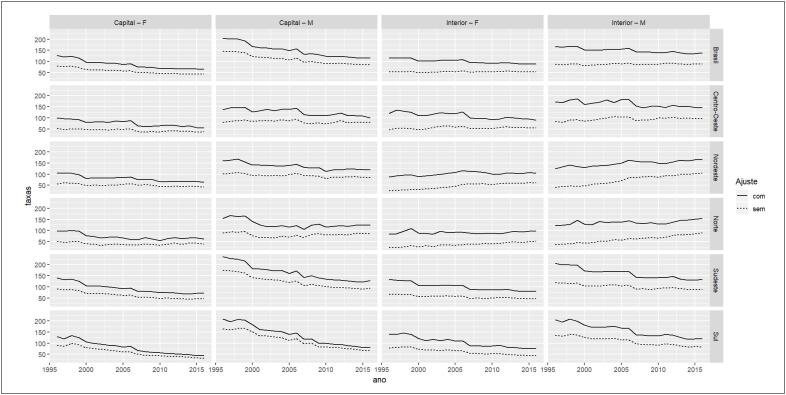
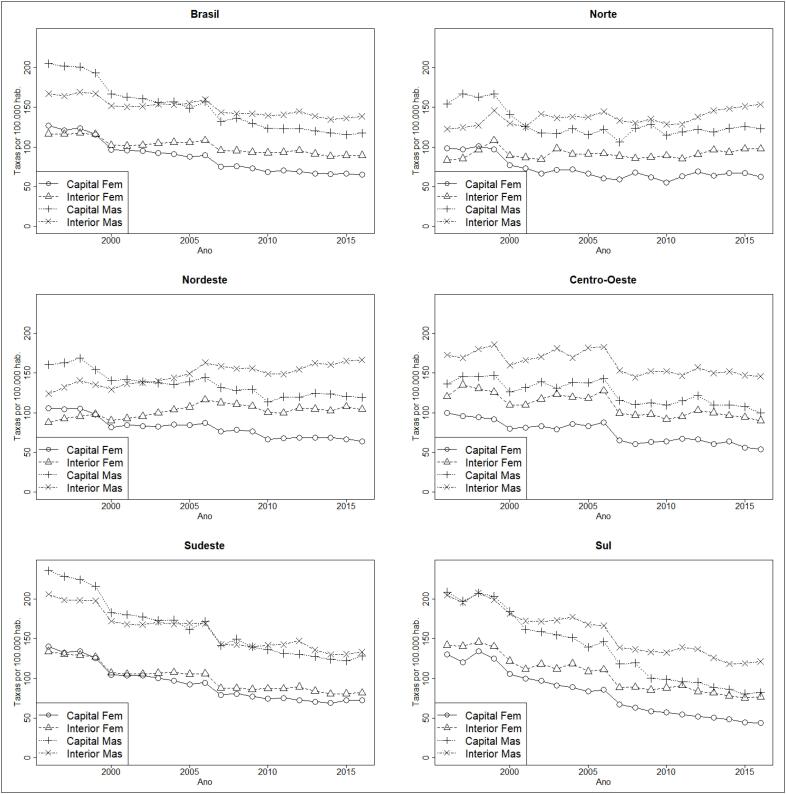
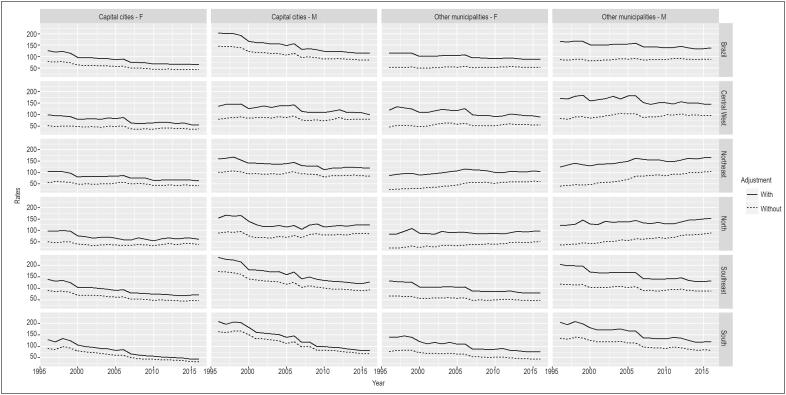
In the period, mortality decreased more sharply in women (-2.2%; 95% CI: -2.5; -1.9) than in men (-1.7%; 95% CI: - 1.9; -1.4) and more in the capital cities (-3.8%; 95% CI: - 4.3; -3.3) than in other municipalities (-1.5%; 95% CI: - 1.8; -1.3). Regional inequalities were observed, with an increase for men living in other municipalities of the North (3.3; 95% CI: 1.3; 5.4) and Northeast (1.3%; 95% CI: 1.0; 1.6). Statistical significance level was set at 5%. Mortality rates after corrections showed a significant difference in relation to the estimates without corrections, mainly due to the redistribution of garbage codes.
Although AMI-related mortality has decreased in Brazil in recent years, this trend is uneven by region and gender. Correcting the numbers of deaths is essential to obtaining more reliable estimates.
急性心肌梗死(AMI)是巴西的主要死亡原因,近年来其死亡率的时间趋势呈现出区域性差异。先前的时间趋势研究并未对死因垃圾代码进行校正,这可能导致了估计结果的偏差。
分析 1996-2016 年巴西 AMI 死亡率的区域性和性别差异趋势。
一项为期 21 年的时间序列研究(1996-2016 年)。数据来自死亡信息系统和巴西地理与统计研究所的人口估计数。对死因不明、垃圾代码和漏报导致的死亡进行了校正。使用分段联合点的线性回归技术对主要地理区域、性别、首府城市和其他城市的时间序列进行了分析。统计显著性水平设定为 5%。
在此期间,女性的死亡率下降更为明显(-2.2%;95%置信区间:-2.5%;-1.9%),而男性的死亡率下降幅度较小(-1.7%;95%置信区间:-1.9%;-1.4%),首府城市的死亡率下降幅度也更大(-3.8%;95%置信区间:-4.3%;-3.3%),而其他城市的死亡率下降幅度较小(-1.5%;95%置信区间:-1.8%;-1.3%)。观察到区域不平等现象,居住在北部和东北部其他城市的男性死亡率有所上升(北部:3.3%;95%置信区间:1.3%;5.4%;东北部:1.3%;95%置信区间:1.0%;1.6%)。统计显著性水平设定为 5%。校正死亡率后与未校正估计值相比,存在显著差异,主要原因是垃圾代码的重新分配。
尽管近年来巴西与 AMI 相关的死亡率有所下降,但这种趋势在区域和性别方面存在不均衡性。对死亡人数进行校正对于获得更可靠的估计至关重要。