Wang Nan, He Jia-Xing, Jia Guo-Zhan, Wang Ke, Zhou Shuai, Wu Tao, He Xian-Li
Department of General Surgery, Tangdu Hospital, the Air Force Medical University, 710038, Xi'an, China.
Cancer Cell Int. 2020 Dec 10;20(1):553. doi: 10.1186/s12935-020-01647-4.
Recent studies suggest that long noncoding RNAs (lncRNAs) play an important role in tumorigenesis. As a newly identified lncRNA, the role of XIST in colorectal cancer (CRC) has not been established. Here, we sought to characterize the role of XIST and its associated regulatory network in CRC cells.
Expression of XIST mRNA, miR-497-5p, and forkhead box k1 (FOXK1) in CRC cells and tissues were detected using quantitative real-time polymerase chain reaction (qRT-PCR). Proliferation and apoptosis of CRC cells were determined using the CCK-8 cell counting assay and flow cytometry. The rate of cell migration and invasion was determined using a transwell assay. The relationships between XIST, miR-497-5p, and FOXK1 were predicted and confirmed using a dual-luciferase reporter assay. Expression of FOXK1 protein was quantified by Western blot.
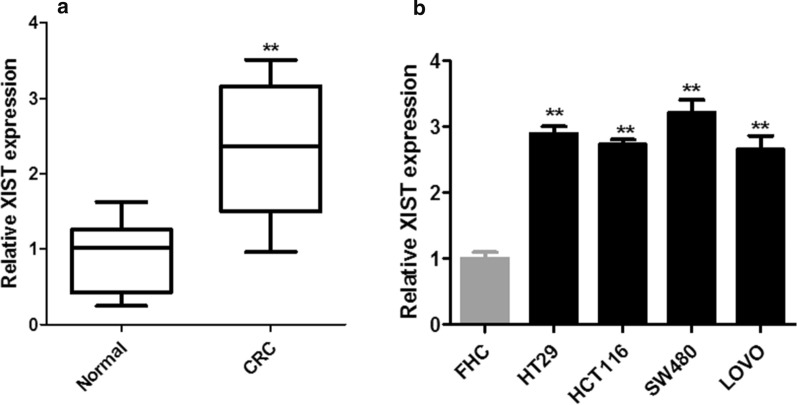
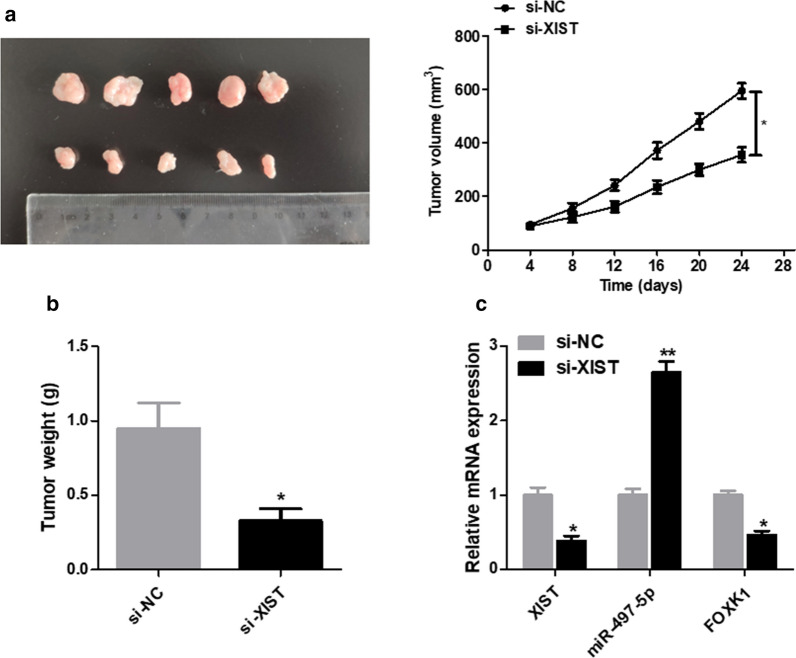
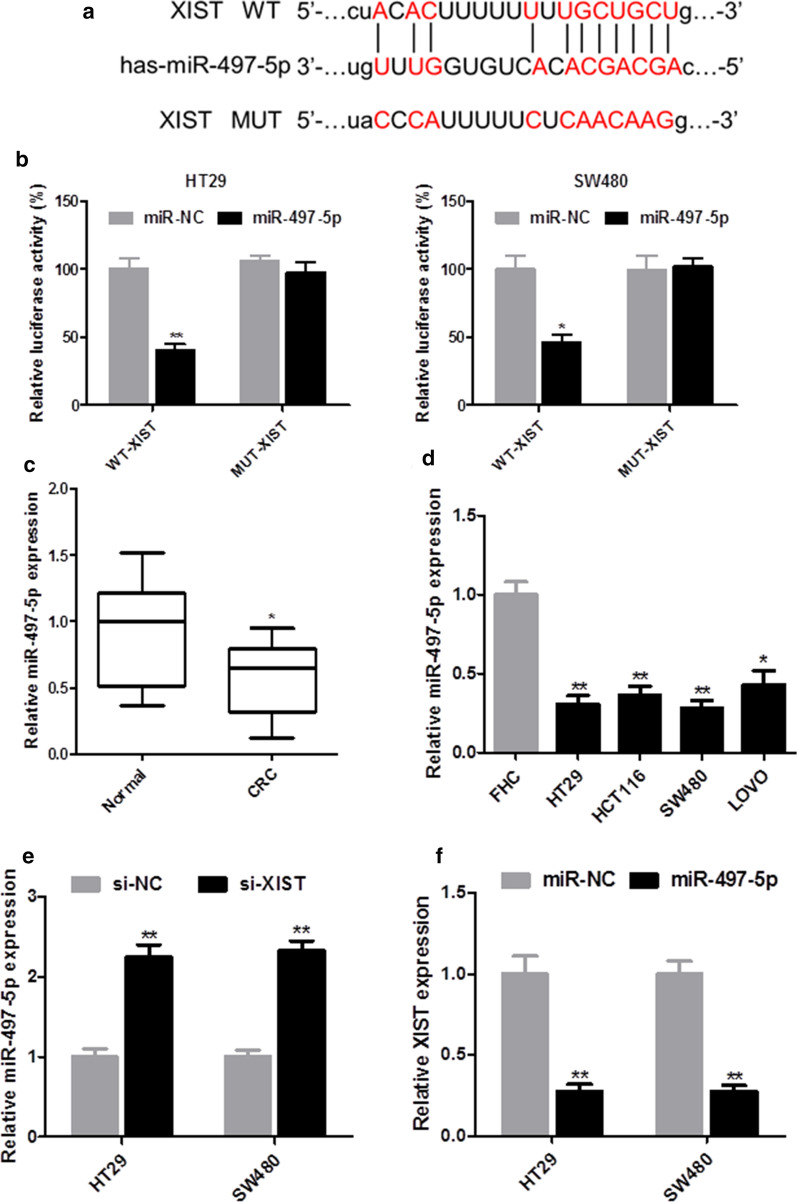
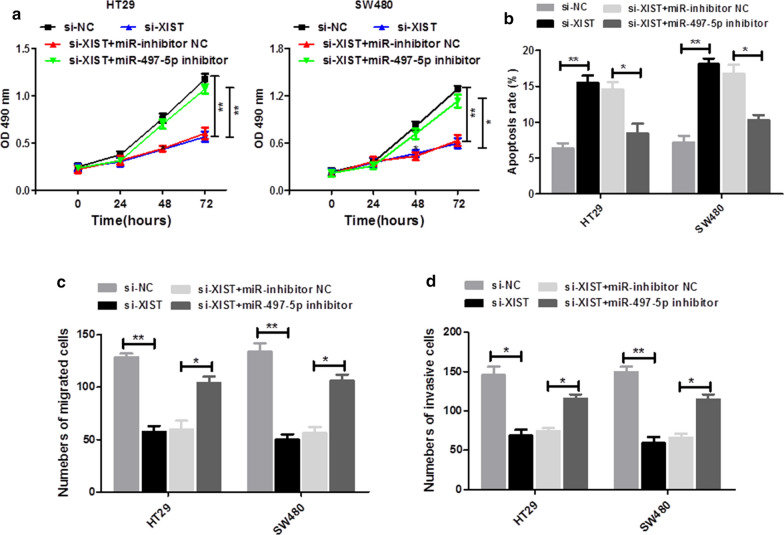
XIST and FOXK1 expression were significantly upregulated in CRC tissues and cell lines, while miR-497-5p expression was downregulated. XIST knockdown significantly suppressed CRC cell proliferation, migration, and invasion. Silencing of XIST also reversed the downregulation of miR-497-5p and upregulation of FOXK1. Moreover, blocking XIST expression was shown to inhibit CRC tumor growth in vivo and the effects were antagonized by the loss of miR-497-5p. miR-497-5p was shown to act as a sponge of XIST and also targeted FOXK1 in CRC cells.
XIST was shown to promote the malignancy of CRC cells by competitively binding to miR-497-5p, resulting in an increase in FOXK1 expression. These results suggest that targeting of XIST may represent a possible treatment for CRC.
近期研究表明,长链非编码RNA(lncRNA)在肿瘤发生过程中发挥重要作用。作为一种新发现的lncRNA,XIST在结直肠癌(CRC)中的作用尚未明确。在此,我们旨在明确XIST及其相关调控网络在CRC细胞中的作用。
采用定量实时聚合酶链反应(qRT-PCR)检测CRC细胞和组织中XIST mRNA、miR-497-5p和叉头框k1(FOXK1)的表达。使用CCK-8细胞计数法和流式细胞术测定CRC细胞的增殖和凋亡。使用Transwell实验测定细胞迁移和侵袭率。通过双荧光素酶报告基因实验预测并证实XIST、miR-497-5p和FOXK1之间的关系。通过蛋白质免疫印迹法对FOXK1蛋白表达进行定量分析。
XIST和FOXK1在CRC组织和细胞系中的表达显著上调,而miR-497-5p的表达下调。敲低XIST可显著抑制CRC细胞的增殖、迁移和侵袭。沉默XIST还可逆转miR-497-5p的下调和FOXK1的上调。此外,阻断XIST表达可在体内抑制CRC肿瘤生长,且miR-497-5p缺失可拮抗该作用。miR-497-5p在CRC细胞中可作为XIST的海绵,还可靶向FOXK1。
XIST通过竞争性结合miR-497-5p促进CRC细胞的恶性增殖,导致FOXK1表达增加。这些结果表明,靶向XIST可能是一种治疗CRC的可行方法。