College of Animal Science and Technology, Hunan Agricultural University, Changsha, Hunan 410128, China.
National Engineering Research Center for Breeding Swine Industry, South China Agricultural University, Guangzhou 510642, China.
Biol Open. 2021 Jan 6;10(1):bio056804. doi: 10.1242/bio.056804.
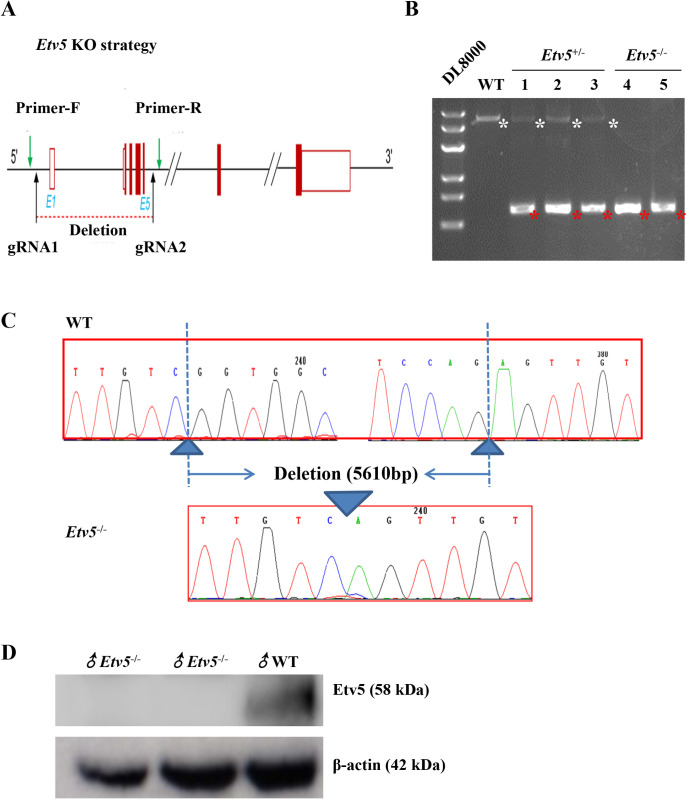
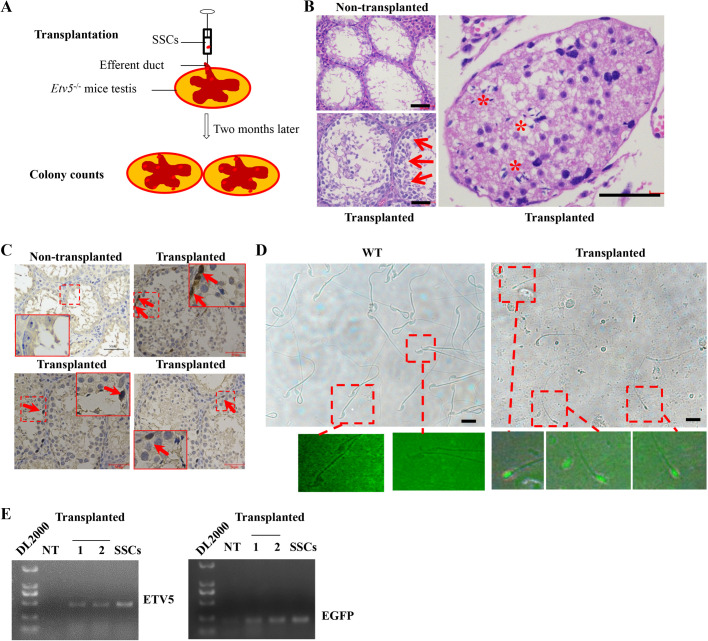
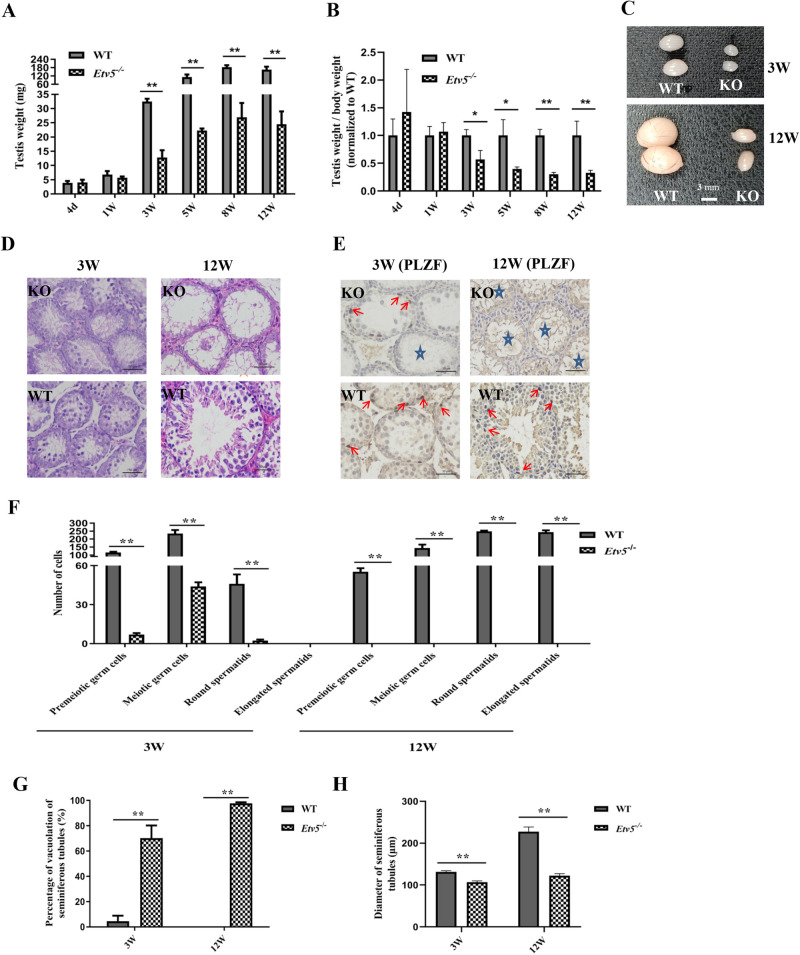
Spermatogonial stem cell (SSC) transplantation is an alternative reproductive method to achieve conservation and production of elite animals in livestock production. Creating a recipient animal without endogenous germ cells is important for effective SSC transplantation. However, natural mutants with depletion of SSCs are difficult to obtain, and drug ablation of endogenous germ cells is arduous to perform for practical use. In this study, we used mouse models to study the preparation of recipients with congenital germ cell ablation. We knocked out (KO) Ets-variant gene 5 () in mice using the CRISPR/Cas9 system. The testicular weight of mice was significantly lower than that of wild-type (WT) mice. The germ cell layer of the seminiferous tubules gradually receded with age in mice. At 12 weeks of age, the tubules of mice lacked almost all spermatogenic cells with a Sertoli cell-only phenotype, and sperm were completely absent in the epididymis. We subsequently transplanted allogeneic SSCs with enhanced green fluorescent protein (EGFP) into 3- (immature) or 7-week-old (mature) mice. Partial restoration of germ cell layers in the seminiferous tubules and spermatogenesis was observed in all immature testes but not in mature adult testes at 2 months post-transplantation. The presence of heterologous genes and in recipient testicular tissue and epididymal sperm by PCR indicated that sperm originated from the transplanted donor cells. Our study demonstrates that, although mice could accommodate and support foreign germ cell transplantation, this process occurs in a quite low efficiency to support a full spermatogenesis of transplanted SSCs. However, using mice as a recipient model for SSC transplantation is feasible, and still needs further investigation to establish an optimized transplantation process.
精原干细胞(SSC)移植是一种替代生殖方法,可用于实现家畜生产中优秀动物的保存和生产。创建没有内源性生殖细胞的受体动物对于有效的 SSC 移植很重要。然而,自然缺失 SSCs 的突变体很难获得,并且药物消融内源性生殖细胞在实际应用中也很困难。在这项研究中,我们使用小鼠模型研究了具有先天性生殖细胞消融的受体准备。我们使用 CRISPR/Cas9 系统敲除了小鼠中的 Ets-variant 基因 5 ()。 小鼠的睾丸重量明显低于野生型 (WT) 小鼠。随着年龄的增长, 小鼠的生精小管生殖细胞层逐渐退缩。在 12 周龄时, 小鼠的小管几乎没有所有的生精细胞,呈现出只有支持细胞的表型,并且在附睾中完全没有精子。随后,我们将携带增强型绿色荧光蛋白 (EGFP) 的同种异体 SSCs 移植到 3-(未成熟)或 7 周龄(成熟)的 小鼠中。在移植后 2 个月,所有未成熟睾丸中都观察到生精小管生殖细胞层和精子发生的部分恢复,但在成熟成年睾丸中则没有。PCR 分析表明,在受体睾丸组织和附睾精子中存在异源基因 和 ,这表明精子来源于移植的供体细胞。我们的研究表明,尽管 小鼠可以容纳和支持外源生殖细胞移植,但这一过程的效率非常低,无法支持移植的 SSCs 完全发生精子发生。然而,使用 小鼠作为 SSC 移植的受体模型是可行的,仍需要进一步研究来建立优化的移植过程。