Bucher Meghan L, Barrett Caitlyn W, Moon Connor J, Mortimer Amanda D, Burton Edward A, Greenamyre J Timothy, Hastings Teresa G
Pittsburgh Institute for Neurodegenerative Diseases, University of Pittsburgh, Pittsburgh, PA, USA.
Department of Neurology, University of Pittsburgh School of Medicine, Pittsburgh, PA, USA.
NPJ Parkinsons Dis. 2020 Nov 13;6(1):34. doi: 10.1038/s41531-020-00134-x.
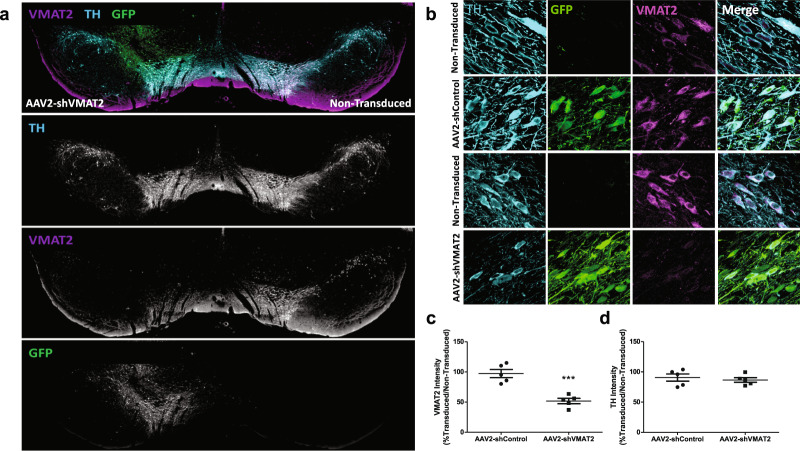
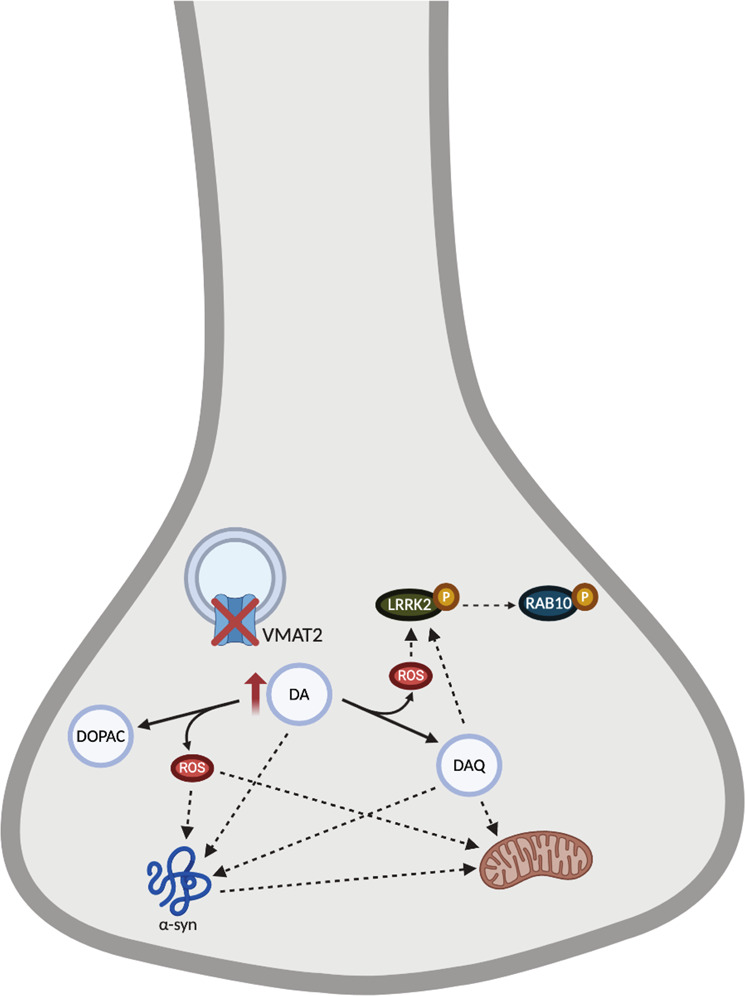
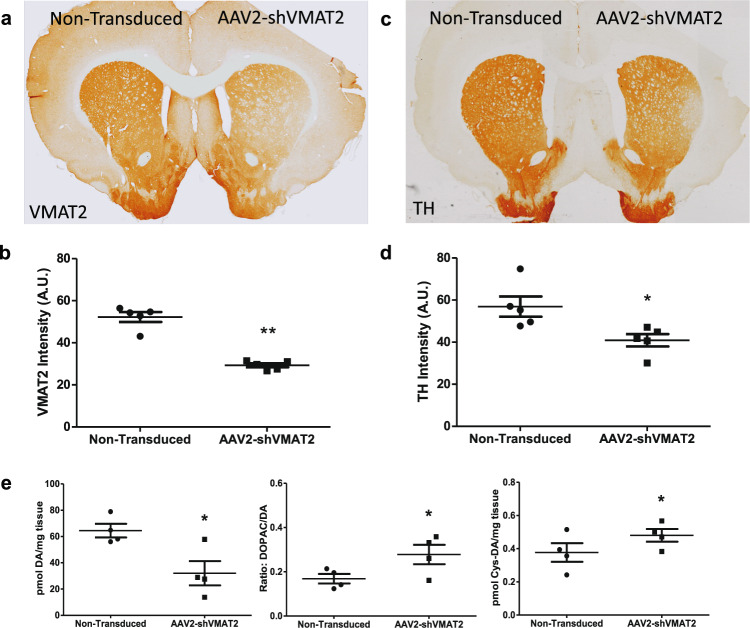
The catecholamine neurotransmitter dopamine has the potential to act as an endogenous neurotoxin when its vesicular sequestration is dysregulated. Despite postmortem analyses from patients with Parkinson's disease that demonstrate decreased vesicular sequestration of dopamine with a corresponding increase in dopamine metabolism, dopamine's contribution to nigrostriatal dopaminergic degeneration in Parkinson's disease has been debated. Here, we present a new in vivo model demonstrating the induction of Parkinson's disease-associated pathogenic mechanisms of degeneration resulting from acquired dysregulation of dopamine sequestration in nigrostriatal dopaminergic neurons in adult rats. Utilizing adeno-associated virus (serotype 2), viral-mediated small-hairpin RNA interference of endogenous vesicular monoamine transporter 2 (VMAT2) expression resulted in a loss of VMAT2 protein expression in transduced dopaminergic cell bodies in the substantia nigra with a corresponding loss of VMAT2 protein within the striatal terminals. The loss of VMAT2 resulted in an accumulation of cytosolic dopamine and subsequent increased dopamine metabolism, deficits in dopamine-mediated behaviors, and degeneration of nigrostriatal dopaminergic neurons that was rescued through reintroduction of exogenous VMAT2, demonstrating that the toxicity was specific to the loss of VMAT2. Analysis of parkinsonian pathogenic mechanisms of degeneration identified oxidative damage, activation of Parkinson's disease-associated kinase LRRK2, and the formation of aberrant α-synuclein. This model demonstrates that a progressive acquired loss of VMAT2 expression in adulthood is sufficient to induce Parkinson's disease-associated pathogenic mechanisms of degeneration and provides a new model to further investigate the consequences of cytosolic dopamine.
当儿茶酚胺神经递质多巴胺的囊泡隔离失调时,它有可能作为一种内源性神经毒素发挥作用。尽管对帕金森病患者的尸检分析表明多巴胺的囊泡隔离减少,同时多巴胺代谢相应增加,但多巴胺在帕金森病黑质纹状体多巴胺能神经元变性中的作用一直存在争议。在此,我们展示了一种新的体内模型,该模型表明成年大鼠黑质纹状体多巴胺能神经元中多巴胺隔离的后天失调可诱导帕金森病相关的变性致病机制。利用腺相关病毒(血清型2),通过病毒介导的内源性囊泡单胺转运体2(VMAT2)表达的小发夹RNA干扰,导致黑质中转导的多巴胺能细胞体中VMAT2蛋白表达丧失,同时纹状体终末内的VMAT2蛋白也相应丧失。VMAT2的丧失导致胞质多巴胺积累,随后多巴胺代谢增加,多巴胺介导的行为出现缺陷,以及黑质纹状体多巴胺能神经元变性,而通过重新引入外源性VMAT2可挽救这种变性,这表明毒性是VMAT2丧失所特有的。对帕金森病变性致病机制的分析确定了氧化损伤、帕金森病相关激酶LRRK2的激活以及异常α-突触核蛋白的形成。该模型表明,成年期VMAT2表达的渐进性后天丧失足以诱导帕金森病相关的变性致病机制,并为进一步研究胞质多巴胺的后果提供了一个新模型。