Laboratori d'Ictiologia Genètica, Universitat de Girona, c/Mª Aurèlia Capmany 40, 17003, Girona, Spain.
Departamento de Zooloxía, Xenética e Antropoloxía Física, Universidade de Santiago de Compostela, Campus Lugo, 27002, Lugo, Spain.
Sci Rep. 2020 Dec 9;10(1):21505. doi: 10.1038/s41598-020-78634-2.
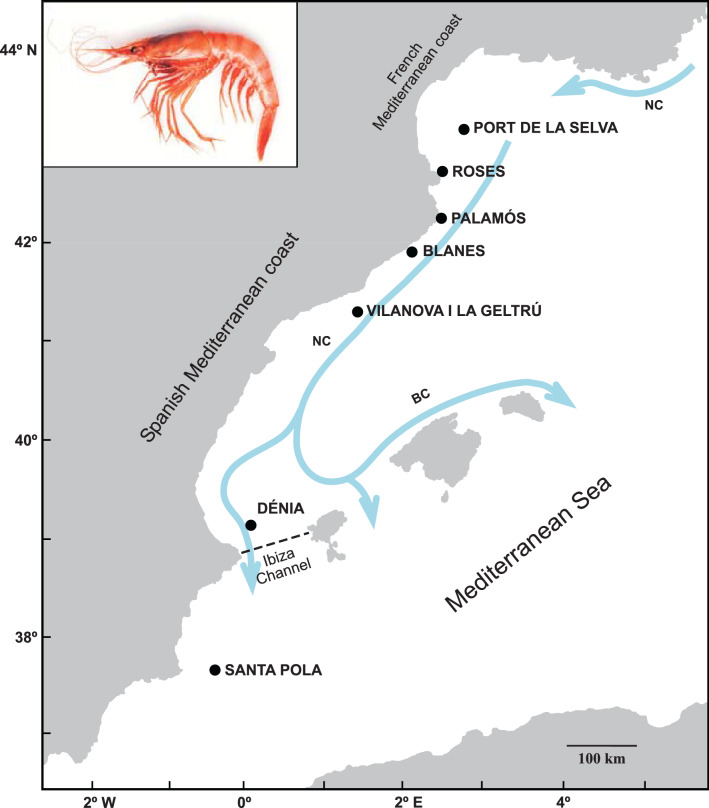
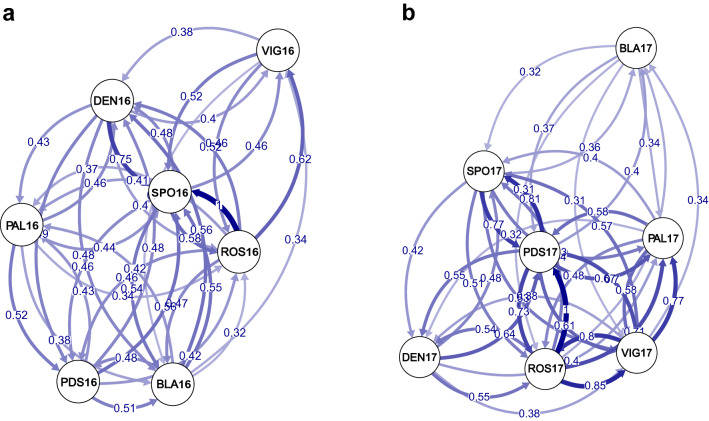
Temporal variability of the genetic structure and connectivity patterns of the blue and red shrimp Aristeus antennatus in the seven most important fishing grounds of the Western Mediterranean Sea, were assessed using twelve microsatellite loci during 2 consecutive years (2016 and 2017), in a total of 1403 adult individuals. A high level of geographical connectivity among groups was observed in the two studied years. In fact, no significant geographical differentiation was found in 2016 (F = 0.0018, p > 0.05), whereas it was indicated in 2017 (F = 0.0025, p < 0.05). This small divergence in 2017 was not attributed to the distance among locations nor to the effect of the Ibiza Channel. Significant allele frequency changes were found at local level between the 2 years (F = 0.0006, p < 0.05), mainly due to Blanes' fishing ground. Larval dispersal from the North to the South through the main superficial current supports the high level of connectivity pattern found. The temporal genetic instability detected in the Blanes' fishing ground could be explained by oceanographic temporary features. Our findings evidence only one biological unit in the study region and establish the baseline for an inter-federal management plan of A. antennatus.
利用 12 个微卫星标记,在连续两年(2016 年和 2017 年)对西地中海 7 个最重要的捕捞区蓝虾和红虾(Aristeus antennatus)的遗传结构和连通模式的时空变化进行了评估,共分析了 1403 个成年个体。在这两年的研究中,观察到各群体之间存在高度的地理连通性。事实上,2016 年没有发现显著的地理分化(F=0.0018,p>0.05),而 2017 年则存在分化(F=0.0025,p<0.05)。2017 年的这种小差异并不是由于地点之间的距离或伊比萨海峡的影响造成的。在这两年之间,在当地水平上发现了显著的等位基因频率变化(F=0.0006,p<0.05),主要是由于布兰斯渔业。通过主要的表层流从北向南的幼虫扩散支持了发现的高度连通模式。在布兰斯渔业中检测到的时空遗传不稳定性可以用海洋学的临时特征来解释。我们的研究结果表明,在研究区域内只有一个生物单位,并为 A. antennatus 的联邦间管理计划建立了基线。