Department of Breast Cancer, Tianjin Medical University Cancer Institute and Hospital, National Clinical Research Center for Cancer, Key Laboratory of Cancer Prevention and Therapy, Tianjin, Tianjin's Clinical Research Center for Cancer, Tianjin 300060, China.
Department of Pathology, West China Hospital, Sichuan University, Chengdu 610041, China.
Cancer Biol Med. 2020 Nov 15;17(4):1014-1025. doi: 10.20892/j.issn.2095-3941.2020.0157. Epub 2020 Dec 15.
The aim of the study was to identify specific chemosensitivity drugs for various molecular subtypes of breast tumors in Chinese women, by detecting the expression of drug resistance genes and by using the drug sensitivity test on different molecular subtypes of breast cancers.
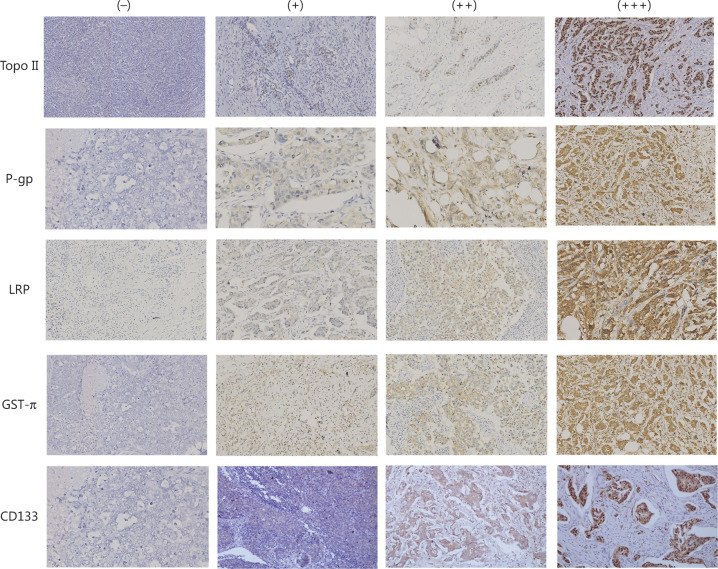
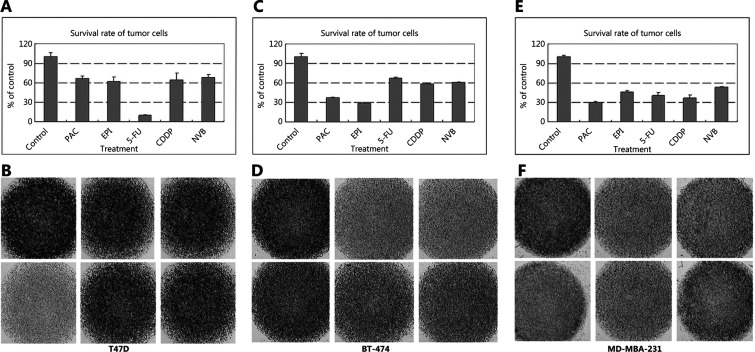
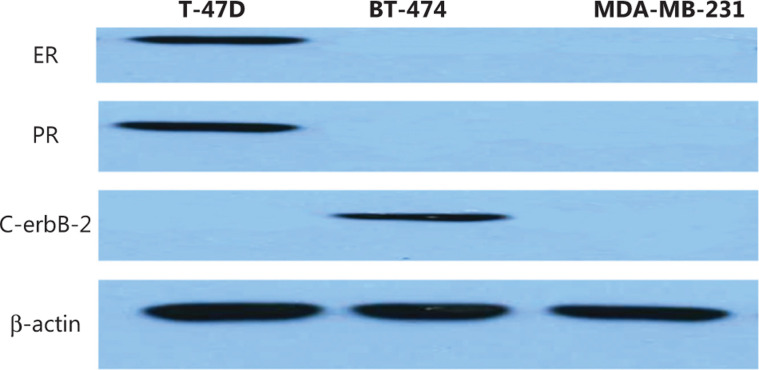
The expression of drug resistance genes including π and were detected with immunohistochemistry in a tissue microarray. Drug sensitivity tests included those for paclitaxel, epirubicin, carboplatin, vinorelbine, and fluorouracil and were conducted on primary cancer tissue cells and cell lines, including the T47D, BT-474, and MDA-MB-231 cells and human breast cancer xenografts in nude mice.
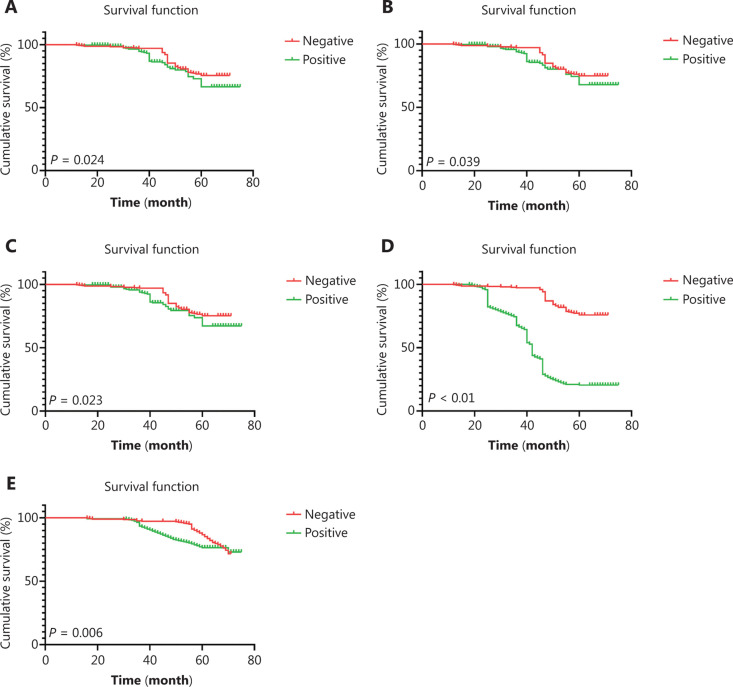
The different drug resistant genes π and were differentially expressed among different molecular subtypes of breast cancers ( < 0.05). Positive expression of CD133 was highest in basal-like breast cancer ( < 0.05). Kaplan-Meier survival analysis showed that positive expressions of Topo II and CD133 both correlated with shorter disease-free survival (DFS) ( < 0.05) and overall survival ( < 0.05), and positive expression of LRP correlated only with shorter DFS ( < 0.05). BT-474 showed chemosensitivity to paclitaxel and epirubicin, while MDA-MB-231 showed chemosensitivities to paclitaxel, epirubicin, carboplatin, and fluorouracil (T/C ≤ 50%). The basal-like and HER2+ breast cancer primary cells showed chemosensitivities to paclitaxel and epirubicin with significant differences compared with luminal breast cancer primary cells ( < 0.05).
The differential expression of drug resistance genes and the differential chemosensitivities of drugs in different molecular subtype of breast cancers suggested that individual treatment should be given for each type of breast cancer.
本研究旨在通过检测耐药基因的表达,并对不同分子亚型的乳腺癌进行药物敏感性试验,鉴定出中国女性不同乳腺癌分子亚型的特异性化疗药物。
采用组织微阵列免疫组化法检测耐药基因π和的表达,对乳腺癌的不同分子亚型进行紫杉醇、表阿霉素、卡铂、长春瑞滨和氟尿嘧啶的药敏试验,包括原代肿瘤细胞和细胞系,包括 T47D、BT-474 和 MDA-MB-231 细胞以及裸鼠人乳腺癌异种移植。
不同的耐药基因π和在不同分子亚型的乳腺癌中表达不同(<0.05)。CD133 在基底样乳腺癌中阳性表达最高(<0.05)。Kaplan-Meier 生存分析显示,Topo II 和 CD133 的阳性表达均与无病生存(DFS)(<0.05)和总生存(<0.05)较短相关,而 LRP 的阳性表达仅与 DFS 较短相关(<0.05)。BT-474 对紫杉醇和表阿霉素敏感,而 MDA-MB-231 对紫杉醇、表阿霉素、卡铂和氟尿嘧啶敏感(T/C≤50%)。基底样和 HER2+乳腺癌原代细胞对紫杉醇和表阿霉素的敏感性明显高于管腔乳腺癌原代细胞(<0.05)。
不同乳腺癌分子亚型耐药基因的差异表达和药物的差异敏感性提示应针对每种乳腺癌类型进行个体化治疗。