Li Xinyan, Wang Mozhi, Wang Mengshen, Yu Xueting, Guo Jingyi, Sun Tie, Yao Litong, Zhang Qiang, Xu Yingying
Department of Breast Surgery, the First Affiliated Hospital of China Medical University, Shenyang, Liaoning Province, China.
Department of Breast Surgery, Cancer Hospital of China Medical University, Liaoning Cancer Hospital & Institute, Shenyang, Liaoning Province, China.
J Breast Cancer. 2019 Dec;22(4):497-521. doi: 10.4048/jbc.2019.22.e49.
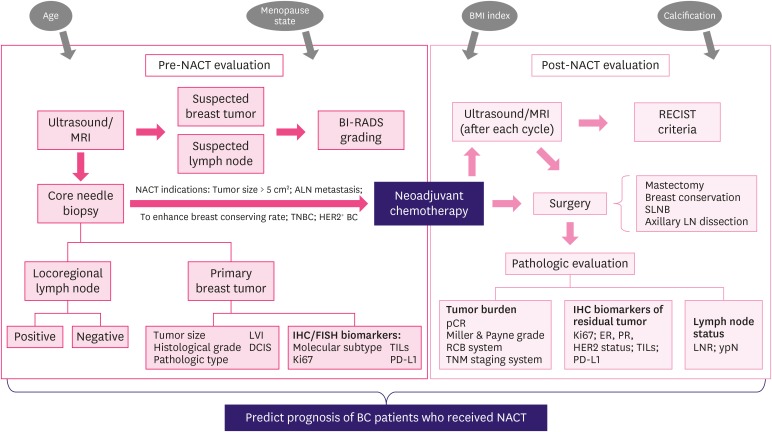
Currently, neoadjuvant chemotherapy is a standard therapeutic strategy for breast cancer, as it can provide timely and individualized chemo-sensitivity information and is beneficial for custom-designing subsequent treatment strategies. To accurately select candidates for neoadjuvant chemotherapy, the association between various immunohistochemical biomarkers of primary disease and tumor response to neoadjuvant chemotherapy has been investigated, and results have shown that certain pathological indicators evaluated after neoadjuvant chemotherapy are associated with long-term prognosis. The Food and Drug Administration (FDA) has recommended that complete pathological response can be used as a surrogate endpoint for neoadjuvant chemotherapy, which is related to better prognosis. Considering that residual tumor persists in the majority of patients after neoadjuvant chemotherapy, the value of various pathological indicators of residual disease in predicting the long-term outcomes is being extensively investigated. This review summarizes and compares various predictive and prognostic indicators for patients who have received neoadjuvant chemotherapy, and analyzes their efficacy in different breast cancer subtypes.
目前,新辅助化疗是乳腺癌的标准治疗策略,因为它可以提供及时且个体化的化疗敏感性信息,有利于定制后续的治疗策略。为了准确选择新辅助化疗的候选者,人们研究了原发性疾病的各种免疫组化生物标志物与肿瘤对新辅助化疗反应之间的关联,结果表明新辅助化疗后评估的某些病理指标与长期预后相关。美国食品药品监督管理局(FDA)已建议完全病理缓解可作为新辅助化疗的替代终点,这与更好的预后相关。鉴于大多数患者在新辅助化疗后仍有残留肿瘤,残留疾病的各种病理指标在预测长期结局方面的价值正在得到广泛研究。本综述总结并比较了接受新辅助化疗患者的各种预测和预后指标,并分析了它们在不同乳腺癌亚型中的疗效。