Horváth József, Wullt Björn, Naber Kurt G, Köves Béla
BKMK SZTE ÁOK Okt. Kh. Urológiai Osztálya, Kecskemét, Hungary.
Division of Microbiology, Immunology and Glycobiology, Lund University, Lund, Sweden.
GMS Infect Dis. 2020 Nov 26;8:Doc24. doi: 10.3205/id000068. eCollection 2020.
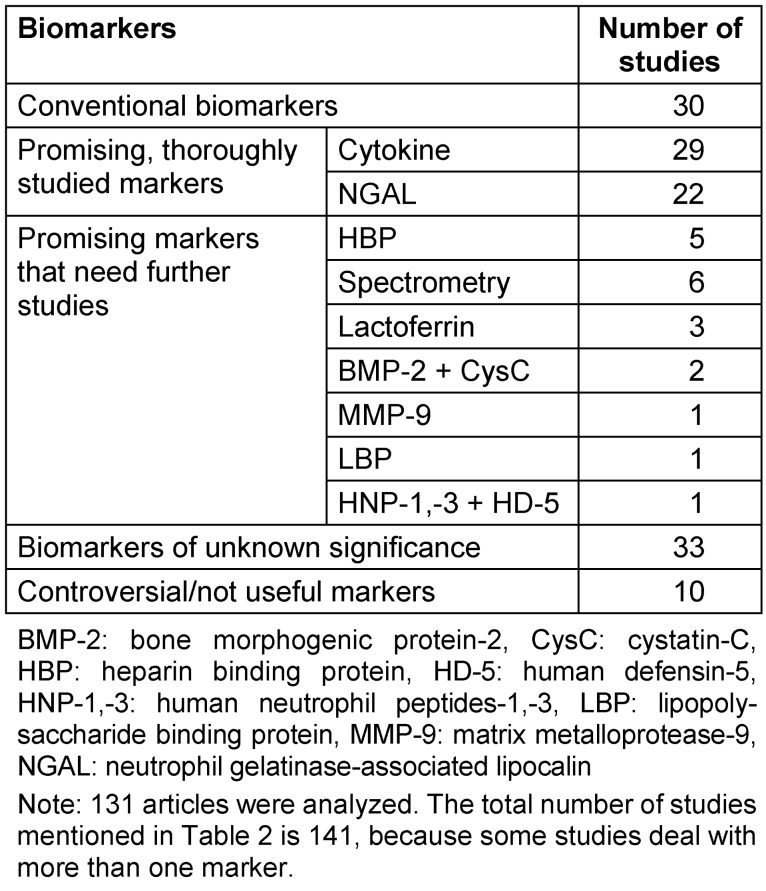
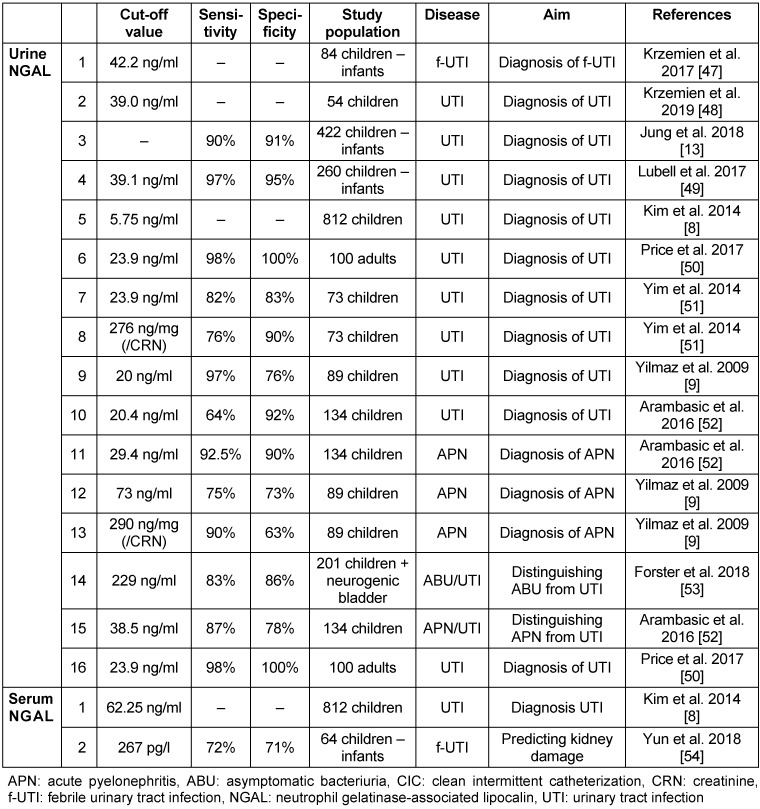
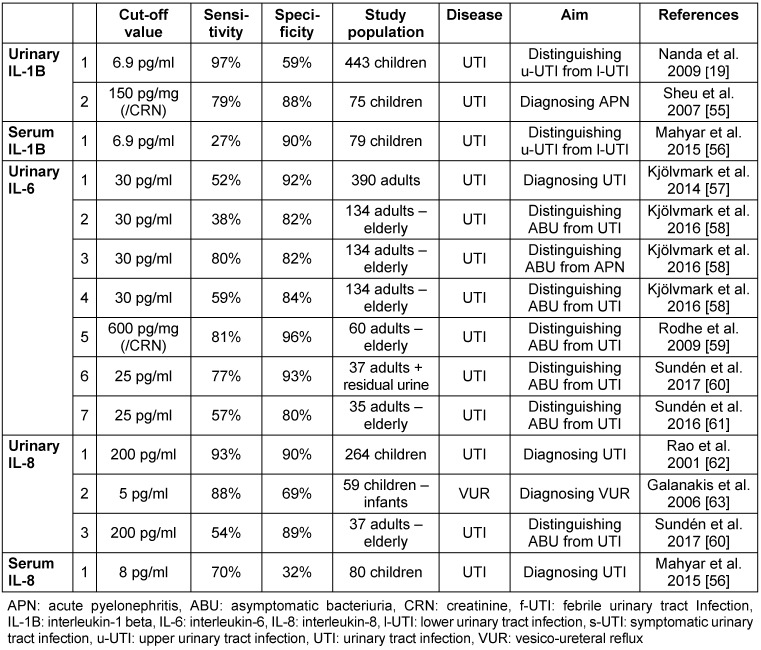
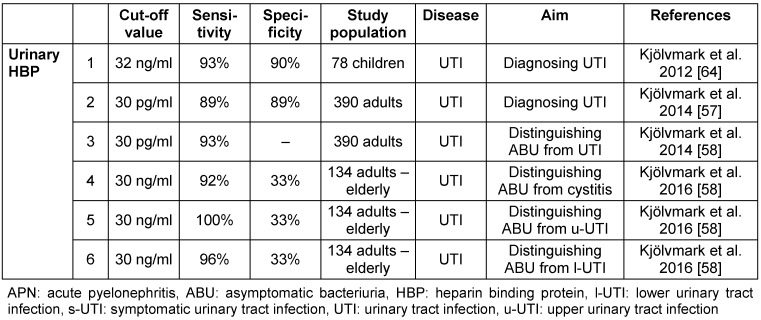
Urinary tract infections (UTIs) are one of the most common infections worldwide. Under special circumstances, clinicians must rely on laboratory findings, which might have a weak predicting value, misguiding the practitioners and leading to incorrect diagnosis and overuse of antibiotics. Therefore, there is an urgent need for reliable biomarkers in UTIs. We performed a literature search for biomarkers used in UTIs from January 1999 until May 2020. We used "urinary tract infection" and "biomarker" as the main key words in the PubMed, Medline and Cochrane databases. After peer review, we excluded the duplicates and identified the suitable articles, from which we collected the data and divided the available biomarkers into 5 groups: i) conventional markers; ii) promising, thoroughly studied biomarkers; iii) promising biomarkers that need further studies; iv) biomarkers of unknown significance; v) controversial, not useful markers. We found 131 articles, mostly from the paediatric population. Neutrophil gelatinase-associated lipocalin (NGAL) and interleukins (IL) have a leading role in diagnosing and differentiating UTIs based on a lot of observational, comparative trials. Heparin Binding Protein (HBP), Lactoferrin (LF), Heat-Shock Protein-70 (HSP-70), Human Defensin-5 (HD-5), Lipopolysaccharide Binding Protein (LBP) and mass spectrometry studies are promising, but confirming data are lacking. The measurable components of the innate immune system and local host cell response could be appropriate biomarkers, but their significance is currently unknown. Conventional biomarkers for UTIs have low specificity. The use of urinary NGAL and interleukins could improve the sensitivity and specificity of laboratory diagnosis of UTIs.
尿路感染(UTIs)是全球最常见的感染之一。在特殊情况下,临床医生必须依赖实验室检查结果,而这些结果可能预测价值有限,误导从业者,导致诊断错误和抗生素的过度使用。因此,迫切需要用于尿路感染的可靠生物标志物。我们对1999年1月至2020年5月期间用于尿路感染的生物标志物进行了文献检索。我们在PubMed、Medline和Cochrane数据库中使用“尿路感染”和“生物标志物”作为主要关键词。经过同行评审,我们排除了重复项,确定了合适的文章,从中收集数据并将可用的生物标志物分为5组:i)传统标志物;ii)有前景的、经过充分研究的生物标志物;iii)需要进一步研究的有前景的生物标志物;iv)意义不明的生物标志物;v)有争议的、无用的标志物。我们发现了131篇文章,大多来自儿科人群。基于大量观察性、对比试验,中性粒细胞明胶酶相关脂质运载蛋白(NGAL)和白细胞介素(IL)在尿路感染的诊断和鉴别中起主导作用。肝素结合蛋白(HBP)、乳铁蛋白(LF)、热休克蛋白-70(HSP-70)、人防御素-5(HD-5)、脂多糖结合蛋白(LBP)和质谱研究很有前景,但缺乏证实数据。先天免疫系统和局部宿主细胞反应的可测量成分可能是合适的生物标志物,但它们目前的意义尚不清楚。尿路感染的传统生物标志物特异性较低。使用尿NGAL和白细胞介素可以提高尿路感染实验室诊断的敏感性和特异性。