Yousif Nooraldaem, Subbramaniyam Suddharsan, Thevan Babu, Amin Mohammad, Sulaibikh Leena, Bukamal Nazar, Tareif Habib, Shivappa Sadananda, Amin Haitham, Noor Husam A
Department of Cardiology, Mohammed Bin Khalifa Cardiac Centre, Riffa, Bahrain.
Department of Cardiac Anesthesia, Mohammed Bin Khalifa Cardiac Centre, Riffa, Bahrain.
J Saudi Heart Assoc. 2020 Oct 14;32(3):434-439. doi: 10.37616/2212-5043.1143. eCollection 2020.
Transcatheter aortic valve implantation (TAVI) is a minimally invasive procedure that is considered a good alternative to surgical aortic valve replacement (sAVR) in selected patients. Our aim is to determine the baseline, procedural characteristics and one-year clinical outcomes of our TAVI registry.
This study is a retrospective observational analysis of a prospectively designed cohort comprising 81 consecutive patients treated at Mohammed bin Khalifa Cardiac Centre (MKCC) who were enrolled in Bahrain TAVI registry from February 2014 to February 2019. The clinical endpoints were defined according to the updated Valve Academic Research Consortium-2 (VARC-2) consensus document.
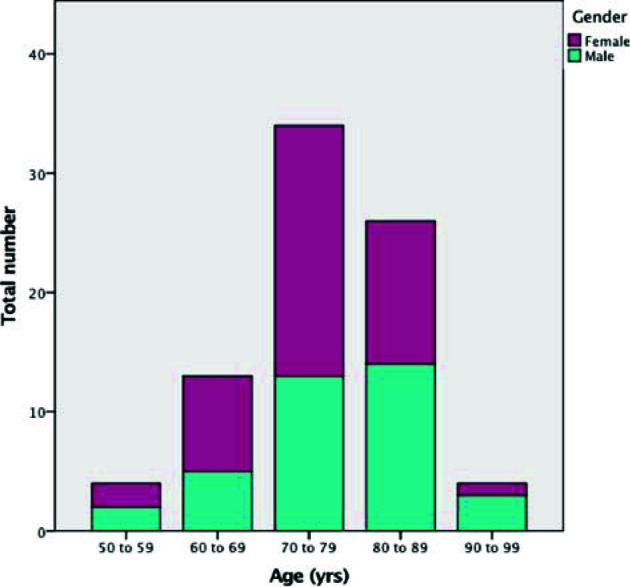
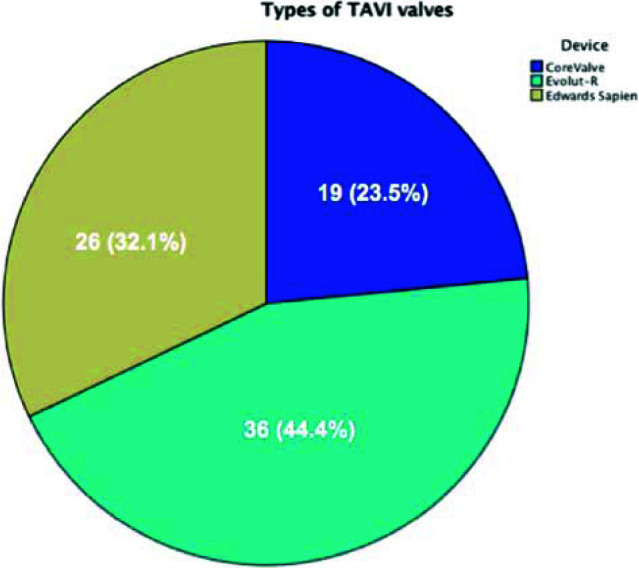
Out of the 81 patients included in our study, there were 37 (45.7%) males. The mean age was 76.4 ± 8.9 years with a mean Logistic European System for Cardiac Operative Risk Evaluation (EuroSCORE II) of 4.1 ± 2.5 and a mean Society of Thoracic Surgery (STS) Risk Score of 4.2 ± 3.5. Evolute-R valve was used for 36 (44.4%) patients, Edward Sapien for 26 patients (32.1%), and Core valve for 19 patients (23.5%). At one year follow up, all-cause death was reported in three (3.7%) patients; none of them was cardiovascular mortality. As per VARC-II criteria, no cases fulfilled the criteria of valve dysfunction but TAVI-related complications (i.e., TAV-in-TAV deployment) were reported in four (4.9%) cases. One (1.2%) case of major bleeding was encountered but no patient experienced life-threatening bleeding. Major vascular complications were documented in two patients (2.5%) only. Significant Acute Kidney Injury (AKI) occurred in two (2.5%) patients, both classified as stage-2 but no one deteriorated to stage-3 or hemodialysis. Seven (8.6%) patients required permanent pacemakers, and all were implanted during the index admission for TAVI. One patient (1.2%) had stroke and all survivors completed one-year follow up.
The TAVI program in Bahrain is encouraging and corresponds to the finest international centers outcomes in terms of procedural success and complications rate.
经导管主动脉瓣植入术(TAVI)是一种微创手术,在特定患者中被认为是外科主动脉瓣置换术(sAVR)的良好替代方案。我们的目的是确定我们TAVI注册研究的基线、手术特征和一年临床结局。
本研究是对一个前瞻性设计队列的回顾性观察分析,该队列包括2014年2月至2019年2月在穆罕默德·本·哈利法心脏中心(MKCC)接受治疗并纳入巴林TAVI注册研究的81例连续患者。临床终点根据更新后的瓣膜学术研究联盟-2(VARC-2)共识文件进行定义。
在我们纳入研究的81例患者中,有37例(45.7%)为男性。平均年龄为76.4±8.9岁,平均欧洲心脏手术风险评估逻辑系统(EuroSCORE II)为4.1±2.5,平均胸外科医师协会(STS)风险评分为4.2±3.5。36例(44.4%)患者使用了Evolute-R瓣膜,26例(32.1%)患者使用了爱德华Sapien瓣膜,19例(23.5%)患者使用了Core瓣膜。在一年的随访中,3例(3.7%)患者报告了全因死亡;其中无一例为心血管死亡。根据VARC-II标准,没有病例符合瓣膜功能障碍的标准,但4例(4.9%)病例报告了与TAVI相关的并发症(即TAV-in-TAV植入)。发生了1例(1.2%)大出血,但没有患者经历危及生命的出血。仅2例(2.5%)患者记录了主要血管并发症。2例(2.5%)患者发生了严重急性肾损伤(AKI),均被分类为2期,但没有患者恶化至3期或需要血液透析。7例(8.6%)患者需要永久起搏器,且均在TAVI首次住院期间植入。1例(1.2%)患者发生了中风,所有幸存者均完成了一年的随访。
巴林的TAVI项目令人鼓舞,在手术成功率和并发症发生率方面与国际顶尖中心的结果相当。