Salam Asharaf Abdul, Al-Khraif Rshood M
Center for Population Studies, King Saud University, Riyadh, Saudi Arabia.
Front Public Health. 2020 Jan 17;7:402. doi: 10.3389/fpubh.2019.00402. eCollection 2019.
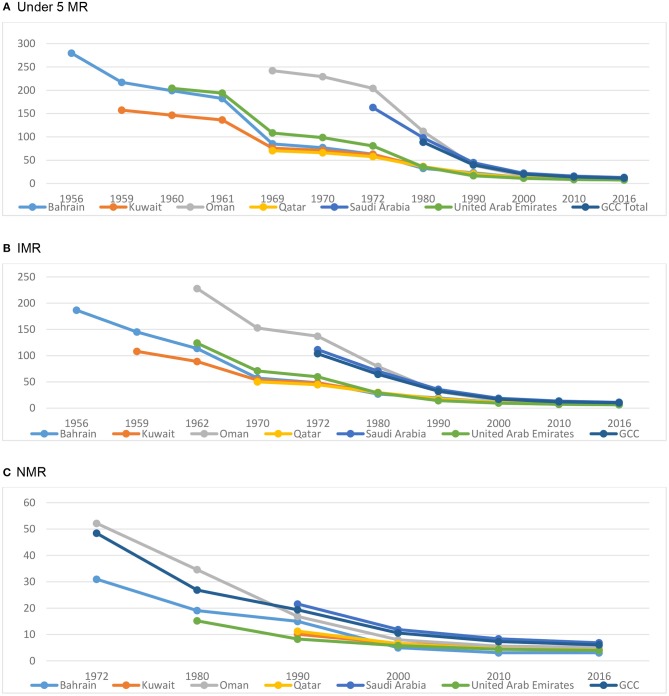
Child mortality is the most crucial indicator of national progress and a reflection of not only the health system performance but also the wealth (budget) utilization and goal achievements. Many developing nations have recorded progress in this dimension but those of the Arabian Gulf (Bahrain, Kuwait, Oman, Qatar, Saudi Arabia, and United Arab Emirates) show remarkable progress and achievements. Using the latest update of United Nations Inter-agency Group for Child Mortality Estimation 2017, an attempt is made here to review and appraise their achievements in child mortality reduction since 1950s taking into account Under 5 mortality, infant mortality, and neonatal mortality. This review finds a rapid decline in child mortality in the Arabian Gulf in a short span of 50 years, which is in line with the achievement of Sustainable Development Goals. There is a remarkable budget allocation and investment in health system building, improving the other contributing sectors like water, sanitation, hygiene, nutrition, and life style modifications apart from the usual health care interventions.
儿童死亡率是国家发展的最重要指标,不仅反映卫生系统的绩效,还反映财富(预算)的利用情况和目标达成情况。许多发展中国家在这方面已取得进展,但阿拉伯湾国家(巴林、科威特、阿曼、卡塔尔、沙特阿拉伯和阿拉伯联合酋长国)的进展和成就尤为显著。利用联合国儿童死亡率估计机构间小组2017年的最新数据,本文尝试回顾和评估自20世纪50年代以来这些国家在降低儿童死亡率方面取得的成就,同时考虑到五岁以下儿童死亡率、婴儿死亡率和新生儿死亡率。本综述发现,阿拉伯湾地区的儿童死亡率在短短50年内迅速下降,这与可持续发展目标的达成情况相符。除了常规的医疗保健干预措施外,这些国家在卫生系统建设方面进行了大量预算拨款和投资,还改善了其他相关领域,如水、环境卫生、个人卫生、营养以及生活方式的改变。