Wang Pengshuo, Zhang Ran, Jiang Xiaowei, Wei Shengnan, Wang Fei, Tang Yanqing
Department of Psychiatry, The First Affiliated Hospital of China Medical University, 155 Nanjing North Street, Heping District, Shenyang, 110001, Liaoning, People's Republic of China.
Brain Function Research Section, The First Affiliated Hospital of China Medical University, Shenyang, 110001, Liaoning, People's Republic of China.
Ann Gen Psychiatry. 2020 Dec 10;19(1):69. doi: 10.1186/s12991-020-00318-y.
Mood disorders are severe mental disorders related to increased suicidal behavior. Finding neural features for suicidal behavior, including suicide attempts (SAs) and suicidal ideation (SI), in mood disorders may be helpful in preventing suicidal behavior.
Subjects consisted of 70 patients with mood disorders and suicidal behavior, 128 patients with mood disorders without suicidal behavior (mood disorders control, MC), and 145 health control (HC) individuals. All participants underwent structural magnetic resonance imaging (MRI). We used voxel-based morphometry (VBM) techniques to examine gray matter volumes (GMVs).
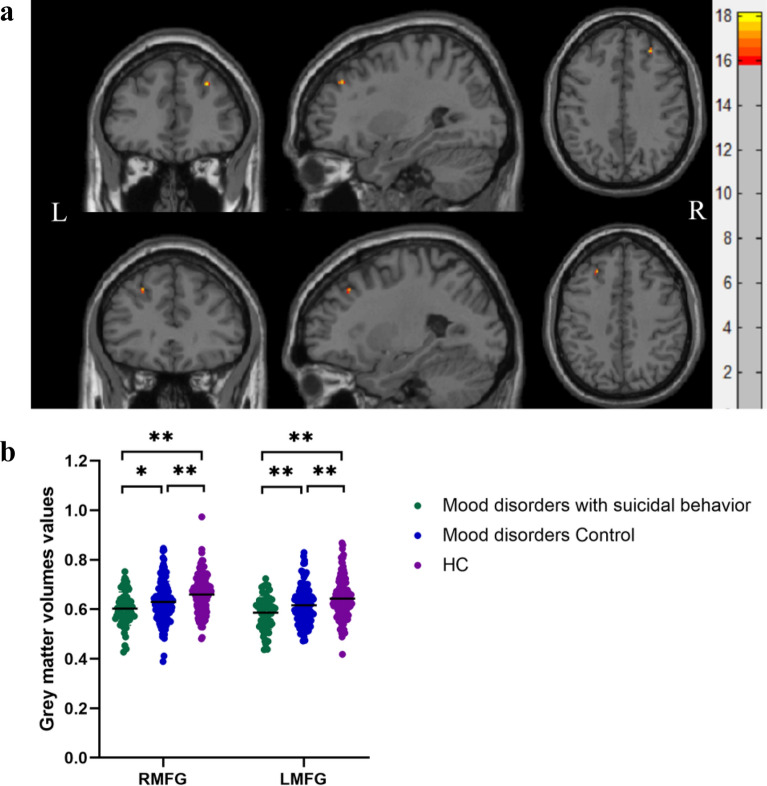
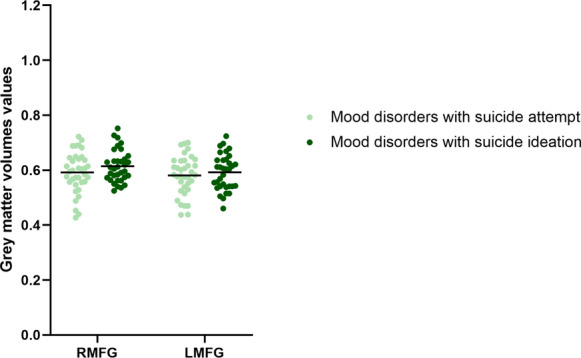
Significant differences were found in GMVs of the left and right middle frontal gyrus among the patients with mood disorders and suicidal behavior, MC, and HC. Post hoc comparisons showed significant differences in the GMVs of the above regions across all three groups (P < 0.01): HC > MC > mood disorders with suicidal behavior. However, there were no significant differences in the GMVs of the left and right middle frontal gyrus between the mood disorders with SI and mood disorders with SAs groups.
These findings provide evidence that abnormal regional GMV in the middle frontal gyrus is associated with suicidal behavior in mood disorders. Further investigation is warranted to determine whether the GMV alterations in mood disorders with SI are different from these in mood disorders with SAs.
情绪障碍是与自杀行为增加相关的严重精神障碍。在情绪障碍中寻找自杀行为的神经特征,包括自杀未遂(SA)和自杀意念(SI),可能有助于预防自杀行为。
研究对象包括70例有自杀行为的情绪障碍患者、128例无自杀行为的情绪障碍患者(情绪障碍对照组,MC)和145名健康对照(HC)个体。所有参与者均接受了结构磁共振成像(MRI)检查。我们使用基于体素的形态测量(VBM)技术来检查灰质体积(GMV)。
在有自杀行为的情绪障碍患者、MC组和HC组之间,左右额中回的GMV存在显著差异。事后比较显示,上述区域的GMV在所有三组之间均存在显著差异(P < 0.01):HC组 > MC组 > 有自杀行为的情绪障碍组。然而,有SI的情绪障碍组和有SA的情绪障碍组之间,左右额中回的GMV没有显著差异。
这些发现提供了证据,表明额中回区域的灰质体积异常与情绪障碍中的自杀行为有关。有必要进一步研究以确定有SI的情绪障碍患者的GMV改变是否与有SA的情绪障碍患者不同。