Clienia Littenheid AG, Hauptstrasse 130, 9573 Littenheid, Switzerland.
Department of Psychiatry, Psychotherapy, and Psychosomatics, Faculty of Medicine, University Halle (Saale), Julius-Kühn-Strasse 7, 6112 Halle (Saale), Germany.
Int J Environ Res Public Health. 2018 Jul 6;15(7):1425. doi: 10.3390/ijerph15071425.
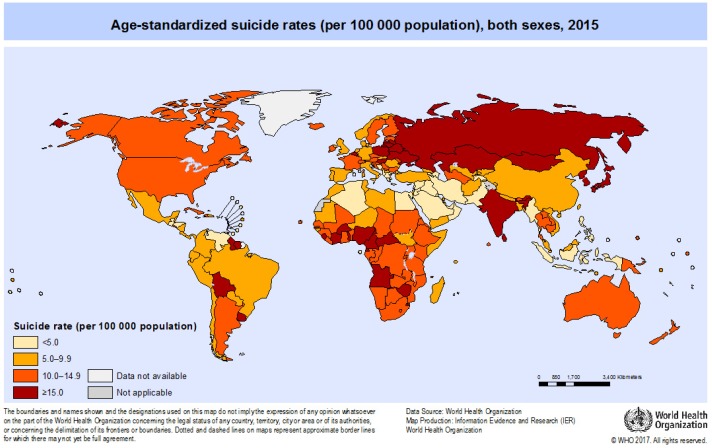
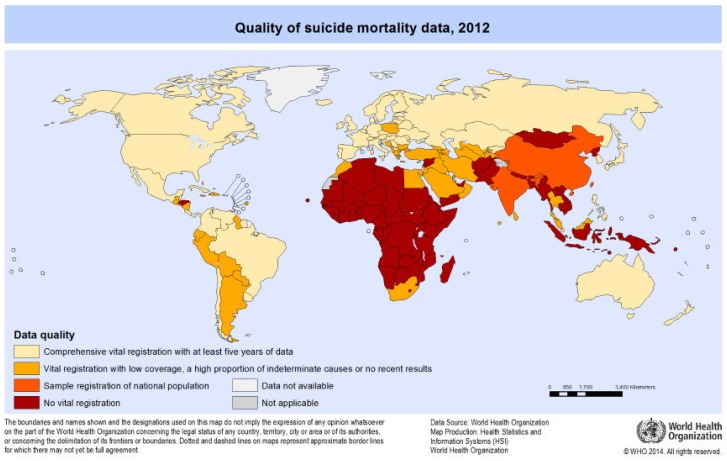
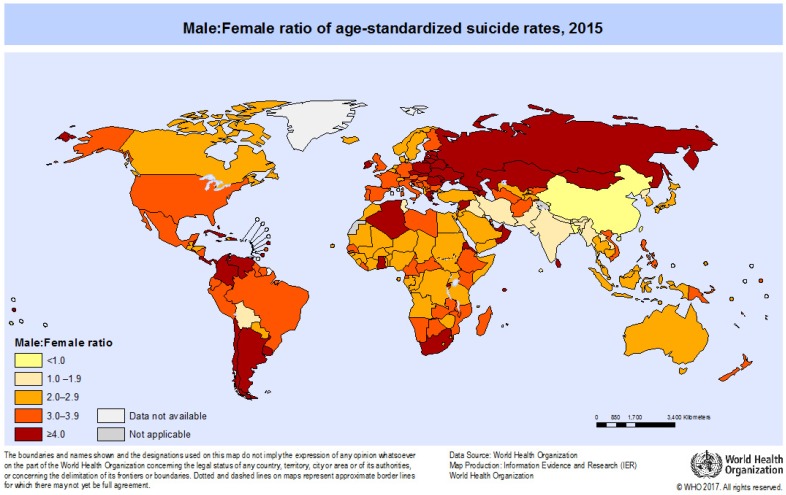
Suicide is a worldwide phenomenon. This review is based on a literature search of the World Health Organization (WHO) databases and PubMed. According to the WHO, in 2015, about 800,000 suicides were documented worldwide, and globally 78% of all completed suicides occur in low- and middle-income countries. Overall, suicides account for 1.4% of premature deaths worldwide. Differences arise between regions and countries with respect to the age, gender, and socioeconomic status of the individual and the respective country, method of suicide, and access to health care. During the second and third decades of life, suicide is the second leading cause of death. Completed suicides are three times more common in males than females; for suicide attempts, an inverse ratio can be found. Suicide attempts are up to 30 times more common compared to suicides; they are however important predictors of repeated attempts as well as completed suicides. Overall, suicide rates vary among the sexes and across lifetimes, whereas methods differ according to countries. The most commonly used methods are hanging, self-poisoning with pesticides, and use of firearms. The majority of suicides worldwide are related to psychiatric diseases. Among those, depression, substance use, and psychosis constitute the most relevant risk factors, but also anxiety, personality-, eating- and trauma-related disorders as well as organic mental disorders significantly add to unnatural causes of death compared to the general population. Overall, the matter at hand is relatively complex and a significant amount of underreporting is likely to be present. Nevertheless, suicides can, at least partially, be prevented by restricting access to means of suicide, by training primary care physicians and health workers to identify people at risk as well as to assess and manage respective crises, provide adequate follow-up care and address the way this is reported by the media. Suicidality represents a major societal and health care problem; it thus should be given a high priority in many realms.
自杀是一个全球性现象。本综述基于对世界卫生组织(WHO)数据库和 PubMed 的文献检索。根据 WHO 的数据,2015 年全球记录到约 80 万例自杀,全球所有自杀完成者中有 78%来自中低收入国家。总体而言,自杀占全球所有过早死亡人数的 1.4%。不同地区和国家之间存在差异,具体表现在个人和各自国家的年龄、性别和社会经济地位、自杀方式以及获得医疗保健的机会。在生命的第二和第三个十年,自杀是第二大主要死因。完成自杀的男性是女性的三倍,而企图自杀的情况则相反。与自杀相比,自杀企图更为常见,可达 30 倍;但它们是重复企图和完成自杀的重要预测因素。总体而言,自杀率在性别和整个生命周期中存在差异,而方法则因国家而异。最常用的方法是上吊、农药自毒和使用枪支。全球大多数自杀与精神疾病有关。在这些疾病中,抑郁、物质使用和精神病构成了最相关的风险因素,但焦虑、人格、饮食和创伤相关障碍以及器质性精神障碍与一般人群相比,也显著增加了非自然死亡的原因。总体而言,目前的情况较为复杂,很可能存在大量未报告的情况。尽管如此,通过限制获得自杀手段、培训初级保健医生和卫生工作者以识别处于危险中的人以及评估和管理各自的危机、提供充分的后续护理以及处理媒体的报道方式,至少可以部分预防自杀。自杀是一个重大的社会和医疗保健问题;因此,它应该在许多领域得到高度重视。