Department of Microbiology and Immunology, Faculty of Medicine, Minia University, Minia, 61511, Egypt.
Department of Biomedical Sciences, College of Medicine, King Faisal University, Al Hofuf, Saudi Arabia.
Antimicrob Resist Infect Control. 2020 Dec 10;9(1):198. doi: 10.1186/s13756-020-00856-w.
Infections caused by Enterobacteriaceae are mainly treated with the β-lactam antibiotics, nevertheless, the emergence of species with plasmid-borne β-lactamases has decreased the efficacy of these antibiotics. Therefore, continuing studies on the resistance pattern of different regions is important for assessment of proper antimicrobial therapy protocols. The study aimed to characterize extended-spectrum β-lactamase (ESBL) and AmpC β -lactamase (AmpC) producing Enterobacteriaceae isolated from community-acquired UTIs in Egypt.
Out of 705 urine samples, 440 Enterobacteriaceae isolates were investigated to detect ESBL and AmpC β -lactamases producers by phenotypic and molecular methods.
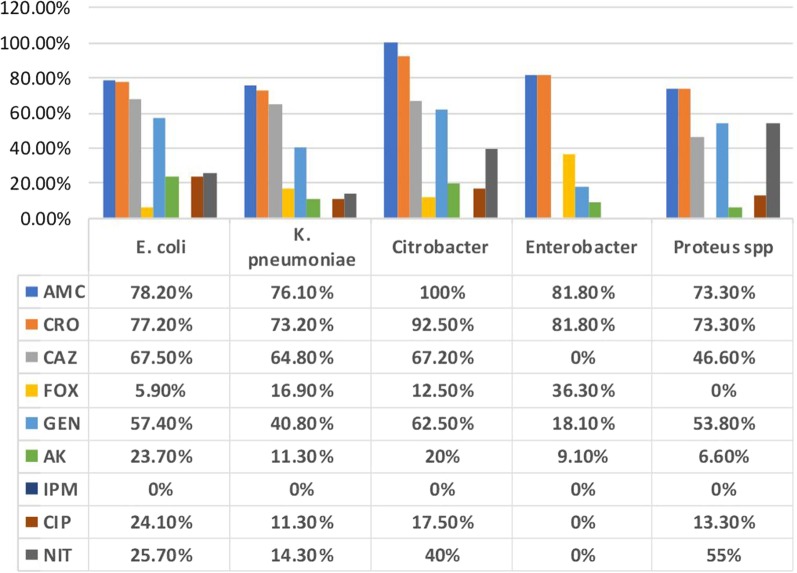
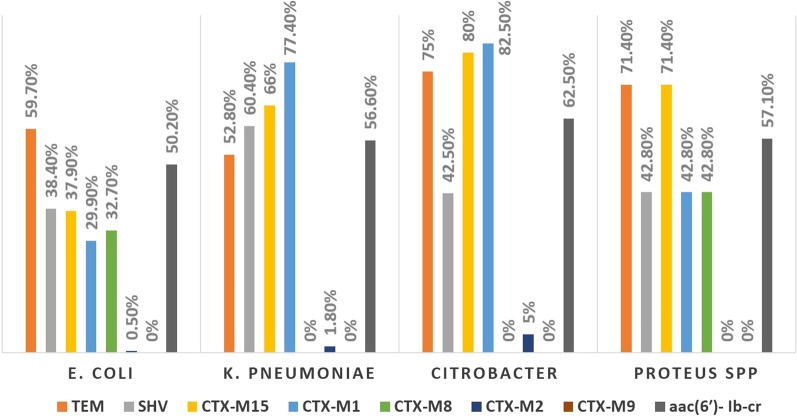
Out of 440 Enterobacteriaceae isolates, 311 were identified as ESBL producers by phenotypic testing. ESBL genes were detected in 308 isolates. BlaCTX-M-type was the most prevalent 254 (81.6%), out of them blaCTXM-15 was the commonest (152, 48.8%) followed by blaCTX-M-1 (140, 45%), blaCTX-M-8 (72, 23.1%) and lastly blaCTX-M-2 (4, 1.3%). blaTEM gene also was detected in a high rate (189, 60.7%). Two hundred and thirty-five (75.5%) of ESBL producers harbored blaCTX-M in combination with blaTEM and/or blaSHV genes. Multiple drug resistance in the ESBL-producers was significantly (P < 0.05) higher than in non-ESBL producers. Imipenem was the most effective drug against ESBL producers. Among 35 cefoxitin resistant isolates, 18 (51.4%) identified as carrying AmpC genes by multiplex PCR. Within AmpC β -lactamase genes, DHA gene was the predominant gene (15, 42.3%). CIT and MOX genes were also present, but in a low rate (5, 14.2% and 4, 11.4%) respectively. Co-existence of multiple AmpC genes was detected exclusively in K. pneumoniae isolates. E. coli isolates harbored DHA gene only. However, FOX gene was not detected in the study isolates. Seventeen of isolates carrying AmpC genes were also positive for ESBL genes.
The study shows that the prevalence of ESBL producing Enterobacteriaceae spread in south Egypt is alarming, however AmpC β -lactamase production is not so high.
肠杆菌科引起的感染主要用β-内酰胺类抗生素治疗,然而,具有质粒携带β-内酰胺酶的物种的出现降低了这些抗生素的疗效。因此,继续研究不同地区的耐药模式对于评估适当的抗菌治疗方案很重要。本研究旨在描述埃及社区获得性尿路感染中分离的产超广谱β-内酰胺酶(ESBL)和AmpC β-内酰胺酶(AmpC)的肠杆菌科。
在 705 份尿液样本中,对 440 株肠杆菌科分离株进行了研究,通过表型和分子方法检测 ESBL 和 AmpC β-内酰胺酶产生菌。
在 440 株肠杆菌科分离株中,311 株通过表型检测被鉴定为 ESBL 产生菌。在 308 株分离株中检测到 ESBL 基因。BlaCTX-M 型最为常见,有 254 株(81.6%),其中 blaCTXM-15 最为常见(152 株,48.8%),其次是 blaCTX-M-1(140 株,45%)、blaCTX-M-8(72 株,23.1%)和 blaCTX-M-2(4 株,1.3%)。blaTEM 基因的检出率也很高(189 株,60.7%)。235 株(75.5%)ESBL 产生菌同时携带 blaCTX-M 与 blaTEM 和/或 blaSHV 基因。ESBL 产生菌的多重耐药性明显高于非 ESBL 产生菌(P<0.05)。亚胺培南对 ESBL 产生菌最有效。在 35 株头孢西丁耐药的分离株中,18 株(51.4%)经多重 PCR 鉴定携带 AmpC 基因。在 AmpC β-内酰胺酶基因中,DHA 基因是主要基因(15 株,42.3%)。CIT 和 MOX 基因也存在,但检出率较低(5 株,14.2%和 4 株,11.4%)。仅在肺炎克雷伯菌分离株中检测到多种 AmpC 基因的共存。大肠杆菌分离株仅携带 DHA 基因。然而,在研究分离株中未检测到 FOX 基因。携带 AmpC 基因的 17 株分离株也呈 ESBL 基因阳性。
本研究表明,肠杆菌科产 ESBL 分离株在埃及南部的流行率令人担忧,然而 AmpC β-内酰胺酶的产生率并不高。