University of Connecticut School of Nursing, Storrs, Connecticut.
University of Connecticut School of Nursing, Storrs, Connecticut.
Pain Manag Nurs. 2021 Jun;22(3):369-376. doi: 10.1016/j.pmn.2020.09.007. Epub 2020 Dec 8.
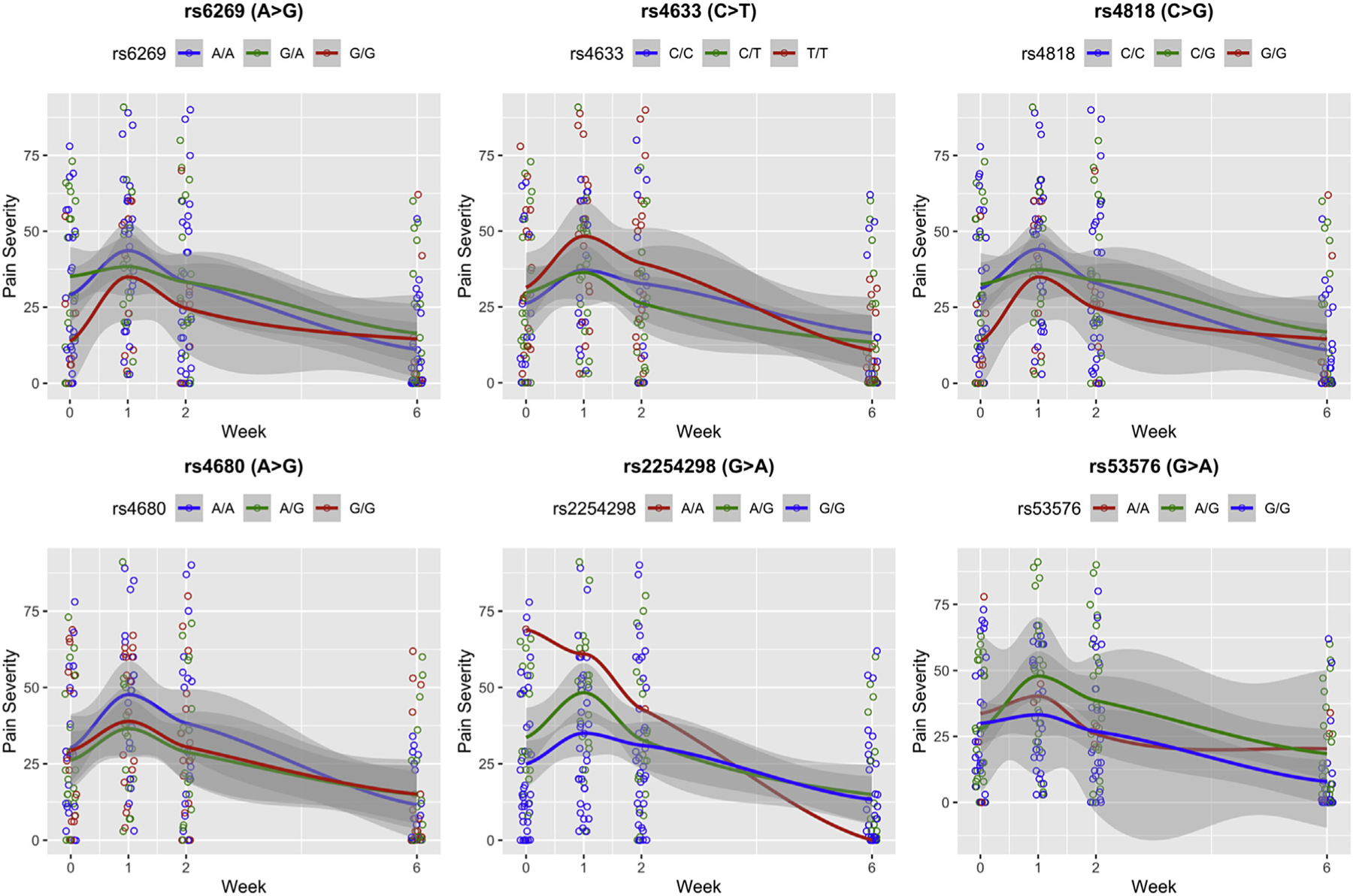
Thirty percent of women who seek professional breastfeeding support require assistance with ongoing breast and nipple pain and < 50% of women report resolution of their pain. It is unknown if there is a molecular risk for ongoing breast and nipple pain during breastfeeding. Aim -To evaluate associations among breast and nipple pain sensitivity and candidate pain sensitivity single-nucleotide polymorphisms [SNPs], (COMT rs6269, rs4633, rs4818, rs4680 and OXTR rs2254298, rs53576) in breastfeeding women. Design - A secondary analysis of a pilot randomized controlled trial of a pain self-management intervention conducted over 6 weeks postpartum. Setting and Participants - Sixty women were recruited from two hospital settings after birth. Methods - All participants underwent standardized mechanical somatosensory testing for an assessment of pain sensitivity and provided baseline buccal swabs for genetic analysis. At 1, 2, and 6 weeks postpartum, women self-reported breast and nipple pain severity using a visual analogue scale. Results - Women with the minor allele OXTR rs53576 reported 8.18-fold higher breast and nipple pain severity over time. For every 1-unit increase in Mechanical detection threshold and windup ratio, women reported 16.51-fold and 4.82-fold higher breast and nipple pain severity respectively. Six women with the OXTR rs2254298 minor allele reported allodynia. Conclusion - The presence of OXTR alleles in women with enhanced pain sensitivity suggests a phenotype of genetic risk for ongoing breast and nipple with potential for pain-associated breastfeeding cessation. Somatosensory testing identified women who reported higher breast and nipple pain during the first weeks of breastfeeding.
寻求专业母乳喂养支持的女性中,有 30%需要持续解决乳房和乳头疼痛问题,而<50%的女性报告其疼痛得到缓解。目前尚不清楚母乳喂养期间持续乳房和乳头疼痛是否存在分子风险。目的 - 评估母乳喂养女性的乳房和乳头疼痛敏感性与候选疼痛敏感性单核苷酸多态性(COMT rs6269、rs4633、rs4818、rs4680 和 OXTR rs2254298、rs53576)之间的关联。设计 - 对一项为期 6 周的产后疼痛自我管理干预的试点随机对照试验的二次分析。地点和参与者 - 在分娩后,从两家医院招募了 60 名女性。方法 - 所有参与者均接受标准化机械躯体感觉测试,以评估疼痛敏感性,并提供基线颊拭子进行基因分析。产后 1、2 和 6 周,女性使用视觉模拟量表自我报告乳房和乳头疼痛严重程度。结果 - 携带 OXTR rs53576 次要等位基因的女性报告的乳房和乳头疼痛严重程度随时间呈 8.18 倍增加。机械检测阈值和windup 比每增加 1 个单位,女性报告的乳房和乳头疼痛严重程度分别增加 16.51 倍和 4.82 倍。6 名携带 OXTR rs2254298 次要等位基因的女性报告出现感觉过敏。结论 - 具有增强疼痛敏感性的女性中 OXTR 等位基因的存在表明存在持续乳房和乳头疼痛的遗传风险表型,可能与与疼痛相关的母乳喂养中断有关。躯体感觉测试确定了在母乳喂养的最初几周报告乳房和乳头疼痛较高的女性。