Department of Surgery, The Pennsylvania State University, College of Medicine, 500 University Drive, H151, Hershey, PA, 17033-0850, USA.
Department of Public Health Sciences, The Pennsylvania State University, College of Medicine, Hershey, PA, USA.
Sci Rep. 2020 Dec 10;10(1):21698. doi: 10.1038/s41598-020-78569-8.
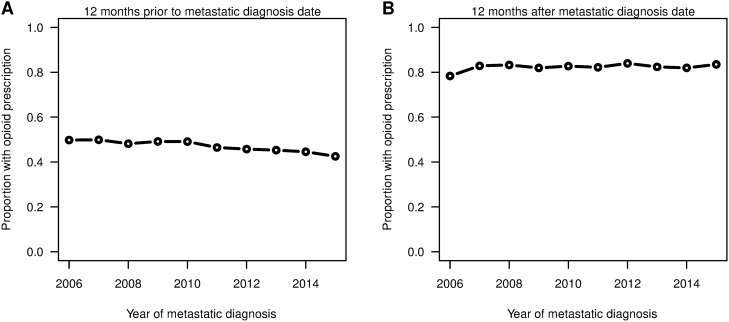
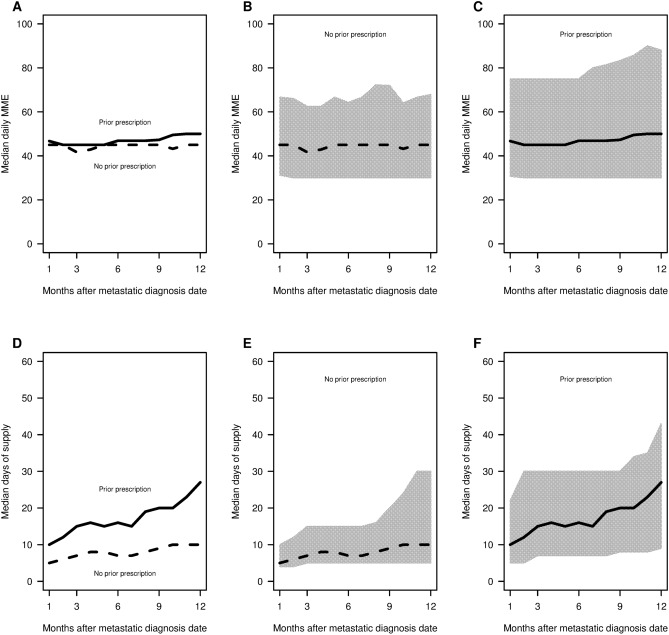
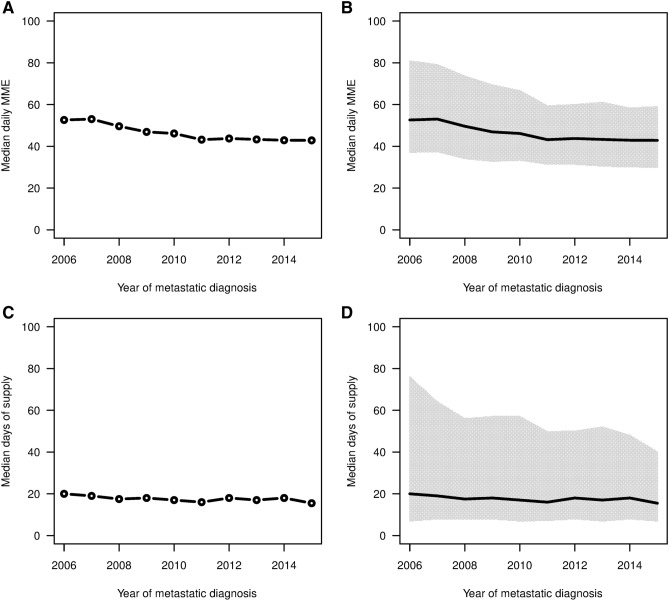
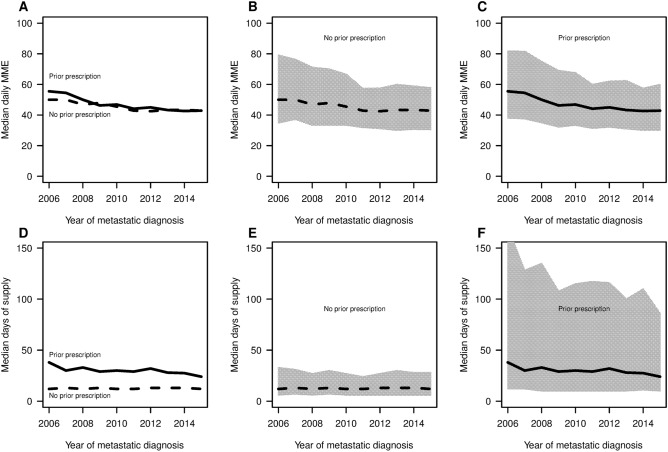
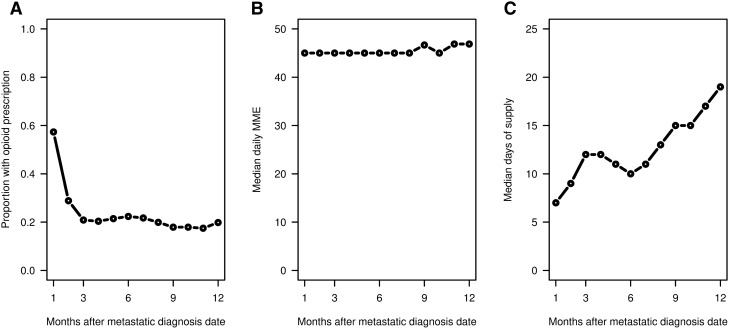
Opioid use among metastatic breast cancer (MBC) patients has not been well-studied. This study examined the trends and patterns of opioid use among working-age, privately insured patients diagnosed with MBC. Using MarketScan data, we identified female patients diagnosed with MBC in 2006-2015. We determined the proportion of patients who filled a prescription for an opioid and calculated days' supply and daily morphine milligram equivalents (MMEs) from 1 year prior to diagnosis till 1 year after. We assessed the trend in opioid use over the 10-year study period and examined opioid usage patterns after the diagnosis of MBC. Among 24,752 patients included, 11,579 (46.8%) had an opioid prescription within 1 year before diagnosis of MBC, and 20,416 (81.4%) had an opioid prescription within 1 year after diagnosis. The proportion of patients with opioid prescriptions after diagnosis was relatively stable from 2006 to 2015. However, both the median daily MME and median days' supply decreased over time with most of the decline from the subgroup of patients with prior prescription opioid use. Most patients received an opioid prescription in the first month after diagnosis (57.3%), dropping to approximately 20% from 3 to 12 months after diagnosis. Also, the median days' supply increased substantially during the year after diagnosis for patients who received opioids (from 7 to 19). Most women with MBC require opioid analgesia within the first month after diagnosis. Judicious, long-term management of pain after diagnosis of MBC will continue to be necessary for many patients.
转移性乳腺癌(MBC)患者的阿片类药物使用情况尚未得到充分研究。本研究调查了在诊断为 MBC 的有工作的、私人保险的女性患者中阿片类药物使用的趋势和模式。使用 MarketScan 数据,我们确定了在 2006 年至 2015 年期间被诊断为 MBC 的女性患者。我们确定了开具阿片类药物处方的患者比例,并计算了从诊断前 1 年到诊断后 1 年的每日供应量和每日吗啡毫克当量(MME)。我们评估了 10 年研究期间阿片类药物使用的趋势,并检查了 MBC 诊断后阿片类药物使用模式。在纳入的 24752 名患者中,11579 名(46.8%)在诊断为 MBC 前 1 年内有阿片类药物处方,20416 名(81.4%)在诊断后 1 年内有阿片类药物处方。诊断后有阿片类药物处方的患者比例从 2006 年到 2015 年相对稳定。然而,随着时间的推移,每日 MME 的中位数和每日供应量的中位数都有所下降,大部分下降来自于有先前阿片类药物处方的患者亚组。大多数患者在诊断后第一个月接受阿片类药物处方(57.3%),从诊断后 3 个月到 12 个月,该比例降至约 20%。此外,接受阿片类药物的患者在诊断后一年的中位日供应量大幅增加(从 7 天增加到 19 天)。大多数患有 MBC 的女性在诊断后第一个月需要阿片类药物镇痛。对于许多患者来说,在诊断为 MBC 后,明智的、长期的疼痛管理将继续是必要的。