Krieger Eduardo André Gomes, Karam Francisco Consoli, Soder Ricardo Bernardi, da Silva Jefferson Luis Braga
Hospital São Lucas da Pontifícia Universidade Católica do Rio Grande do Sul (PUCRS), Porto Alegre, RS, Brazil.
Radiol Bras. 2020 Nov-Dec;53(6):375-380. doi: 10.1590/0100-3984.2019.0105.
To establish the prevalence of patellar chondropathy using 3T magnetic resonance imaging (MRI) and to correlate the findings with individual features such as gender, age, and body mass index.
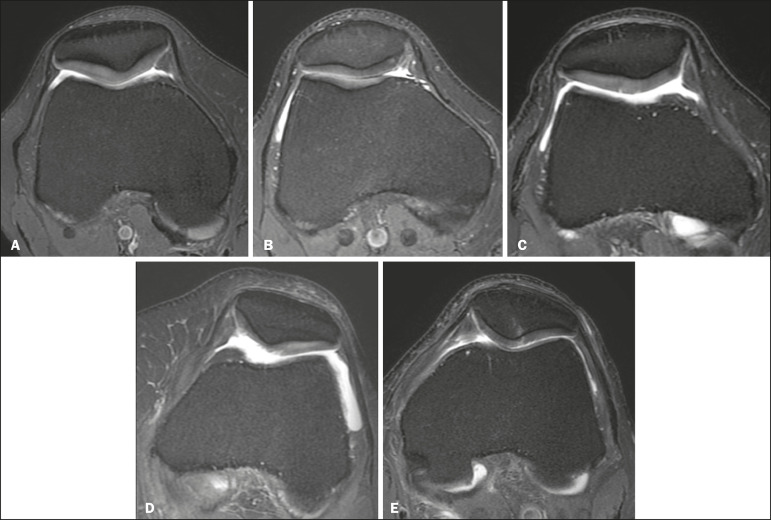
Data consisted of collecting 3T MRIs of patients' knees obtained between October 2016 and September 2017, comprising a period of 12 months. These MRIs were assessed by an experienced musculoskeletal radiologist who confirmed the presence of patellar chondropathy and, when present, rated the finding into the four grades ascribed by the International Cartilage Repair Society.
A total number of 291 patients were assessed during the period with 389 MRI scans. Of those patients, 308 (79.2%) were diagnosed with patellar chondropathy, while 81 (20.8%) were not. Chondropathy was more prevalent in the female gender, in subjects above 40 years of age, and in obese patients. When the results were weighed in International Cartilage Repair Society classification, the milder grades (1 and 2) were seen in younger men (< 30 years of age), while the more severe grades (3 and 4) were mostly present in females, those above 40 years of age, and in obese patients.
There was a high prevalence of patellar chondropathy in patients who had undergone high-field knee MRIs (79.2%), being highest in the female gender and in subjects above 40 years of age. The most prevalent group was graded as 4 by the International Cartilage Repair Society classification.
使用3T磁共振成像(MRI)确定髌软骨病的患病率,并将结果与性别、年龄和体重指数等个体特征相关联。
数据收集自2016年10月至2017年9月期间(为期12个月)获取的患者膝关节3T MRI图像。这些MRI图像由一位经验丰富的肌肉骨骼放射科医生进行评估,该医生确认髌软骨病的存在,并在存在该病时,将结果按照国际软骨修复协会指定的四个等级进行分级。
在此期间,共评估了291例患者的389次MRI扫描。其中,308例(79.2%)被诊断为髌软骨病,81例(20.8%)未患该病。软骨病在女性、40岁以上人群和肥胖患者中更为普遍。按照国际软骨修复协会分类权衡结果时,较轻等级(1级和2级)多见于年轻男性(<30岁),而较重等级(3级和4级)主要见于女性、40岁以上人群和肥胖患者。
接受高场强膝关节MRI检查的患者中,髌软骨病的患病率较高(79.2%),在女性和40岁以上人群中最高。按照国际软骨修复协会分类,最常见的等级为4级。