Manenti Rosa, Gobbi Elena, Baglio Francesca, Macis Ambra, Ferrari Clarissa, Pagnoni Ilaria, Rossetto Federica, Di Tella Sonia, Alemanno Federica, Cimino Vincenzo, Binetti Giuliano, Iannaccone Sandro, Bramanti Placido, Cappa Stefano F, Cotelli Maria
Neuropsychology Unit, IRCCS Istituto Centro San Giovanni di Dio Fatebenefratelli, Brescia, Italy.
IRCCS, Fondazione Don Carlo Gnocchi - ONLUS, Milan, Italy.
Front Aging Neurosci. 2020 Nov 16;12:585988. doi: 10.3389/fnagi.2020.585988. eCollection 2020.
In recent years, the potential usefulness of cognitive training procedures in normal aging and mild cognitive impairment (MCI) have received increased attention.
The main aim of this study was to evaluate the efficacy of the face-to-face cognitive virtual reality rehabilitation system (VRRS) and to compare it to that of face-to-face cognitive treatment as usual for individuals with MCI. Moreover, we assessed the possibility of prolonging the effects of treatment with a telerehabilitation system.
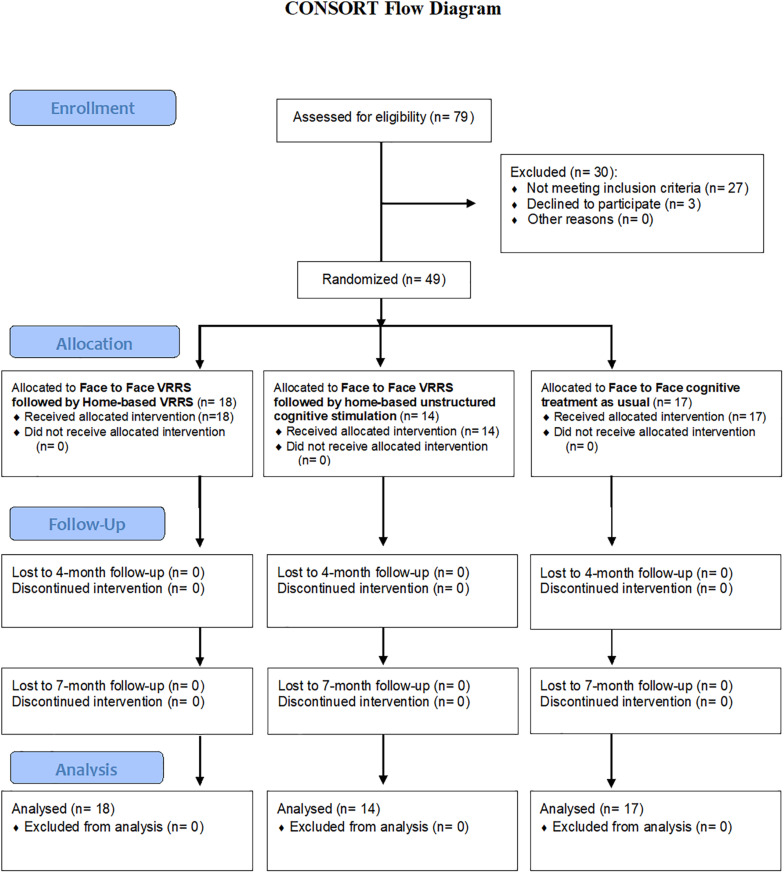
A total of 49 subjects with MCI were assigned to 1 of 3 study groups in a randomized controlled trial design: (a) those who received face-to-face cognitive VRRS (12 sessions of individualized cognitive rehabilitation over 4 weeks) followed by telerehabilitation (36 sessions of home-based cognitive VRRS training, three sessions for week); (b) those who received face-to-face cognitive VRRS followed by at-home unstructured cognitive stimulation (36 sessions of home-based unstructured cognitive stimulation, three sessions for week); and (c) those who received face-to-face cognitive treatment as usual (12 sessions of face-to-face cognitive treatment as usual).
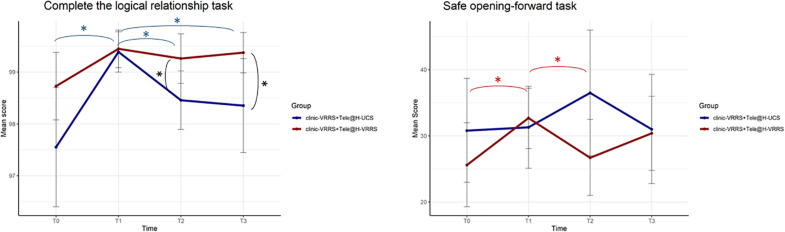
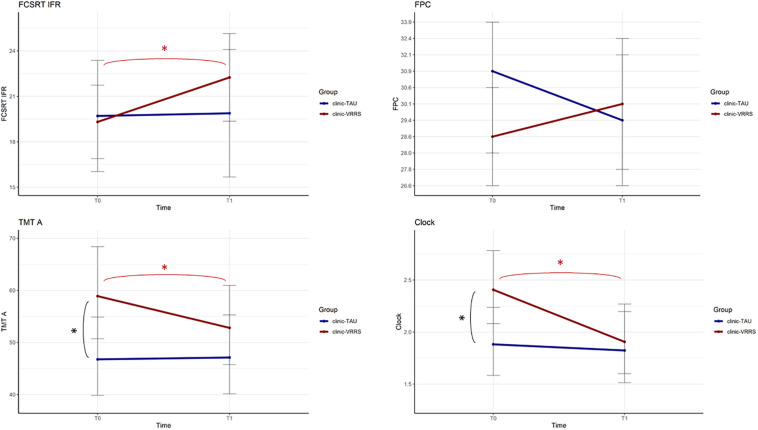
An improvement in memory, language and visuo-constructional abilities was observed after the end of face-to-face VRRS treatment compared to face-to-face treatment as usual. The application of home-based cognitive VRRS telerehabilitation seems to induce more maintenance of the obtained gains than home-based unstructured stimulation.
The present study provides preliminary evidence in support of individualized VRRS treatment and telerehabilitation delivery for cognitive rehabilitation and should pave the way for future studies aiming at identifying optimal cognitive treatment protocols in subjects with MCI.
www.ClinicalTrials.gov, identifier NCT03486704.
近年来,认知训练程序在正常衰老和轻度认知障碍(MCI)中的潜在效用受到了更多关注。
本研究的主要目的是评估面对面认知虚拟现实康复系统(VRRS)的疗效,并将其与MCI患者的常规面对面认知治疗进行比较。此外,我们评估了通过远程康复系统延长治疗效果的可能性。
在一项随机对照试验设计中,将49名MCI受试者分配到3个研究组中的1组:(a)接受面对面认知VRRS治疗的受试者(在4周内进行12次个性化认知康复治疗),随后进行远程康复治疗(36次基于家庭的认知VRRS训练,每周3次);(b)接受面对面认知VRRS治疗,随后进行家庭非结构化认知刺激的受试者(36次基于家庭的非结构化认知刺激,每周3次);以及(c)接受常规面对面认知治疗的受试者(12次常规面对面认知治疗)。
与常规面对面治疗相比,面对面VRRS治疗结束后,观察到记忆、语言和视觉构建能力有所改善。与家庭非结构化刺激相比,基于家庭的认知VRRS远程康复治疗似乎能使获得的改善得到更多维持。
本研究提供了初步证据,支持个性化VRRS治疗和远程康复治疗用于认知康复,并应为未来旨在确定MCI患者最佳认知治疗方案的研究铺平道路。