Matamala-Gomez Marta, Maisto Marta, Montana Jessica Isbely, Mavrodiev Petar Aleksandrov, Baglio Francesca, Rossetto Federica, Mantovani Fabrizia, Riva Giuseppe, Realdon Olivia
"Riccardo Massa" Department of Human Sciences for Education, University of Milano-Bicocca, Milan, Italy.
IRCCS Fondazione don Carlo Gnocchi ONLUS, Milan, Italy.
Front Neurol. 2020 May 6;11:354. doi: 10.3389/fneur.2020.00354. eCollection 2020.
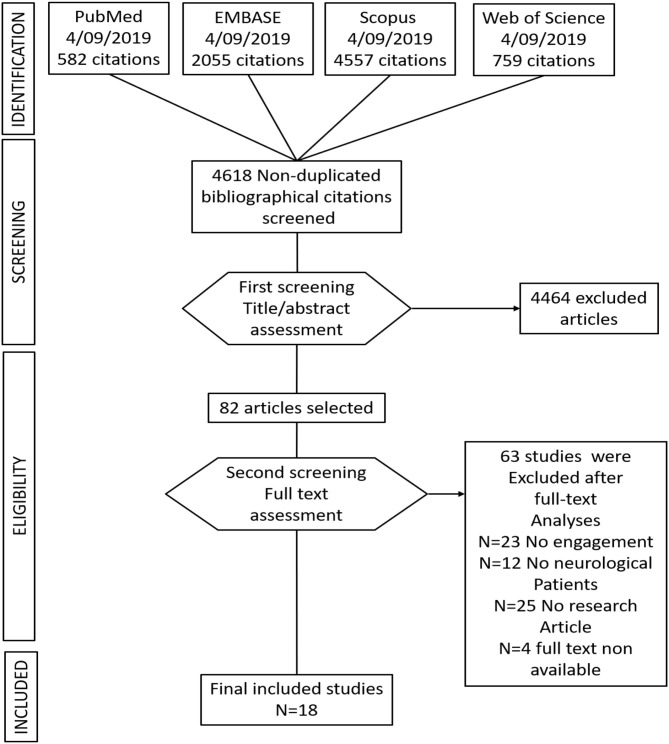
The growing understanding of the importance of involving patients with neurological diseases in their healthcare routine either for at-home management of their chronic conditions or after the hospitalization period has opened the research for new rehabilitation strategies to enhance patient engagement in neurorehabilitation. In addition, the use of new digital technologies in the neurorehabilitation field enables the implementation of telerehabilitation systems such as virtual reality interventions, video games, web-based interventions, mobile applications, web-based or telephonic telecoach programs, in order to facilitate the relationship between clinicians and patients, and to motivate and activate patients to continue with the rehabilitation process at home. Here we present a systematic review that aims at reviewing the effectiveness of different engagement strategies and the different engagement assessments while using telerehabilitation systems in patients with neurological disorders. We used PICO's format to define the question of the review, and the systematic review protocol was designed following the Preferred Reported Items for Systematic Reviews and Meta-Analysis (PRISMA) guidelines. Bibliographical data was collected by using the following bibliographic databases: PubMed, EMBASE, Scopus, and Web of Science. Eighteen studies were included in this systematic review for full-text analyses. Overall, the reviewed studies using engagement strategies through telerehabilitation systems in patients with neurological disorders were mainly focused on patient self-management and self-awareness, patient motivation, and patient adherence subcomponents of engagement, that are involved in by the behavioral, cognitive, and emotional dimensions of engagement. Conclusion: The studies commented throughout this systematic review pave the way for the design of new telerehabilitation protocols, not only focusing on measuring quantitative or qualitative measures but measuring both of them through a mixed model intervention design (1). The future clinical studies with a mixed model design will provide more abundant data regarding the role of engagement in telerehabilitation, leading to a possibly greater understanding of its underlying components.
人们越来越认识到,让神经疾病患者参与日常医疗保健对于慢性病的居家管理或住院治疗后的康复非常重要,这开启了对新康复策略的研究,以提高患者在神经康复中的参与度。此外,神经康复领域中新型数字技术的应用使得远程康复系统得以实施,如虚拟现实干预、电子游戏、基于网络的干预、移动应用程序、基于网络或电话的远程指导项目,以便促进临床医生与患者之间的关系,并激励和促使患者在家中继续康复进程。在此,我们进行了一项系统综述,旨在评估在神经疾病患者中使用远程康复系统时不同参与策略和不同参与度评估的有效性。我们采用PICO格式来界定综述问题,并按照系统综述与Meta分析优先报告条目(PRISMA)指南设计了系统综述方案。通过使用以下书目数据库收集文献数据:PubMed、EMBASE、Scopus和科学网。本系统综述纳入了18项研究进行全文分析。总体而言,这些综述研究通过远程康复系统对神经疾病患者采用参与策略,主要关注参与度的患者自我管理与自我意识、患者动机以及患者依从性子成分,这些子成分涉及参与度的行为、认知和情感维度。结论:本系统综述中所评论的研究为新远程康复方案的设计铺平了道路,不仅关注定量或定性测量,而且通过混合模型干预设计同时测量两者(1)。未来采用混合模型设计的临床研究将提供更丰富的数据,说明参与度在远程康复中的作用,从而可能更深入地理解其潜在组成部分。