Zhang Ting-Ting, Hou Yi-Kun, Yang Ting, Zhang Shu-Ya, Yue Ming, Liu Jianni, Li Zhonghu
Key Laboratory of Resource Biology and Biotechnology in Western China, Ministry of Education, College of Life Sciences, Northwest University, Xi'an, China.
Early Life Institute, State Key Laboratory of Continental Dynamics, Department of Geology, Northwest University, Xi'an, China.
PeerJ. 2020 Nov 25;8:e10312. doi: 10.7717/peerj.10312. eCollection 2020.
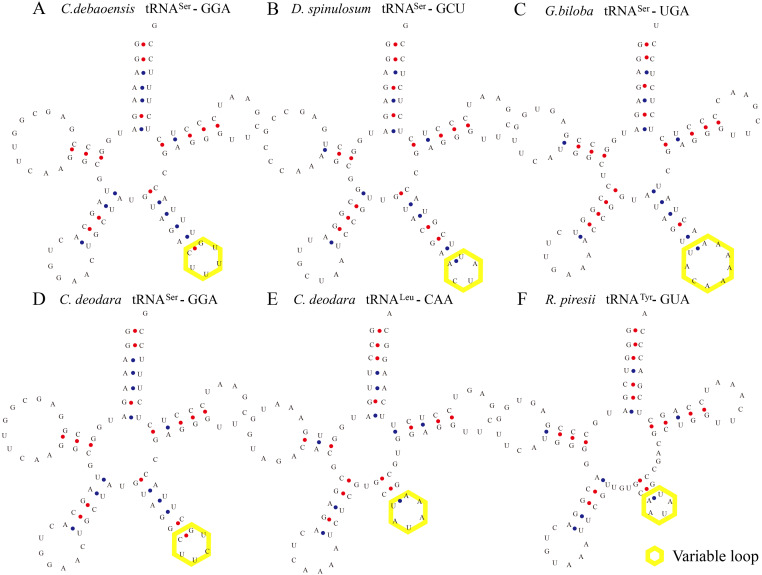
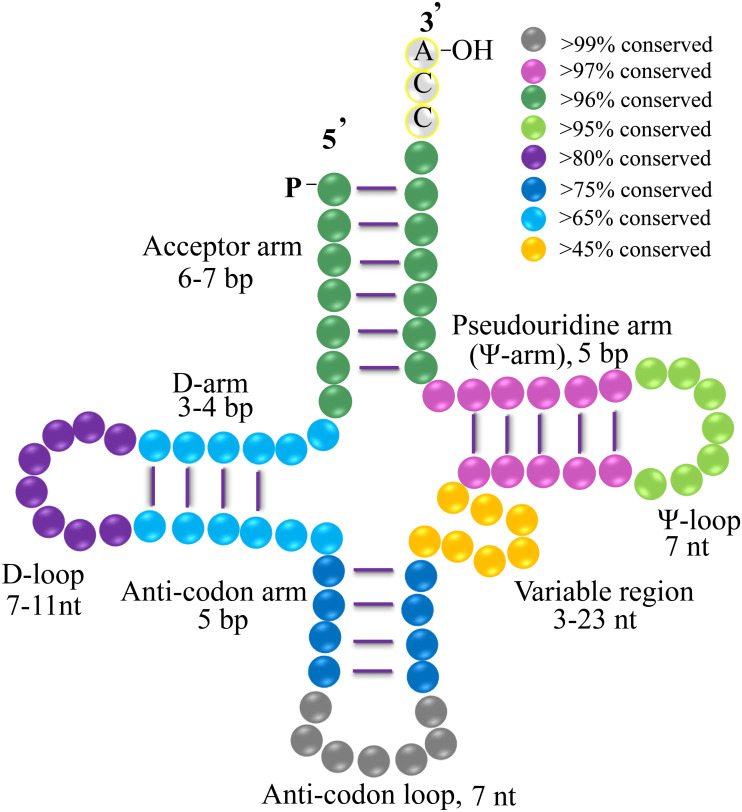
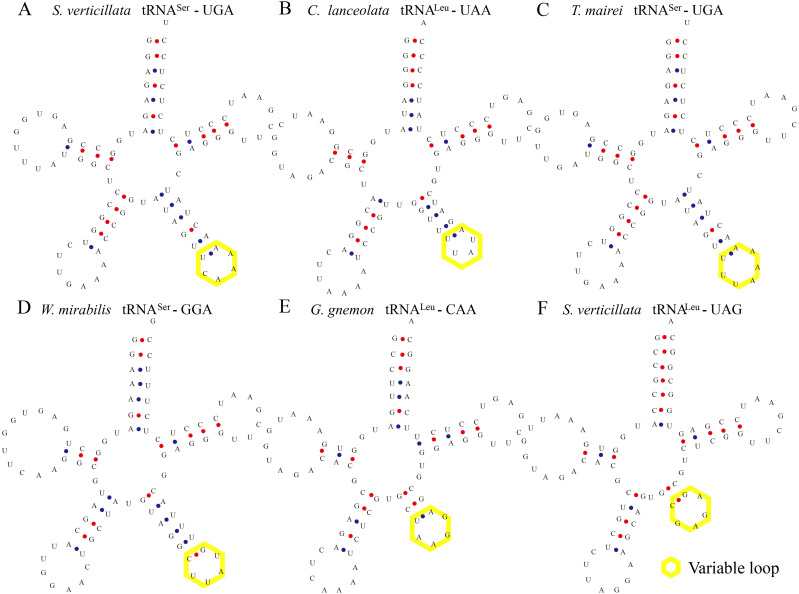
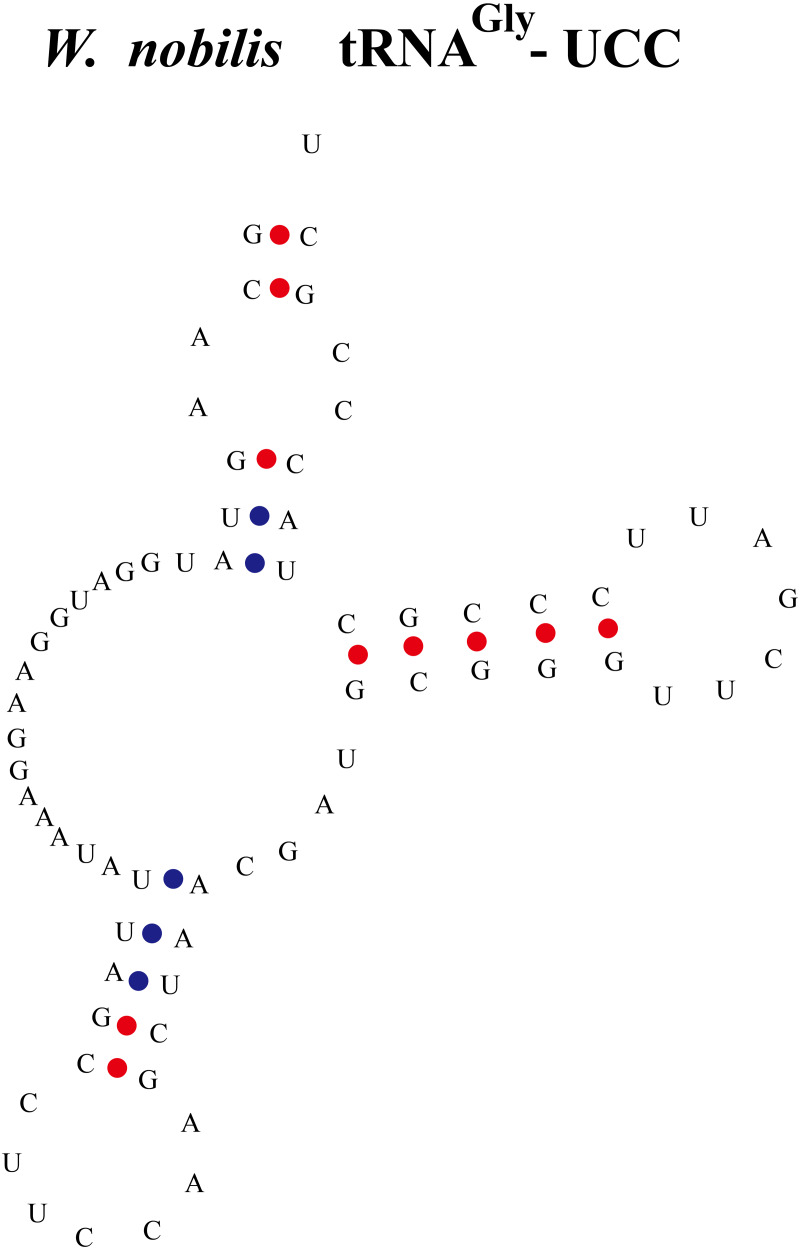
Gymnosperms such as ginkgo, conifers, cycads, and gnetophytes are vital components of land ecosystems, and they have significant economic and ecologic value, as well as important roles as forest vegetation. In this study, we investigated the structural variation and evolution of chloroplast transfer RNAs (tRNAs) in gymnosperms. Chloroplasts are important organelles in photosynthetic plants. tRNAs are key participants in translation where they act as adapter molecules between the information level of nucleic acids and functional level of proteins. The basic structures of gymnosperm chloroplast tRNAs were found to have family-specific conserved sequences. The tRNAΨ -loop was observed to contain a conforming sequence, i.e., U-U-C-N-A-N. In gymnosperms, tRNA was found to encode a "CAU" anticodon, which is usually encoded by tRNA. Phylogenetic analysis suggested that plastid tRNAs have a common polyphyletic evolutionary pattern, i.e., rooted in abundant common ancestors. Analyses of duplication and loss events in chloroplast tRNAs showed that gymnosperm tRNAs have experienced little more gene loss than gene duplication. Transition and transversion analysis showed that the tRNAs are iso-acceptor specific and they have experienced unequal evolutionary rates. These results provide new insights into the structural variation and evolution of gymnosperm chloroplast tRNAs, which may improve our comprehensive understanding of the biological characteristics of the tRNA family.
银杏、针叶树、苏铁和买麻藤等裸子植物是陆地生态系统的重要组成部分,它们具有重要的经济和生态价值,并且作为森林植被发挥着重要作用。在本研究中,我们调查了裸子植物叶绿体转运RNA(tRNA)的结构变异和进化。叶绿体是光合植物中的重要细胞器。tRNA是翻译过程中的关键参与者,它们在核酸的信息水平和蛋白质的功能水平之间充当衔接分子。发现裸子植物叶绿体tRNA的基本结构具有家族特异性保守序列。观察到tRNAΨ环含有一个符合的序列,即U-U-C-N-A-N。在裸子植物中,发现tRNA编码一个“CAU”反密码子,这通常由tRNA编码。系统发育分析表明,质体tRNA具有共同的多系进化模式,即起源于丰富的共同祖先。对叶绿体tRNA的复制和丢失事件的分析表明,裸子植物tRNA经历的基因丢失比基因复制略多。转换和颠换分析表明,tRNA是同工受体特异性的,并且它们经历了不平等的进化速率。这些结果为裸子植物叶绿体tRNA的结构变异和进化提供了新的见解,这可能会提高我们对tRNA家族生物学特性的全面理解。