Key Laboratory of Resource Biology and Biotechnology in Western China, Ministry of Education, College of Life Sciences, Northwest University, Xi'an 710069, China.
State Key Laboratory of Cotton Biology, Institute of Cotton Research, Chinese Academy of Agricultural Sciences, Anyang 455000, China.
Genes (Basel). 2021 May 27;12(6):822. doi: 10.3390/genes12060822.
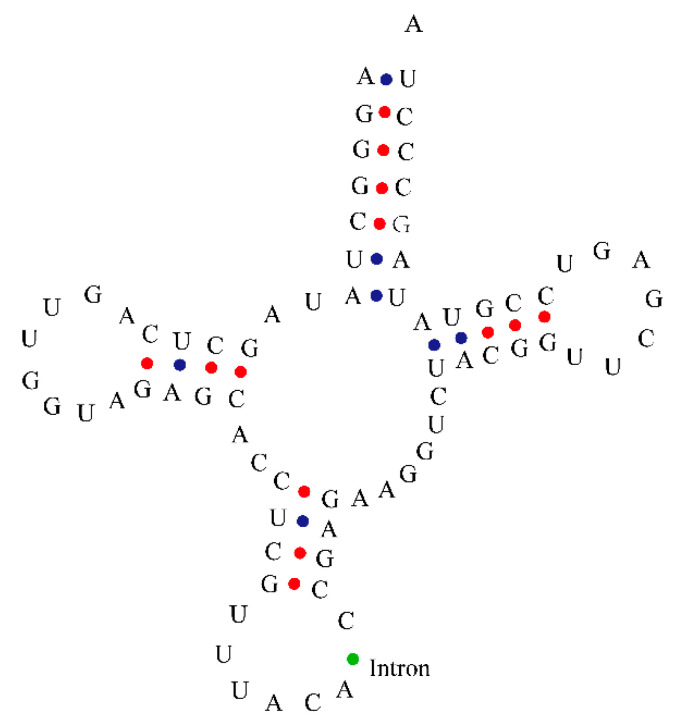
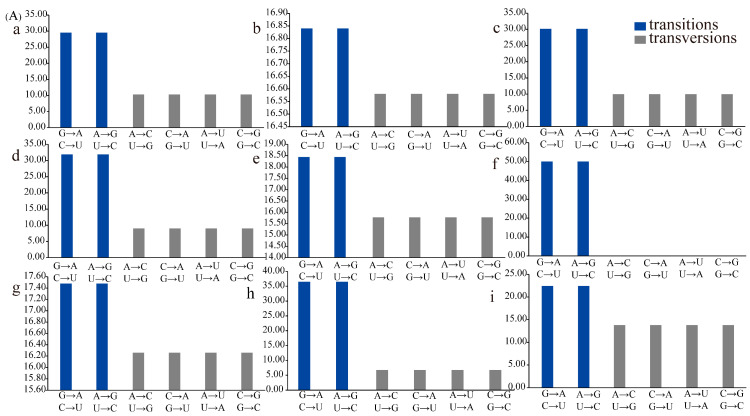
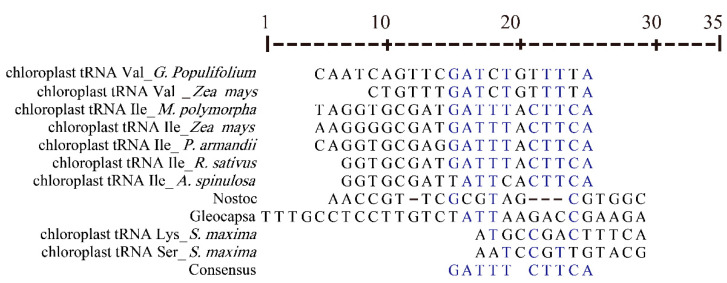
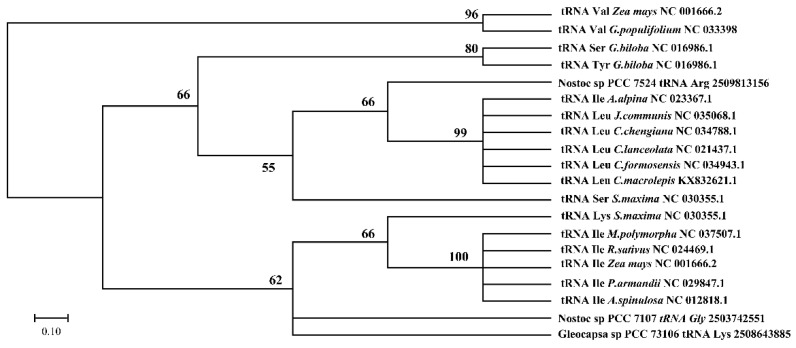
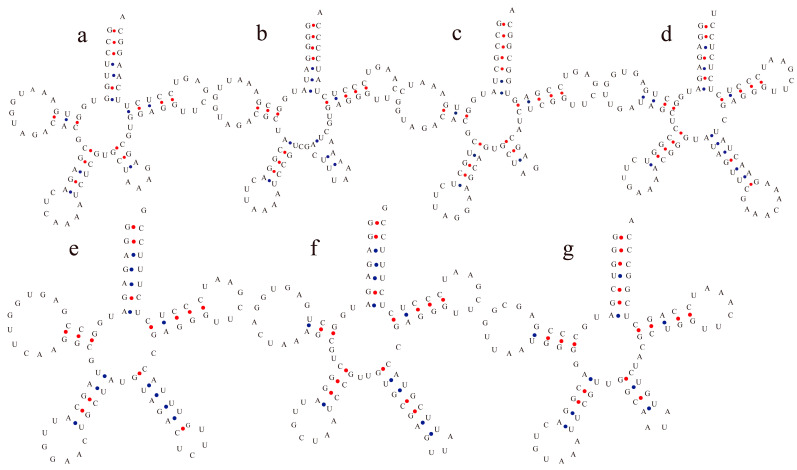
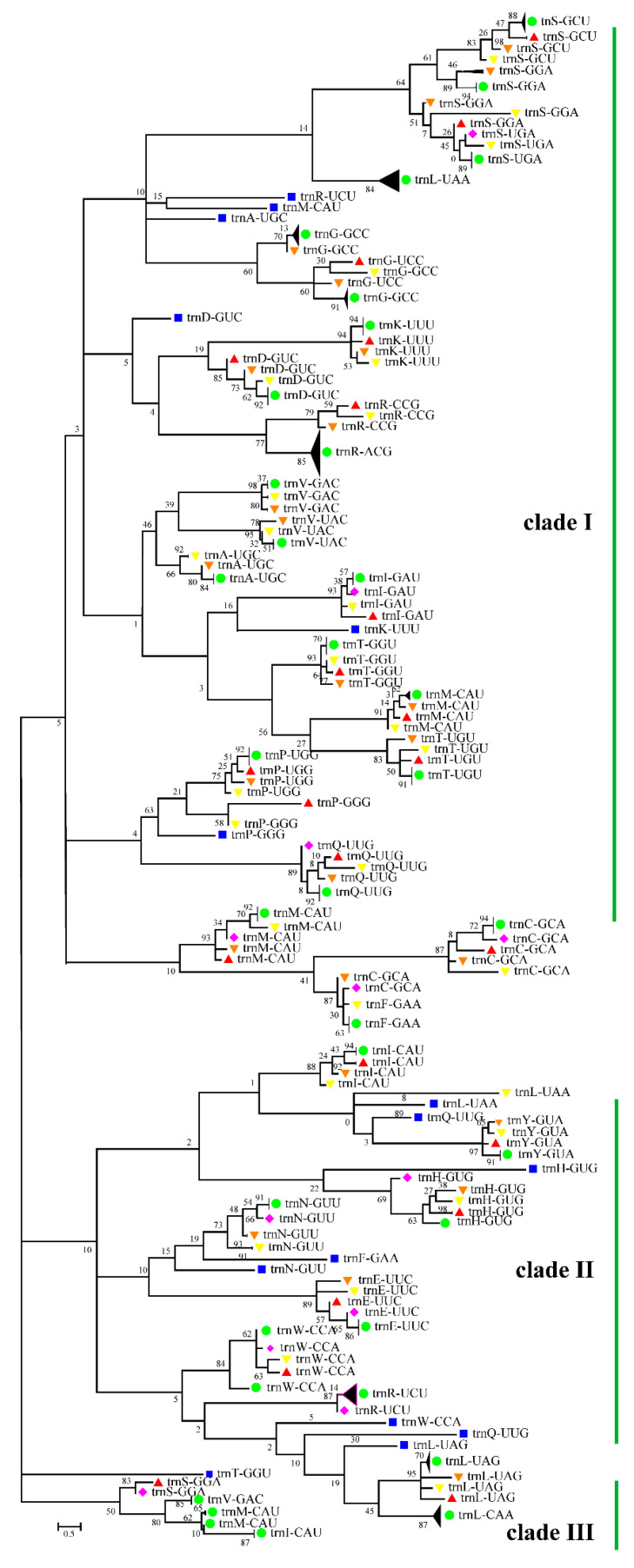
Cotton is one of the most important fiber and oil crops in the world. Chloroplast genomes harbor their own genetic materials and are considered to be highly conserved. Transfer RNAs (tRNAs) act as "bridges" in protein synthesis by carrying amino acids. Currently, the variation and evolutionary characteristics of tRNAs in the cotton chloroplast genome are poorly understood. Here, we analyzed the structural variation and evolution of chloroplast tRNA (cp tRNA) based on eight diploid and two allotetraploid cotton species. We also investigated the nucleotide evolution of chloroplast genomes in cotton species. We found that cp tRNAs in cotton encoded 36 or 37 tRNAs, and 28 or 29 anti-codon types with lengths ranging from 60 to 93 nucleotides. Cotton chloroplast tRNA sequences possessed specific conservation and, in particular, the Ψ-loop contained the conserved U-U-C-X3-U. The cp tRNAs of L. contained introns, and cp tRNA contained the anti-codon (C-A-U), which was generally the anti-codon of tRNA. The transition and transversion analyses showed that cp tRNAs in cotton species were iso-acceptor specific and had undergone unequal rates of evolution. The intergenic region was more variable than coding regions, and non-synonymous mutations have been fixed in cotton cp genomes. On the other hand, phylogeny analyses indicated that cp tRNAs of cotton were derived from several inferred ancestors with greater gene duplications. This study provides new insights into the structural variation and evolution of chloroplast tRNAs in cotton plants. Our findings could contribute to understanding the detailed characteristics and evolutionary variation of the tRNA family.
棉花是世界上最重要的纤维和油料作物之一。叶绿体基因组拥有自己的遗传物质,被认为是高度保守的。转移 RNA(tRNA)通过携带氨基酸在蛋白质合成中充当“桥梁”。目前,棉花叶绿体基因组中 tRNA 的变异和进化特征还知之甚少。在这里,我们基于 8 个二倍体和 2 个异源四倍体棉种分析了叶绿体 tRNA(cp tRNA)的结构变异和进化。我们还研究了棉属植物叶绿体基因组的核苷酸进化。我们发现棉花 cp tRNA 编码 36 或 37 种 tRNA,反密码子类型 28 或 29 种,长度为 60 至 93 个核苷酸。棉花叶绿体 tRNA 序列具有特定的保守性,特别是 ψ-环包含保守的 U-U-C-X3-U。L. 的 cp tRNA 含有内含子,而 cp tRNA 含有反密码子(C-A-U),这通常是 tRNA 的反密码子。转换和颠换分析表明,棉属植物的 cp tRNA 是同工受体特异性的,经历了不均等的进化速率。基因间隔区比编码区更具变异性,棉属 cp 基因组中已固定非同义突变。另一方面,系统发育分析表明,棉花的 cp tRNA 源自几个具有更大基因重复的推断祖先。本研究为棉花植物叶绿体 tRNA 的结构变异和进化提供了新的见解。我们的研究结果有助于深入了解 tRNA 家族的详细特征和进化变异。