Ji Guofeng, Ma Lushun, Yao Haochen, Ma Sheng, Si Xinghui, Wang Yalin, Bao Xin, Ma Lili, Chen Fangfang, Ma Chong, Huang Leaf, Fang Xuedong, Song Wantong
Department of Gastrointestinal and Colorectal Surgery, China-Japan Union Hospital of Jilin University, Changchun 130033, China.
Key Laboratory of Polymer Ecomaterials, Changchun Institute of Applied Chemistry, Chinese Academy of Sciences, Changchun 130022, China.
Acta Pharm Sin B. 2020 Nov;10(11):2171-2182. doi: 10.1016/j.apsb.2020.09.004. Epub 2020 Sep 15.
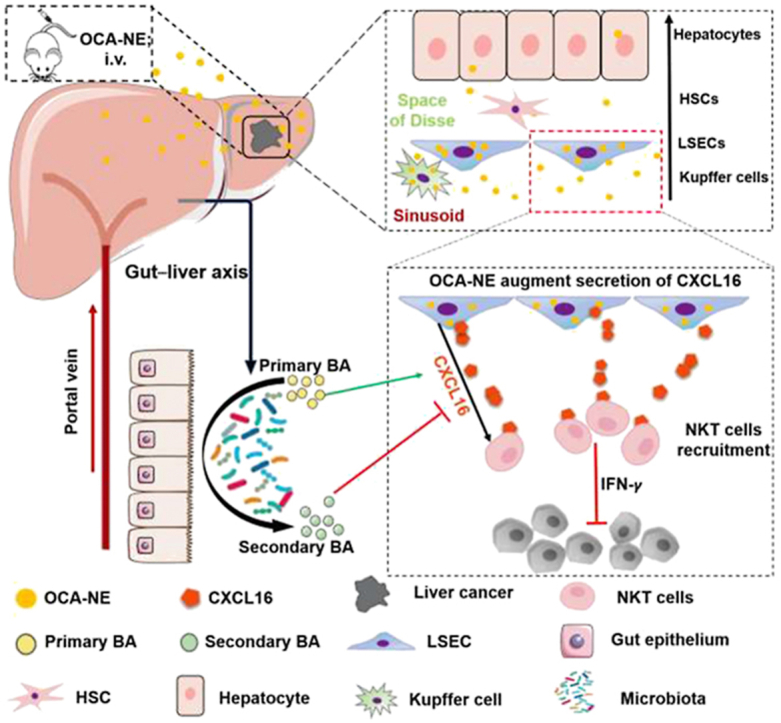
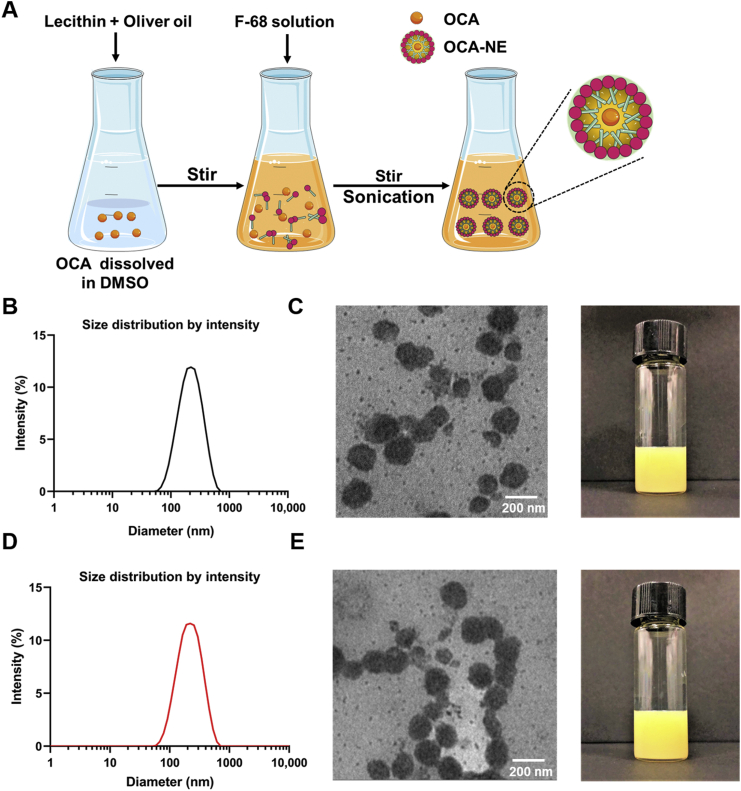
Primary bile acids were reported to augment secretion of chemokine (C‒X‒C motif) ligand 16 (CXCL16) from liver sinusoidal endothelial cells (LSECs) and trigger natural killer T (NKT) cell-based immunotherapy for liver cancer. However, abundant expression of receptors for primary bile acids across the gastrointestinal tract overwhelms the possibility of using agonists against these receptors for liver cancer control. Taking advantage of the intrinsic property of LSECs in capturing circulating nanoparticles in the circulation, we proposed a strategy using nanoemulsion-loaded obeticholic acid (OCA), a clinically approved selective farnesoid X receptor (FXR) agonist, for precisely manipulating LSECs for triggering NKT cell-mediated liver cancer immunotherapy. The OCA-nanoemulsion (OCA-NE) was prepared ultrasonic emulsification method, with a diameter of 184 nm and good stability. biodistribution studies confirmed that the injected OCA-NE mainly accumulated in the liver and especially in LSECs and Kupffer cells. As a result, OCA-NE treatment significantly suppressed hepatic tumor growth in a murine orthotopic H22 tumor model, which performed much better than oral medication of free OCA. Immunologic analysis revealed that the OCA-NE resulted in augmented secretion of CXCL16 and IFN-, as well as increased NKT cell populations inside the tumor. Overall, our research provides a new evidence for the antitumor effect of receptors for primary bile acids, and should inspire using nanotechnology for precisely manipulating LSECs for liver cancer therapy.
据报道,初级胆汁酸可增强肝窦内皮细胞(LSEC)分泌趋化因子(C-X-C基序)配体16(CXCL16),并触发基于自然杀伤T(NKT)细胞的肝癌免疫疗法。然而,初级胆汁酸受体在胃肠道广泛表达,这使得利用这些受体的激动剂来控制肝癌的可能性变得渺茫。利用LSEC在循环中捕获循环纳米颗粒的固有特性,我们提出了一种策略,即使用负载纳米乳剂的奥贝胆酸(OCA),一种临床批准的选择性法尼醇X受体(FXR)激动剂,精确操控LSEC以触发NKT细胞介导的肝癌免疫疗法。通过超声乳化法制备了OCA纳米乳剂(OCA-NE),其直径为184nm,稳定性良好。生物分布研究证实,注射的OCA-NE主要积聚在肝脏,尤其是LSEC和库普弗细胞中。结果,在小鼠原位H22肿瘤模型中,OCA-NE治疗显著抑制了肝肿瘤生长,其效果比游离OCA口服给药好得多。免疫学分析显示,OCA-NE导致CXCL16和IFN-分泌增加,以及肿瘤内NKT细胞数量增加。总体而言,我们的研究为初级胆汁酸受体的抗肿瘤作用提供了新的证据,并应激发利用纳米技术精确操控LSEC用于肝癌治疗。