Bartling Bastian, Brüchle Nora C, Rehfeld Johanna S, Boßmann Daniel, Fiebig Timm, Litschko Christa, Fohrer Jörg, Gerardy-Schahn Rita, Scheper Thomas, Beutel Sascha
Institute of Technical Chemistry, Leibniz University Hannover, D-30167 Hannover, Germany.
Institute of Clinical Biochemistry, Hannover Medical School, D-30625 Hannover, Germany.
Biotechnol Rep (Amst). 2020 Nov 18;28:e00562. doi: 10.1016/j.btre.2020.e00562. eCollection 2020 Dec.
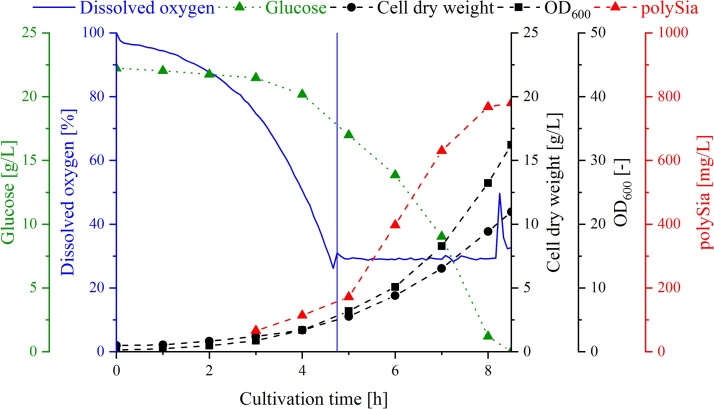
Polysialic acid (polySia) are α2,8- and/or α2,9-linked homopolymers with interesting properties for meningococcal vaccine development or the cure of human neurodegenerative disorders. With the goal to avoid large scale production of pathogenic bacteria, we compare in the current study the efficacy of conventional polySia production to recombinant approaches using the engineered laboratory safety strain BL21. High cell density cultivation (HCDC) experiments were performed in two different bioreactor systems. Increased cell densities of up to 11.3 (±0.4) g/L and polySia concentrations of up to 774 (±18) mg/L were reached in K1. However, cultivation of engineered BL21 strains delivered comparable cell densities but a maximum of only 133 mg/L polySia. Using established downstream procedures, host cell DNA and proteins were removed. All recombinant polySia products showed an identical degree of polymerization >90. Polymers with different glycosidic linkages could be successfully differentiated by nuclear magnetic resonance spectroscopy.
聚唾液酸(polySia)是α2,8-和/或α2,9-连接的同聚物,对于脑膜炎球菌疫苗开发或人类神经退行性疾病的治疗具有有趣的特性。为了避免大规模生产致病细菌,我们在当前研究中比较了传统聚唾液酸生产与使用工程化实验室安全菌株BL21的重组方法的功效。在两种不同的生物反应器系统中进行了高细胞密度培养(HCDC)实验。在K1中,细胞密度增加到高达11.3(±0.4)g/L,聚唾液酸浓度增加到高达774(±18)mg/L。然而,工程化BL21菌株的培养产生了相当的细胞密度,但聚唾液酸的最高含量仅为133mg/L。使用既定的下游程序,去除了宿主细胞DNA和蛋白质。所有重组聚唾液酸产品均显示出相同的聚合度>90。通过核磁共振光谱可以成功区分具有不同糖苷键的聚合物。