Shin Dong-Seok, Kim Kyeong-Hyeon, Kang Sang-Won, Kang Seong-Hee, Kim Jae-Sung, Kim Tae-Ho, Kim Dong-Su, Cho Woong, Suh Tae Suk, Chung Jin-Beom
Department of Biomedical Engineering, Department of Biomedicine and Health Sciences, College of Medicine, The Catholic University of Korea, Seoul, South Korea.
Research Institute of Biomedical Engineering, College of Medicine, The Catholic University of Korea, Seoul, South Korea.
Front Oncol. 2020 Nov 16;10:593381. doi: 10.3389/fonc.2020.593381. eCollection 2020.
This study proposes a cascaded network model for generating high-resolution doses (i.e., a 1 mm grid) from low-resolution doses (i.e., ≥3 mm grids) with reduced computation time.
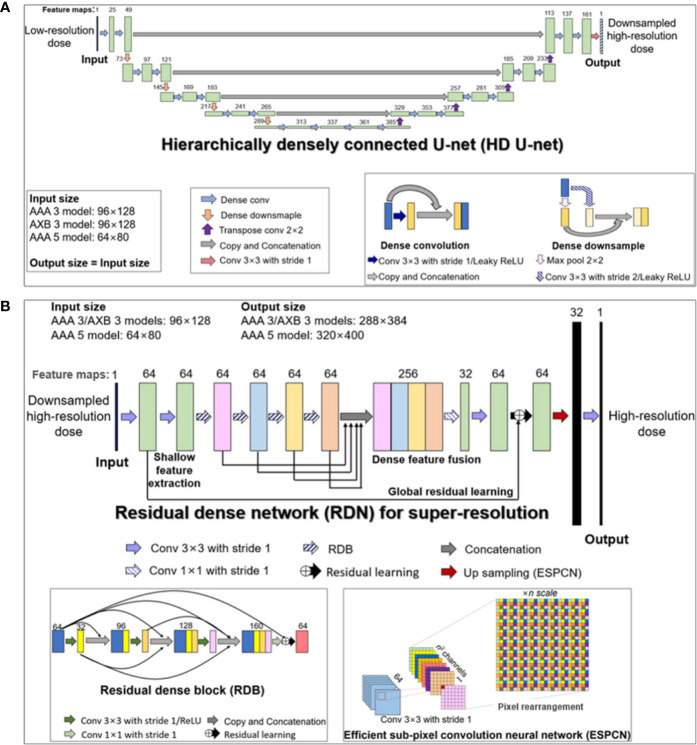
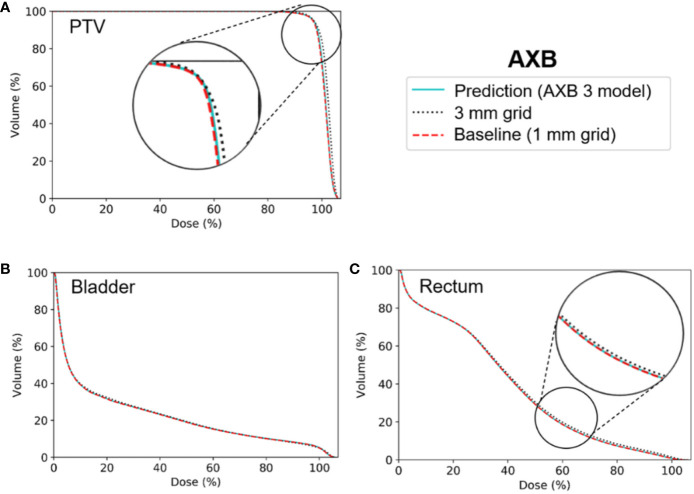
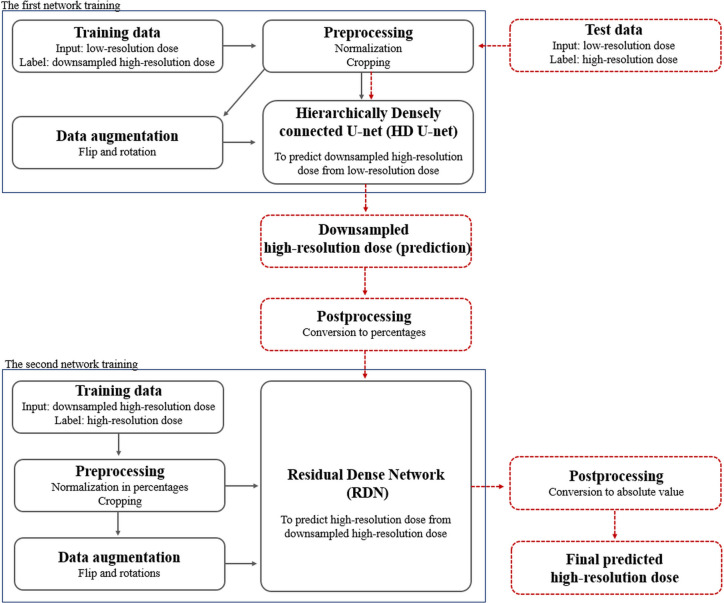
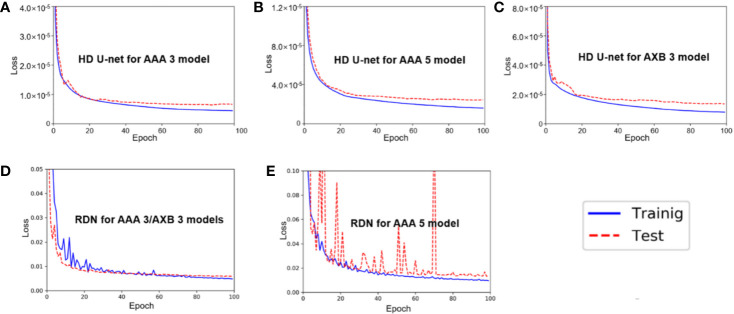
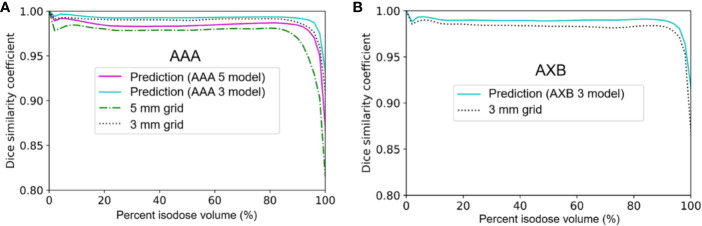
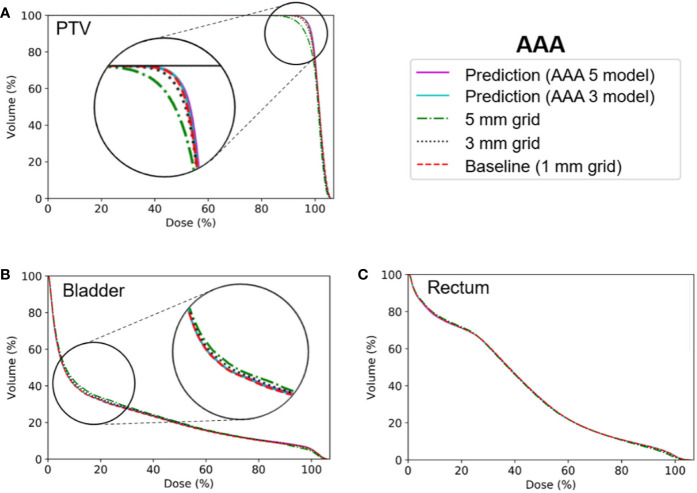
Using the anisotropic analytical algorithm with three grid sizes (1, 3, and 5 mm) and the Acuros XB algorithm with two grid sizes (1 and 3 mm), dose distributions were calculated for volumetric modulated arc therapy plans for 73 prostate cancer patients. Our cascaded network model consisted of a hierarchically densely connected U-net (HD U-net) and a residual dense network (RDN), which were trained separately following a two-dimensional slice-by-slice procedure. The first network (HD U-net) predicted the downsampled high-resolution dose (generated through bicubic downsampling of the baseline high-resolution dose) using the low-resolution dose; subsequently, the second network (RDN) predicted the high-resolution dose from the output of the first network. Further, the predicted high-resolution dose was converted to its absolute value. We quantified the network performance using the spatial/dosimetric parameters (dice similarity coefficient, mean dose, maximum dose, minimum dose, homogeneity index, conformity index, and V, V, V, and V) for the low-resolution and predicted high-resolution doses relative to the baseline high-resolution dose. Gamma analysis (between the baseline dose and the low-resolution dose/predicted high-resolution dose) was performed with a 2%/2 mm criterion and 10% threshold.
The average computation time to predict a high-resolution axial dose plane was <0.02 s. The dice similarity coefficient values for the predicted doses were closer to 1 when compared to those for the low-resolution doses. Most of the dosimetric parameters for the predicted doses agreed more closely with those for the baseline than for the low-resolution doses. In most of the parameters, no significant differences (p-value of >0.05) between the baseline and predicted doses were observed. The gamma passing rates for the predicted high-resolution does were higher than those for the low-resolution doses.
The proposed model accurately predicted high-resolution doses for the same dose calculation algorithm. Our model uses only dose data as the input without additional data, which provides advantages of convenience to user over other dose super-resolution methods.
本研究提出一种级联网络模型,用于从低分辨率剂量(即≥3毫米网格)生成高分辨率剂量(即1毫米网格),同时减少计算时间。
使用具有三种网格尺寸(1、3和5毫米)的各向异性分析算法以及具有两种网格尺寸(1和3毫米)的Acuros XB算法,为73例前列腺癌患者的容积调强弧形治疗计划计算剂量分布。我们的级联网络模型由分层密集连接的U型网络(HD U-net)和残差密集网络(RDN)组成,它们按照二维逐片程序分别进行训练。第一个网络(HD U-net)使用低分辨率剂量预测下采样的高分辨率剂量(通过对基线高分辨率剂量进行双三次下采样生成);随后,第二个网络(RDN)根据第一个网络的输出预测高分辨率剂量。此外,将预测的高分辨率剂量转换为其绝对值。我们使用相对于基线高分辨率剂量的低分辨率和预测高分辨率剂量的空间/剂量学参数(骰子相似系数、平均剂量、最大剂量、最小剂量、均匀性指数、适形指数以及V、V、V和V)来量化网络性能。使用2%/2毫米标准和10%阈值进行伽马分析(在基线剂量与低分辨率剂量/预测高分辨率剂量之间)。
预测高分辨率轴向剂量平面的平均计算时间<0.02秒。与低分辨率剂量相比,预测剂量的骰子相似系数值更接近1。预测剂量的大多数剂量学参数与基线剂量的一致性比与低分辨率剂量的一致性更高。在大多数参数中,未观察到基线剂量与预测剂量之间存在显著差异(p值>0.05)。预测高分辨率剂量的伽马通过率高于低分辨率剂量。
所提出的模型能够准确预测相同剂量计算算法下的高分辨率剂量。我们的模型仅使用剂量数据作为输入,无需额外数据,这相对于其他剂量超分辨率方法为用户提供了便利优势。